


Researcher of the Month
Stone Chou
Majors: Physics, Mathematics, Class of 2027
Research Mentor: Dr. Ciro Riccio, Physics & Astronomy
News and Video Feature: 9/1/2026
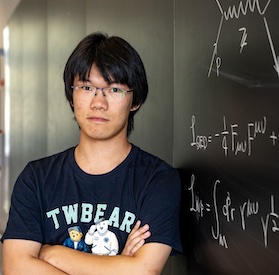
Stone Chou is a senior majoring in physics and mathematics (class of 2027) who has been doing research since January 2025 in the Neutrino and Nucleon Decay (NN) Group, under the mentorship of Dr. Ciro Riccio and Dr. Chang Kee Jung of the Department of Physics & Astronomy.
Stone’s early involvement in research, after only one semester of study at SBU, can be traced back to his conversations with the instructor for “Special Topics in Physics” in fall 2024 – none other than Nobelist Barry Barish. The opportunity to learn from Dr. Barish and get advice and inspiration to pursue research is something that Stone is particularly grateful for. Reflecting on his time at SBU, Stone points to the overall collaborative nature of problem-solving as comprising his favorite aspect of the research experience:
“… what you realize is that the most interesting aspect when you have a problem that you don't know how to deal with involves learning how to communicate or phrase it so that other people can understand what your problem is, and how to approach the problem. It's not a matter that you have to solve for yourself. During this process of communication and finding people who are good at this and that, you brainstorm with other people to think about what to do next and you come up with ideas. I'm enjoying this process the most and working with others has taught me a lot. I’ve learned a lot from the PhD students in our group and in the other high energy groups that are really just experts in this area, and I’ve learned how to ask them questions and get suggestions for the problems I’m working on.”
Working on the Deep Underground Neutrino Experiment (DUNE), Stone has focused on developing reconstruction algorithms for atmospheric neutrino events in liquid argon time project chambers; and recently submitted a first-author paper on Enhanced Reconstruction of Sub-GeV Neutrino Charged-Current Interactions in LArTPCs to the Physical Review D. To explore his understanding of theoretical physics, Stone also studied random matrix theory and quantum many body theory with Pr. Jacobus Verbaarschot. Very recently, Stony had the opportunity to present to the Fermi National Accelerator Laboratory journal club on the Enhanced Reconstruction of Sub-GeV neutrino. He is a two-time recipient of the department’s “Fumi Kato Fellowship”; will be serving as a Teaching Assistant this semester for an Advanced Quantum Mechanics course; and will be applying to Ph.D. physics programs this fall.
On campus, Stone enjoys playing table tennis and is active as captain of the “High Energy Physics” soccer team; and is a member and Vice President of the newly established Tango Club.
Stone is an international student who transferred to SBU after spending one year at Xi-an Jiaotong University (at age 15); he was previously a participant in the Young Gifted Program (starting in 9th grade). Below are excerpts of his interview with Karen Kernan, URECA Director.
The Interview:
When I first came here, I had no idea about how to do research. The first semester here, I was improving my English and trying to adjust to a new environment and grasp how the American university works. I think the most important thing that I learned that semester came from auditing a physics course. It was an undergraduate “Special topics in Physics course” that was being taught that year by the Nobel Prize Laureate Barry Barish.
I was excited about all the stuff I was learning about what's going on in the frontier in physics, so I attended his course. And it turned out to be a very, very interesting, experience. I talked to Professor Barish a lot and we had very good conversations. I also got a lot of suggestions from him, and the one that was most important was to get involved in something to help me figure out in a real way whether experimental or theoretical physics was going to be the right path for me. He pointed me in the direction of contacting Dr. Chang Kee Jung and Dr. Ciro Riccio who ended up being my primary research mentor from spring semester 2025 through spring 2026. And I took his advice to try that group and see what's going on there.
Professor Barish also explained to me that you can’t do this for a month and then
change to another topic. It's not the way it works. The way to learn how to work independently
is to do something for yourself and get some result, and that's exactly what I did.
I had a great experience with the research group I joined, and we made a lot of progress.
I have a first-author paper that was submitted to PRD. Professor Riccio also gave
me the chance to do some work at BNL to do some other work on cold electron tests
for the same experimental project ----DUNE. I also did some theoretical research later
on with Prof. Jacobus Verbaarschot on random matrix theory and quantum many body theory
and now I am working on a Topological Quantum Error Correction project with Dr. Nathanan
Tantivasadakarn.
In our experimental neutrino physics group, my work was focused on developing an algorithm for understanding atmospheric neutrino events in liquid argon time projection chambers (LArTPCs) as part of the Deep Underground Neutrino Experiment (DUNE). Our goal was to improve the detecting method for the next generation of neutrino detectors, to help improve our understanding of the neutrino's energy and momentum and lead to better measurement of neutrino oscillation and the CP phase angle. I acquired a lot of quantum simulation and data analysis skills in the process.
I think before I started to do research, I thought I could learn to solve problems and come up with very creative ideas that could change the world, or our understanding --something like that. But that was a kind of fantasy. I sometimes would spend weeks and weeks on something that doesn't really matter, or something that couldn’t be really solved.
When you actually go further in research, what you realize is that the most interesting aspect when you have a problem that you don't know how to deal with involves learning how to communicate or phrase it so that other people can understand what your problem is and how to approach the problem. It's not a matter that you have to solve for yourself. During this process of communication and finding people who are good at this and that, you brainstorm with other people to think about what to do next and you come up with ideas. I'm enjoying this process the most and working with others has taught me a lot. I’ve learned a lot from the PhD students in our group and in the other high energy groups that are really just experts in this area, and I’ved learned how to ask them questions and get suggestions for the problems I’m working on.
I’ll be applying this fall to graduate programs. The PhD is really a long process and you really want to do something that you're really interested in long term. I’m still figuring out what I want to spend my time and energy on.
Stony Brook has been a fantastic place for me to learn and to help me prepare for future graduate studies. When I came, I knew that this would be a good university and have a lot of resources. But it has been a great and welcoming environment for me to learn. Even in the summer there are Simon Center physics workshops. We’ve gone to Long Island beaches on the south side to hear very famous people giving lectures on the beach and providing free lunch. I think this is fantastic.
I think the most important thing is communication. A lot of people are just too afraid to talk to professors and to learn from them, or they don't think they're qualified to do serious research. Most of our professors are not that formidable, and want to teach you and let you contribute to society. So it's very important to talk to professors. Communication is the most important thing.
They have been extremely supportive. I started to do presentations in our group very early, and they gave me several opportunities to practice communicating. I think I’ve become more independent at understanding how to tackle problems from working in the group.
I'm going to TA an advanced quantum mechanics course next semester, and I'm excited
about it — partly because I think teaching is one of the best ways to learn. When
you explain something to someone else, you can't coast on the feeling of understanding. You have to rebuild the idea in plain words, in an order that makes
sense to someone who doesn't already know the answer, and the moment you hit a step
where you're just reciting a formula instead of explaining it, you've found the gap.
That's the core of what people call the Feynman technique: explain it as if to a beginner,
notice exactly where you stumble or start hiding behind jargon, go back to the source
until you can get through that spot cleanly.
Let me think about that. … I think the thing I'm proud of the most is that we're dealing with new problems that nobody has solved. You spend all this time searching for the technique that is possible, and finally, after trying many approaches, you find something that may be useful for you and that you can apply what you’ve learned. We worked on figuring out something that may turn out to be a relatively good method, something you can actually apply to solve the problem we were trying to solve. It's very exciting for me.