


Researcher of the Month
Charlotte Cain
Majors: Computer Science (honors), Applied Mathematics & Statistics; Class of 2027
Research Mentor: Dr. Zhichen Liu, Civil Engineering
News and Video Feature: 8/4/2026
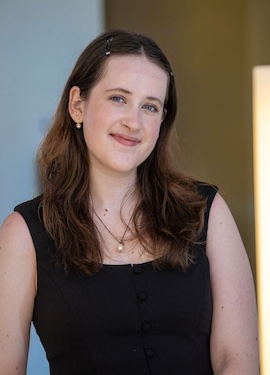
Charlotte Cain is a Computer Science (Honors) and Applied Mathematics and Statistics double-major (class of 2027) specializing in Data Science and Artificial Intelligence, whose dream is to pursue a PhD in Computer Science, focusing on the intersection between computer science and social behavioral science.
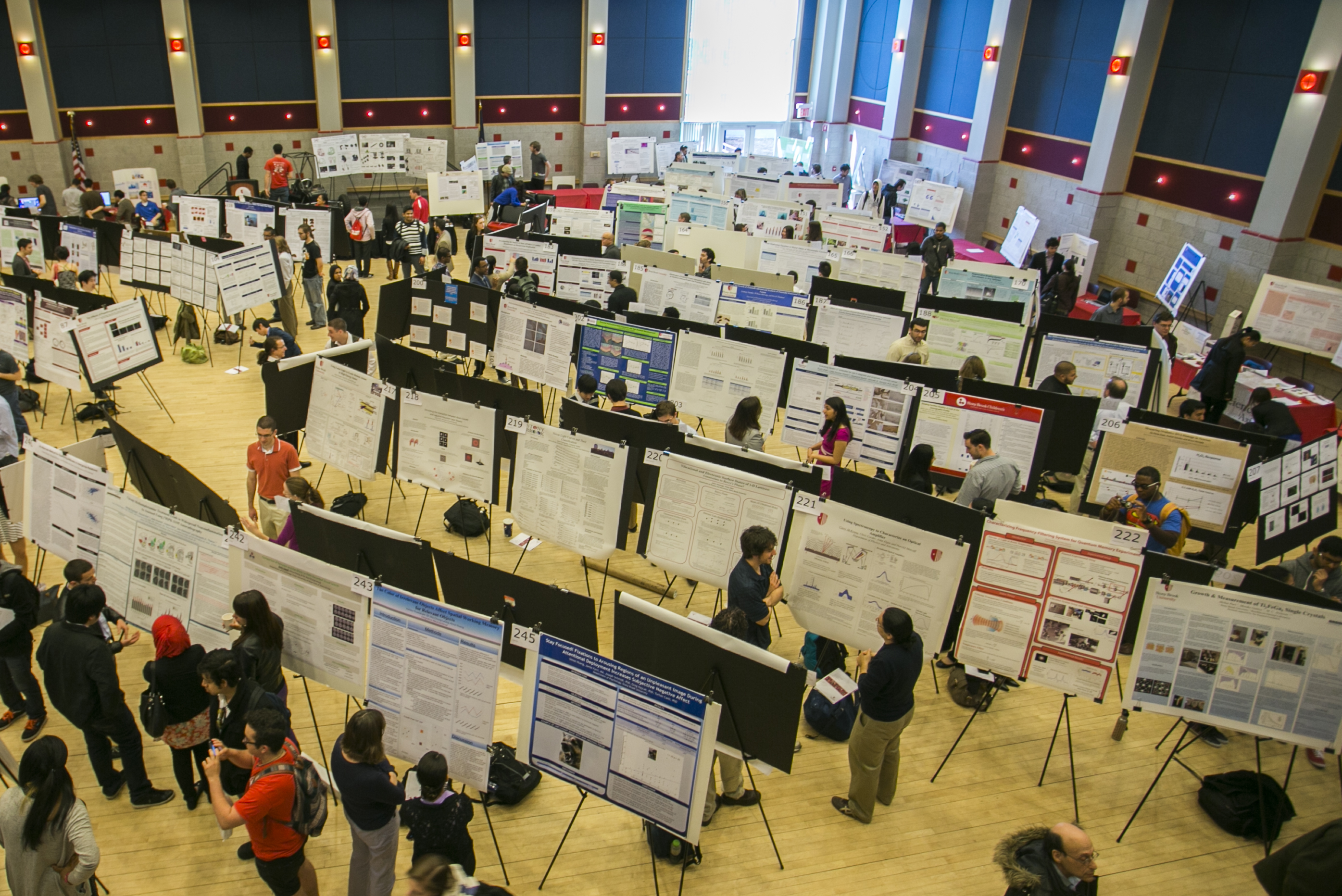
After working for only a few months under the mentorship of Dr. Zhichen Liu (Civil Engineering) to investigate how generative AI may influence learning in engineering education settings, Charlotte applied for and was admitted to URECA-Explorations in STEM, a 10-week summer research program co-administered by URECA and the Career Center that supports students new to research. On Friday July 31, Charlotte presented a poster on "Using natural language processing to study student interactions with generative AI chatbots" at the Summer Symposium, an event sponsored by URECA and the Center for Inclusive Education that featured 148 undergraduate research projects.
In her application to URECA, Charlotte explained the personal significance of the project to her. “I bring a unique perspective to this particular research project, as I am a member of the graduating class that has most clearly seen how AI has evolved over the past three years. I still remember the times when AI was strictly prohibited in classes, and have kept a close eye while the use of it has garnered public approval. As I look towards a career in academia, there is no doubt that AI will be laced into every piece of it. Whether it be through convincing people that education is still important, using AI as a tool for increased efficiency, or navigating the ethical challenges inherent to the technology, this project will always be something that I look back on, and will retain relevance throughout the remainder of my career.”
On campus, Charlotte is active on the Poli Tech VIP team which conducts political informatics research. She serves as Corresponding Secretary for the Tau Beta Pi Honors Society, Outreach Coordinator for Paper Airplanes Volunteering Club, and is the recipient of an IAP Study Abroad Scholarship for SUNY Korea in the Fall 2025 semester.
Charlotte is an out of state student from Worcester, MA, who graduated from the Massachusetts Academy of Math and Science. Her hobbies include: knitting and crocheting, running, and watching Formula 1.
Below are excerpts of her interview with Karen Kernan, URECA Director.
The Interview:
Charlotte: I started getting involved a little later in the game, in my junior year. I really didn't know entering college that research was something that I wanted to do, or even what research in the computer science field looked like.With some encouragement from my professors, though, I decided in my junior year to join a VIP team on campus - called PoliTech. And I was able to be involved in a group research project which I really enjoyed where we look at US Census data and the different ways that census lines can be drawn to best comply with the Voting Rights Act. I mostly work on the ARS maintenance – essentially doing a lot of downloading data, cleaning data, helping to process data, which is very fun. And I've gotten the opportunity to work with many fantastic master's students last semester. It's been a great learning opportunity.
Last year, after one of my friends shared a posting for an independent project, I emailed Professor Zhichen Liu who was looking for computer science researchers for a project she was doing on AI in education. And I started working with her in November. That became my URECA summer project. We’re looking at how Artificial Intelligence (AI) is used by undergraduate and postgraduate students in educational settings, with the ultimate goal of formulating suggestions as to how the undergraduate curriculum should adapt to the new technology.
The objectives of the project are to observe how reliant students are on Generative AI when approaching a problem; to determine how the use of Generative AI in educational settings affects the long-term memory of students; and to create a set of suggestions for how AI is approached in the undergraduate curriculum to ensure that students are being best prepared for the current job market. We're using natural language processing models and machine learning techniques to analyze the behaviors that are being shown in terms of using these AI tools. It's definitely interesting though it has proven to be a bit of a difficult project too.
Getting good quality data has been our biggest challenge. It's also just been interesting for me to see how little research was done before AI was just accepted in classrooms. AI is obviously being heavily integrated into a lot of our daily life. And while it is a really, phenomenal technology, it's a little bit disheartening to feel as though in being the first generation to have access to this technology, we are also, in turn becoming test subjects in a sense. Right now there is some cool emerging research coming out on the social effects of AI. But it is interesting to see that, even six months ago, at the start of this project, in January, it was a lot harder to find specific research on this topic from a technical perspective.There were a lot of conversations from education professionals about what they thought would happen with AI in the classroom, but there wasn't a lot of data to back up the predictions. Now as time goes on, more articles are coming out.
I believe that the research we're doing has a unique approach. Our ultimate aim for this project is to observe the effects of AI on long-term memory, and give suggestions as to how the education system should adapt to the use of AI in classrooms using a data-driven approach.Part of our work is to ask: What is actually happening in classrooms? By looking at students multiple times throughout the semester, we can see how they are changing their use, and how things are evolving.
Yes, right now, it's just a small group from an engineering class on campus, but we're hoping to expand that in the fall semester.
These experiences have opened up the really interdisciplinary nature of computer science to me. As someone who chose computer science because it's something I really enjoy, and it's something I'm good at, but not because it was the only thing I wanted to do, it's been really fun and hopeful to look into my future and think that there's so much more for me to learn, and that there are so many more subjects that I can apply what I’ve learned to and jump into that I couldn't have even guessed when I started out.
My goal is to get a PhD in computer science. I really want to follow the path I've started to build, which is to look at the intersection between computer science and social behavioral science. The use of generative AI is fascinating to me and there is going to be a lot more data available that looks at its effects. Right now, the U.S. does not really have any concrete legislation surrounding AI, and I would love to be sort of part of that shift and that change.
I think that the biggest thing is if you're doing a project in the classroom, you can kind of say, well, here are some projects that people did before. This is what other students did with the exact same prompt as you. There's a bit of comfort in knowing what to expect. When you jump into research, by contrast, there’s a lot more uncertainty. This project might not be good, and it might not be viable, and you don't know if you’re going to acquire good information, but…you just kind of do it because it's interesting, and hope for the best. Starting a project from the ground up with no knowledge of where you're going to end up is daunting, but incredibly exciting.
Specifically, I would say the conversations that it has sparked. It's a really fun topic because I feel that you don't really need a background in computer science or in education to have an opinion on it. When you bring up the questions we’re working on to 10 different people, you're going to get 10 incredibly different perspectives on the same project. So it's been really fun. I presented this project at the URECA Celebration, and it was able to talk to people from a variety of disciplines. I always love asking people their opinion, and getting their feedback. At URECA, I had a lot of people come up to me who were not from CS at all, they were still so interested in having a conversation about this topic.
Professor Liu is such an incredible mentor, and she really has done a great job of steering me in the right direction, while also giving me opportunities to make crucial decisions about the project's progress.I've learned so much from her because she's let me take on as much as I want to do, and she really encourages me to learn and to develop the skills I need to further this project. She's also very passionate about all the projects she does, and I always feel that the meetings with her help me so much.
I’ve also learned a lot from the master’s students from the VIP PoliTech team. It was really fun to be able to work on a project with people who are just two years ahead of me, and to be learning from them.
Yes, I’m really enjoying having the time to work full-time on research, but also getting a lot out of the workshops in the Explorations in STEM program. It's been really useful, too as the first in my family who plans to pursue a PhD. The workshop we had last week on ways to manage in your time as a grad student, and sort of what that entails, was really great.
I have two pieces of advice. One: if you know that you want to go into research, be sure to think about what is interesting to you, and don't limit yourself or narrow yourself just to technology. Computer science can be so interdisciplinary - and there may be a lot of possibilities that you never thought of - so take your time to look into the various opportunities to find what’s right for you so that you can get the most of your experience.
My second piece of advice is to try to not feel the pressure of needing to follow a very specific path– which is really hard. With the way that technology evolves so quickly, people can feel that they need to do as much as possible, and feel that they must constantly be keeping up with everything new. And while it is good to keep up with things, you don't need to be go-go-go all the time.
Yes, 100%. Even though I didn't know I was going to be involved in research coming in, I loved the department. I felt that there would be such a strong group of faculty at this school, and I have really seen that in a lot of my classes. There are a lot of opportunities for undergraduates here, from the VIP teams to the independent research experiences. It's provided me with mentorship and lessons that you can't really learn in a classroom.
I'm really excited about it! I have learned a lot and made a lot more progress since the last time I presented - back in May. And I’m looking forward to the conversations I’ll have!