


Researcher of the Month
Marko Zimic
Major: Chemical & Molecular Engineering; Class of 2026
Research Mentor: Dr. Tad Koga, Dr. Maya Endoh, Materials Science & Chemical Engineering
News and Video Feature: 4/7/2026
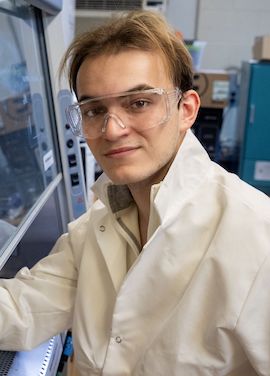
“...even though we have more knowledge, and more concrete conclusions that we can say about certain things,there are more questions that have come out of the research as well. So, it's really an exploratory and iterative process.””…-Marko Zimic, Class of 2026
Marko Zimic is a senior in the Honors College, majoring in Chemical and Molecular Engineering,
with minors in Chemistry and Materials Science. In his first year at SBU, he joined
the research group of Dr. Tadanori Koga and Dr. Maya Endoh in the Department of Material
Science and Chemical Engineering where he investigates how proteins and bacteria attach
to polymer surfaces and how surfaces can be engineered to prevent bacterial attachment
and limit biofouling. His research has involved conducting
experimental work at both Brookhaven National Laboratory and Oak Ridge National Laboratory
to understand nanopatterns and bacterial attachment. In 2024, Marko earned the Education
Collaboration Program Summer Scholarship from Oak Ridge National Laboratory to perform
work on his project. He was also awarded URECA summer funding in 2025 to support his
work on “Rational Surface Design to Optimize Antibacterial Properties” and has received URECA travel awards to support conference presentations. Marko is
also completing a senior thesis project, titled “Evaluating the Antifouling
Properties of TPX™ Polymethylpentene Thin Films” under Dr. Miriam Rafailovich, as well as asenior design project, titled “A Generic Synthesis of Niraparib, an Ovarian Cancer Drug” under Dr. Devinder Mahajan.
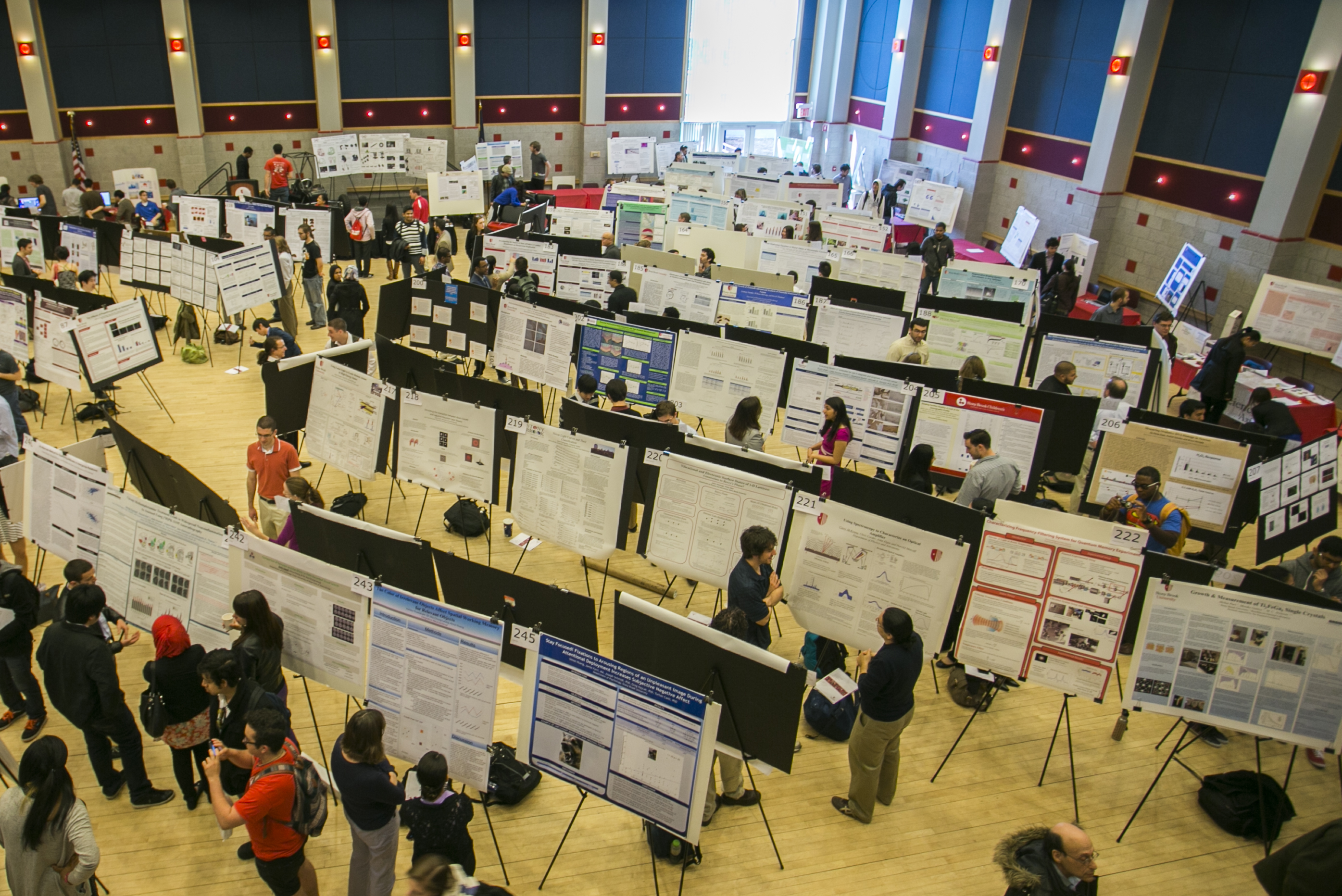
To date, Marko has showcased his work in the Endoh/Koga group at eight poster sessions
including the URECA Symposium, the 2024 American Chemical Society (ACS) Meeting, and
the 2025 Oak Ridge National Laboratory Joint Nanoscience and Neutron Scattering User
Meeting. Very recently, he gave an oral presentation at the Spring 2025 American Physical
Society Global Summit in Anaheim, California with the support of a URECA conference
award. Marko also is a co-author on a recent publication, “Antifouling Property of Nanostructured Surfaces Prepared by Block Copolymer Self-Assembly: Bacterial Adhesion” published in the Journal of Undergraduate Chemical Engineering Research in 2025. Be sure to look for Marko’s poster presentation at several upcoming events
including the CEASSenior Design (April 28), the Honors College symposium (April 30)
and the URECA poster
symposium (May 5)!
On campus, Marko volunteers as a Lead Mentor in the CEAS Peer Mentoring Program. In
addition, he has served as President of the Undergraduate Linguistics Club, as Community
Engagement Director of the SBU Pre-Medical Society, and as a group leader of the SBU
Music in Medicine club, which performs live music for patients at Stony Brook Hospital.
In addition to his research, he is a teacher and performer of Croatian folk music
with the Kardinal Stepinac Croatian Youth Group, which performs at community events
including at the UN Headquarters and at Croatian communities across North America.
Marko also enjoys guitar making and treasures playing on the instrument that belonged
to his grandfather.
Marko has been admitted to the Icahn School of Medicine at Mount Sinai and intends
to pursue a career as a physician-scientist. Later this month, he will be one of 14
Stony Brook University students recognized with the Chancellor's Award for Student
Excellence. Prior to enrolling at SBU, Marko graduated fromStuyvesant High School. Below are excerpts of his interview with Karen Kernan, URECA Director.
The Interview:
mentee in the program, and now I've been a mentor for a number of years. When I was a
mentee, they had events every semester including faculty roundtables where you meet
professors, get to mingle and whatnot. And that’s how I met one of my PIs, Dr. Tad Koga. We
talked about his research and had a really good conversation, and over the next few weeks, I
visited him and my other PI, Dr. Maya Koga, and we continued to have great conversations
about their work, and what I wanted to get involved in. So, at the beginning of my second
semester I started research, and I've been with them ever since.
necessarily taught in the classroom. It's a great way to develop soft skills like leadership,
communication, teamwork, and networking. Getting involved in research early also looks good
on your resume so I do think it can be advantageous in that regard as well.
we engineer surface nanostructures that have antibacterial or antibiological properties. The
development of a biofilm, where proteins start to attach to a surface that facilitates bacterial and other microbial proliferation on the surface, is obviously not something that we want in a medical environment – especially if you're talking about surgical tools, or implants, or even doorknobs. So, our work is important for understanding how the nanostructures affect the way proteins and bacteria attach to surfaces. That's generally what we work on.
I think what makes them stand out is their unwavering support for their students,
both graduate students and undergrads. They're always there to help you whenever you
have a question about your project or a methodology. And they also help us expand
opportunities by
encouraging us to present at URECA, or APS or ACS. They're always standing behind
you,
ready to give you that letter of recommendation or that referral to help put you ahead
of the
curve.
In a general sense, it’s the pursuit of knowledge. I love coming into lab every day
and doing my
project, or whatever method I'm doing that day, and thinking about: what's the physics
behind
this? What's the chemistry behind this?... In the process of research, it's not just
that you're
recalling the physics and chemistry behind it, but you're actively discovering those
things as
well... For example, with the protein adsorption project, that's all about elucidating
how exactly
protein adsorption occurs – what's the mechanism? What are the dynamics? What are
the
kinetics? And so thinking about these kinds of questions is what’s most interesting
to me about
research.
specifically, where we're starting to finally make some good conclusions. And some of those
initial questions that we had have been addressed, but now there's a whole host of other
questions that have arisen from the work….So even though we have more knowledge, and
more concrete conclusions that we can say about certain things, there are more questions that
have come out of the research as well. So, it's really an exploratory and iterative process.
Yes, I have a couple of upcoming presentations including the Honors College and URECA
symposia. I do think that the opportunity to present your research is very important.
Post
presentations are a great way not just to network with people, but to learn how to
describe yourresearch in a succinct manner. You also can get ideas from other people
who might be
presenting with you... I can think of a few scenarios where just walking around at
a poster
presentation, and discussing with other researchers, I was able to get some ideas
to bring back
to my own project, and there was an exchange of ideas.
Last year I had the opportunity to present at the American Physical Society annual meeting, andI'll also be presenting at the end of March at the American Chemical Society annual meeting. When you’re doing an oral presentation in front of an audience, it kind of feels like a test: you'rein front of all of these accomplished scientists, and you may be bombarded with questions that you might not be fully equipped to answer. But I’ve found that people are generally friendly, and it’s so valuable to have the chance to network and exchange ideas with people who know a lot more than you, and are more experienced than you, and more accomplished. I'm excited to have these opportunities. It's a good exercise in thinking on your feet!
I will be matriculating at Mount Sinai School of Medicine in August, and I'm very
excited for that.
I'm not exactly sure what specialty I want to go into in the future, but I would like
to continue
research in some capacity – not just in medical school, but hopefully, as a physician
as well.
My advice is to make sure you do your research beforehand, before getting involved.
The
reason I hit it off with Dr. Koga so well when I started was that I did my homework
beforehand,
and I read not just his research, but a lot of the research that was going on in the
department. I
realized that his project was really the one opportunity that I wanted to jump on.
I think a lot of
students take the first opportunity that presents itself and they don't really look
into or
understand what it is that they're jumping into. It’s true that you can rotate between
a couple of
labs, which is nice because you get a lot of exposure. But at the same time, you're
not
developing the same sort of strong relationship with your PI, or with the grad students,
or even
other undergraduates in the lab that I would say that I've developed. I think doing
some planning before you start is important to get the most out of the experience.