


Researcher of the Month
Amy Chen
Major: Information Systems, Class of 2027
Research Mentor: Dr. Guanyu Huang, Program in Public Health; Family, Population and Preventive Medicine; School of Marine & Atmospheric Science
News and Video Feature: 10/1/2026
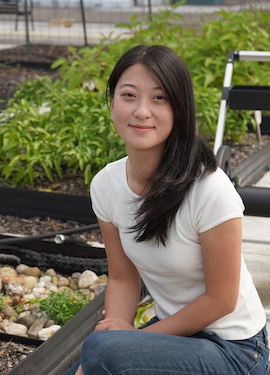
Amy Chen is a an Information Systems major in the WISE honors program, minoring in Environmental Studies. In March 2025, she began doing research under the mentorship of Dr. Guanyu Huang (Program in Public Health, SoMAS), work that was supported in summer 2025 through the SUNY SOAR undergraduate research program designed for motivated first-generation and or economically disadvantaged students.
Amy’s research project began with establishing an ozone bioindicator garden, collecting leaf samples, photographing foliage across multiple sensitive plant species, and documenting damage progression throughout the growing season. She then worked on developing an AI-based system to detect ozone injury on plants using observations from the ozone garden. She presented her research on “Development of an Ozone Bioindicator Garden and Automated Detection of Ozone-Induced Leaf Damage Using Convolutional Neural Networks” at the Summer Symposium 2025 at the end of the 10-week program; and was featured on Stony Brook Medicine news.
Amy continued with her research after the summer program concluded, and went on to present at the 106th American Meteorological Society Annual Meeting in Houston Texas (January 2026) where she won a best student poster award. This past August, Amy gave an oral presentation in Boulder, Colorado at the National Ozone Garden Network Conference. Currently Amy is working with her research group on preparing a manuscript on U-Net segmentation of ozone injury across four bioindicator species. Her research with Dr. Guanyu Huang will also be the basis of her WISE senior thesis
Amy’s long-term plans are to pursue a PhD in environmental studies. She is active on campus as Secretary of the Stony Brook Sailing Club. This past summer, Amy held an Environmental Engineering position with the Department of Environmental Conservation (DEC), where she used her GIS knowledge to track and map wells across Long Island, among other projects. She also interned in fall 2025 with the Landmarks Preservation Commission in Manhattan to update maps of NYC historic districts using ArcGIS.
Reflecting on her research experiences to date, Amy is very pleased that her primary academic interests in Information Sciences and Environmental Studies coalesced so perfectly in her research project.
…for most of my time at Stony Brook those two areas felt like separate tracks until I started doing research. Through my work on ozone damage detection, I have been building a system that uses computer vision to identify pollution stress in plants, combining fieldwork, dataset construction, and machine learning into a single ongoing project. That experience taught me what research really looks like, working through a problem over many months, adjusting your approach when things do not work, and learning to think critically about what your results actually mean.
Amy's hobbies include hiking, rock climbing, sailing, and journaling. Below are excerpts of her interview with Karen Kernan, URECA Director.
The Interview:
Amy: It started out with URECA! I contacted the URECA office in spring 2025 to set up a meeting with you and Marina to get some suggestions of potential faculty to contact, based on my interests. And then I started sending out some emails. Prof. Huang responded to my email and agreed to mentor me in the summer if I received an offer for summer research. I was very happy to have the opportunity to participate in SUNY SOAR in summer 2025 to do research full-time.
I did my research on designing and establishing an ozone bioindicator garden. Dr. Guanyu Huang suggested this project to me, knowing that I wanted to do something at the intersection of technology and environmental studies. That first summer was very much all about getting the garden established. We were sent seeds from the National Ozone Garden-- specific, bioindicator seeds including snap beans, potatoes, coneflowers, and milkweeds. That first summer, we planted all of these seeds, and I was taking weekly pictures, tracking ozone damage on the leaves, and updating data to the National Ozone Garden portal. To improve the process of identifying ozone injury (which is slow and inconsistent), we worked on establishing a computer model to automate the process of data collection. I started training or building the model using convolutional neural networks, and that took some time.… We didn't get it to fully work that summer although we got it to do a binary identification: does this leaf have damage? Yes or no? The model wasn't able to tell you the percentage of damage a leaf would have, which is what we were aiming for, but we achieved 82% test accuracy on classifying leaf images as ozone damaged or healthy.
Moving on from that summer, we got more into modeling. We focused on perfecting the model to get percentages rather than a binary answer or result, and this involved getting lots more photos. One problem we had initially was that we didn't have enough photos for the model to train on, so we emailed other managers of Ozone Gardens from across the world to share photos to train this model. We finally got it to work, and right now, we're currently writing a paper on what we learned. In the future, I want to refine the model even more to be able to look at different types of damages (other than ozone damage).
No, SUNY SOAR was my first ever research experience. I had not done research before. As an Information Systems major, I had a foundation through my computer classes. But I hadn’t developed AI models, so it took some time to learn what I needed to do for the project. I went through lots of tutorials to learn how to do that kind of stuff, and I read papers, and also got a lot of help from other partners in the lab.
Lab meetings. I really like our group meetings, where we all get to see what everyone is working on, how people are doing, and what problems we're dealing with. There are a few of us in the lab right now, all on different projects. We're all willing to help each other out, because we understand how hard it is to work on something on your own and get stuck.
He is very encouraging, reassuring, and supportive. In our weekly meetings, if there's anything I'm stuck on, he's always there to help. He also pushed me to apply for graduate school, and he's urged me to attend professional conferences so I understand why research matters and get experience connecting and networking with other people.
Thanks to his encouragement, I got to travel to a conference in Houston, and another in Colorado. And they are really exciting because you get to meet so many other researchers doing really amazing research. At the Colorado meeting, I had the chance to meet a lot of the ozone garden managers who’d I previously emailed but never got to talk to in person.
Yes, I think SUNY SOAR really gave me a lot of preparation for presenting at these conferences. We had those workshops on how to present a poster, plus the experience of the Summer Symposium itself was great practice.
My advice is to be open-minded …Research can be intimidating when you're a newcomer. Keeping an open mind and not being afraid to make contact – whether it’s with the URECA office, or other professors—is essential. You have to let people know that you're interested in doing research and follow through.
I think the other thing to know about research is that there are times that you're going to get stuck. There will be times when you don’t know what to do, or when, no matter what, you're going to fail over and over again. That's just expected, it’s part of the process. But ask your professor for help. Ask other people in your lab that have experience-- that really helps. I remember when I got stuck with some parts of the code and asked one of my other lab partners for help. And now we’re writing a paper together!