


Researcher of the Month
Simon Salmon
Majors: Electrical Engineering ; Class of 2028
Research Mentor: Dr. Fang Luo, Electrical & Computer Engineering
News Feature: 11/1/2026
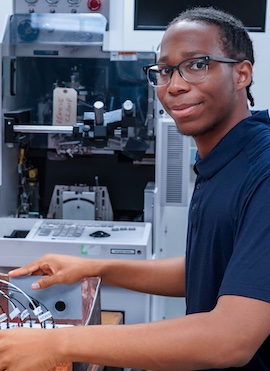
“Research can seem a little bit intimidating at first…but I'd say you should embrace the uncertainty with open arms, because it's quite a beautiful process. You will learn how to formulate a hypothesis for yourself, how to test set a hypothesis, debug it, and how to quantitatively and qualitatively analyze each stage of your work as you contribute to make progress. So I would say, embrace the challenge with open arms!” - Simon Salmon, electrical engineering major
Simon Salmon is a junior in the Electrical Engineering honors program with a concentration in power
electronics. Step one in accelerating his research journey was applying in his first
year at SBU to the SUNY SOAR summer research program—a CIE-URECA collaborative program
designed to increase research opportunities for first-generation college and economically
disadvantaged students. Working under the mentorship of Dr. Fang Luo in the Spellman
High Voltage Power Electronics Laboratory, Simon had the opportunity to focus on electromagnetic
interference optimization for power conversion systems; and to develop his knowledge
of addressing real-time synchronization challenges and excess electromagnetic interference
(EMI) propagation associated with paralleling an array of modular power converters.
At the conclusion of the 10 week program, Simon presented a poster titled “High Power Density Three-Phase DC-AC Convert Control Circuit Design with Power Over
Ethernet Interface” at the Summer Symposium.
Continuing with his research in fall 2025, Simon was selected to present at two external
conferences, including the Undergraduate Research Technology Conference at MIT; and
the Columbia Center of Advanced Electrification Symposium at Columbia University.
He also presented at the spring 2026 URECA 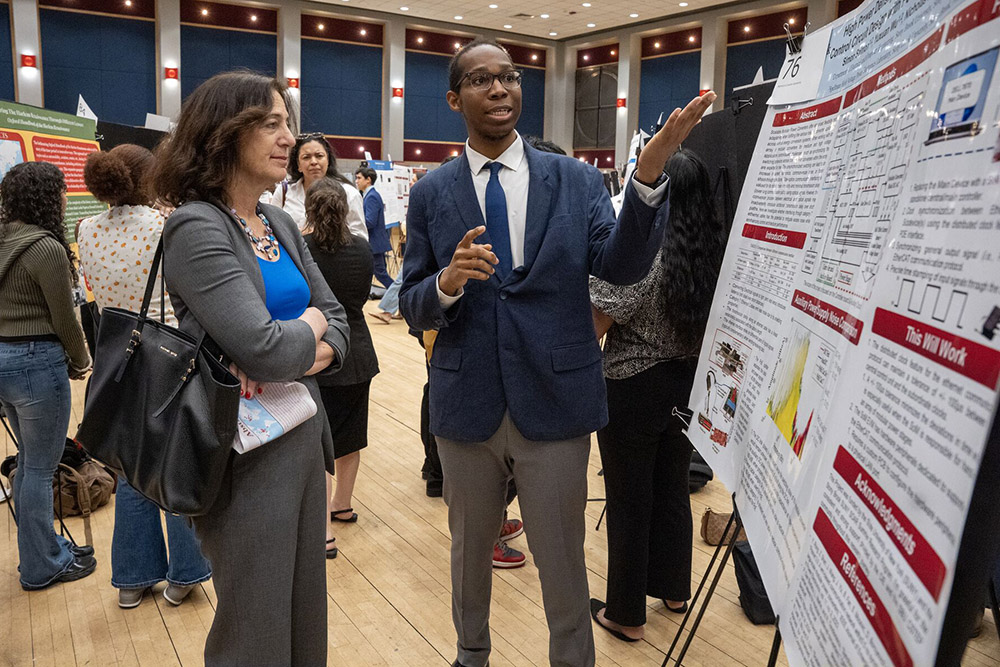 Celebration (see photo). This past summer, Simon’s research in the Spellman Laboratory
was funded through the Explorations in STEM program (PI: Dr. Monica Bugallo), a URECA-Career
Center partnership program. Simon continued to work on optimizing modular converter
designs, and presented a poster at the 2026 Summer Symposium on “Near-Field Electromagnetic Coupling Analysis for GaN JFET Power Converters with Tuned
Breakdown/Avalanche Path.” He also is currently involved in a collaborative research project at Brookhaven National Laboratories. Long term, Simon plans to pursue a PhD in electrical
engineering.
On campus Simon is a member of University Scholars honors program, of the College Science Technology Entry Program (CSTEP); and serves as vice president of the National Society of Black Engineers. He has served as a member of the Chancellor’s Student Advisory Council (CSAC); volunteered to present at CommUniversity in 2025 and 2026; and led outreach activities to peers promoting research involvement through URECA.
Simon is a graduate of the High School for Youth and Community Development at Erasmus Hall in Brooklyn. His hobbies include cooking/baking, biking, and DIY mechatronics. Below are excerpts of his interview with Karen Kernan, URECA Director.
The Interview:
Simon: I’m a member of the Spellman High Voltage Power Electronics Laboratory, and I first got involved when I applied to the SOAR program in the spring semester of my first year, and was paired with Dr. Fang Luo as a mentor. Our lab has three main areas. What I mostly work on is modular converter design and improving electromagnetic compatibility — evaluating how controlled power conversion may be affected by propagated electromagnetic interference during both short-term and extended testing periods; and assessing overall system performance in terms of power efficiency. I’m focused on optimizing the circuit design and developing EMI mitigation strategies appropriate for the current circuit topology. …So as the overall size decreases, there are certain things that you have to account for—high-frequency phenomena, how these electronic components within the overall system interact magnetically and electrically (because you have an increase in your parasitic energy nearby). So basically, the overall gist is near-field coupling, studying the nearby parasitic energy and how it may interact with the modular converter topology.
Yes. And I'm actually seeing the results now. When I first engaged with research, I knew next to nothing about microelectronics… Now I'm taking Dr. Luo's Power Electronics course officially, and I already feel confident in what I’ve learned in the course through what I've been exposed to in my research. When I first joined the lab, Dr. Luo gave me different textbooks to read through and self-study, and gave me technical papers that had practical applications in the laboratory setting. As my understanding of the project developed, I got to work on a lot of different projects that were going on in the lab – and get exposure to different projects. So that’s been valuable in my academic coursework overall.
I enjoy the challenge. Although it can be a little bit intimidating, daunting, and frustrating in the initial phase, when you come across a barrier that may impede the research, or just the fact that you're working with so many different unknowns simultaneously, and there's so much to account for, and the literature may not be as developed…I find that trial and error process to be exciting. I find it to be a really beautiful process as you navigate through it, and are trying essentially to develop your own ideas, put in your own hypotheses into action in order to try and make sense of the different unknowns that have yet to be explored.
I do intend on going to grad school for a PhD, and right now, Stony Brook is my top choice.I’d like to continue under Dr. Luo. After that, career-wise, I'm still undecided between whether or not I would like to be on the research and development track., or stay in academia, to some combination of the two.
Very beneficial because one, you don’t have to worry about classes. The summer programs gave me more free time to work in the lab, more time to navigate around some of the tools and equipment that I may not have exposure to…and more time with the PhD students. During the summers, the PhD students don't have as full a course load so you have much more time to interact with them one-on-one, to learn from them and also support the projects that are ongoing in the lab. During the academic year, it can be harder to find time based on their availability to receive that form of mentoring that you can find during the summer.
Yes, Our research group is actually pretty big. I'd say we have approximately 25 PhD students. Over the course of the summer, there have been a few graduate students who've just joined the lab, as well as new undergraduates. So I’ve had opportunities to mentor new students who are just joining the lab.
I really enjoyed the graduate panel workshops that we had. This last year, we also had a journal club in Explorations in STEM and I liked that it gave me an opportunity to learn how to communicate my science to people who aren't from electrical engineering… or at least identify my strengths and weaknesses when it comes to communicating my science to people who are outside of my field of study.
Yes, and I've been able to use those skills, and apply what I learned when I went to conferences last year – including one at Columbia University, and at MITl. Every time you present,you have to think: how can I translate my research into plots and figures in order to communicate what I’ve done effectively? How can I deliver content in a way that makes sure everyone is able to understand what I'm trying to convey?
I was able to get some really good feedback from my projects from the conference experiences. There are a few that happen in Long Island that are also geared towards power electronics that I'm looking forward to attending this semester, that I believe will help me gain more insight on what it is that I can do to improve the project, and continue with that iterative design process.
It was really very beneficial. This past summer, I was accepted into the honors program within my department, and from doing research early on, I already have a good idea of what topics that I’m most interested in, and what I want to pursue in more depth. I’ve had conversations with my mentor on what I can develop into a technical paper. Currently, the goal by this summer is to do a literature review, so that by the summer I can start on the thesis.
Research can seem a little bit intimidating at first, because there's always the idea of not wanting to mess up or stumble, or not knowing how to navigate around the challenges. But I'd say you should embrace the uncertainty with open arms, because it's quite a beautiful process. You will learn how to formulate a hypothesis for yourself, how to test set a hypothesis, debug it, and how to quantitatively and qualitatively analyze each stage of your work as you contribute to make progress. So I would say, embrace the challenge with open arms! Start talking with professors who are teaching your introductory courses within your field of study. If you already have an idea as to what it is you want to focus on for research, then consult the department website that lists faculty with a mini description as to their research focus. That will help you to navigate or narrow down what mentor you'd like to contact, which principal investigator you'd like to work under. Use the resources provided by the university to help you – like the URECA office.
What I'm most proud of was the fact that the projects that I worked on were accepted to external conference presentations. It gave me the confidence to realize that, okay, I had a good idea, something that wasn't trivial, something that does have value within my field of study. And that was a great feeling.
Along with the research presentation. I would also just say that I can see how I've grown in terms of my analytical skills. Dr. Luo s told me that he’s observed that, and that he's started to feel more confidence in my ability to support our more intense projects. So now that Dr. Luo has been able to see that development in my analytical skills and my ability to do research, and feels that I have a good grasp on what I'm doing, he starts to assign me to more projects that are external-based. Right now, there's a project that I'm leading, in collaboration with Brookhaven National Labs. I feel proud to have gained that trust from Dr. Luo, and to have these opportunities as only a third year student. And that goes back to having had an early start through the SOAR program.