Transmutation Science, Characterization, and Materials Development for Fusion Reactors
|
Lead P.I. - Dr. David Sprouster
 Realization of fusion energy requires high-performance radiation-tolerant structural
and functional materials that can withstand the extreme temperature and radiation
environments for the fusion first-wall, blanket structures and plasma-facing components.
A significant gap in our current understanding is the behavior of materials under
the high neutron doses and transmutant H and He levels intrinsic to fusion reactors.
Although some experimental data have been obtained in fission reactors for damage
levels approaching realistic relevant doses, the level of simultaneous transmutant
He generation from fission reactors is more than two orders of magnitude below that
from fusion reactors. Therefore, severe performance degradation due to the synergies
between neutron damage and transmutation products is expected for numerous candidate
materials for a variety of applications in fusion reactor concepts like the Demonstration
Power Plant (DEMO) in EU/Japan or the Fusion Neutron Science Facility (FNSF) in the
US. Specific material examples where critical data is missing include reduced activation
ferritic-martensitic (RAFM) steels for the first-wall/blanket, tungsten alloys for
divertor, copper alloys for high-heat flux components, SiC/SiC ceramic composites
for coolant channels, lithium based oxides for solid breeders (to name a few). Until
a fusion prototypic neutron source (FPNS) becomes available, grassroots research that
can emulate the effect of transmutation products for future validation with 14 MeV
neutrons is required using fission neutrons and accelerator based energetic ions.
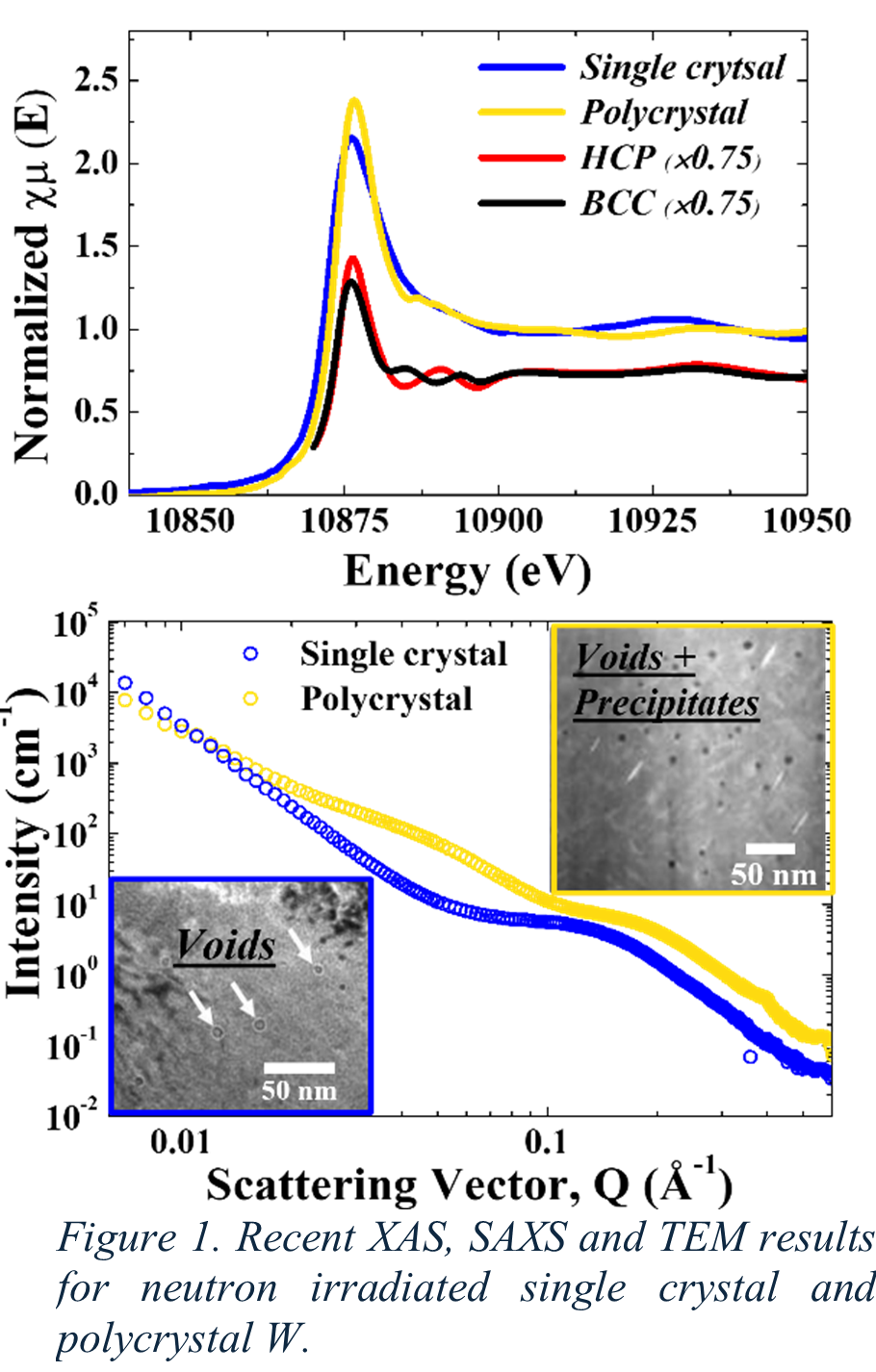
This project leverages advanced synchrotron-based characterization methods of spectroscopy
and scattering to characterize the material-dependent transmutation pathways in fusion
relevant material systems including tungsten and tungsten alloys, RAFM steels and
ultra-high temperature ceramics. Realization of fusion energy requires high-performance radiation-tolerant structural
and functional materials that can withstand the extreme temperature and radiation
environments for the fusion first-wall, blanket structures and plasma-facing components.
A significant gap in our current understanding is the behavior of materials under
the high neutron doses and transmutant H and He levels intrinsic to fusion reactors.
Although some experimental data have been obtained in fission reactors for damage
levels approaching realistic relevant doses, the level of simultaneous transmutant
He generation from fission reactors is more than two orders of magnitude below that
from fusion reactors. Therefore, severe performance degradation due to the synergies
between neutron damage and transmutation products is expected for numerous candidate
materials for a variety of applications in fusion reactor concepts like the Demonstration
Power Plant (DEMO) in EU/Japan or the Fusion Neutron Science Facility (FNSF) in the
US. Specific material examples where critical data is missing include reduced activation
ferritic-martensitic (RAFM) steels for the first-wall/blanket, tungsten alloys for
divertor, copper alloys for high-heat flux components, SiC/SiC ceramic composites
for coolant channels, lithium based oxides for solid breeders (to name a few). Until
a fusion prototypic neutron source (FPNS) becomes available, grassroots research that
can emulate the effect of transmutation products for future validation with 14 MeV
neutrons is required using fission neutrons and accelerator based energetic ions.
This project leverages advanced synchrotron-based characterization methods of spectroscopy
and scattering to characterize the material-dependent transmutation pathways in fusion
relevant material systems including tungsten and tungsten alloys, RAFM steels and
ultra-high temperature ceramics.
|
| |
| |
| |
| |
