Technical Approach to Achieving Attractive ADS Economics Based on Near-Term High Current Cyclotrons
|
Lead P.I. - Dr. David Sprouster and Dr. Lance Snead
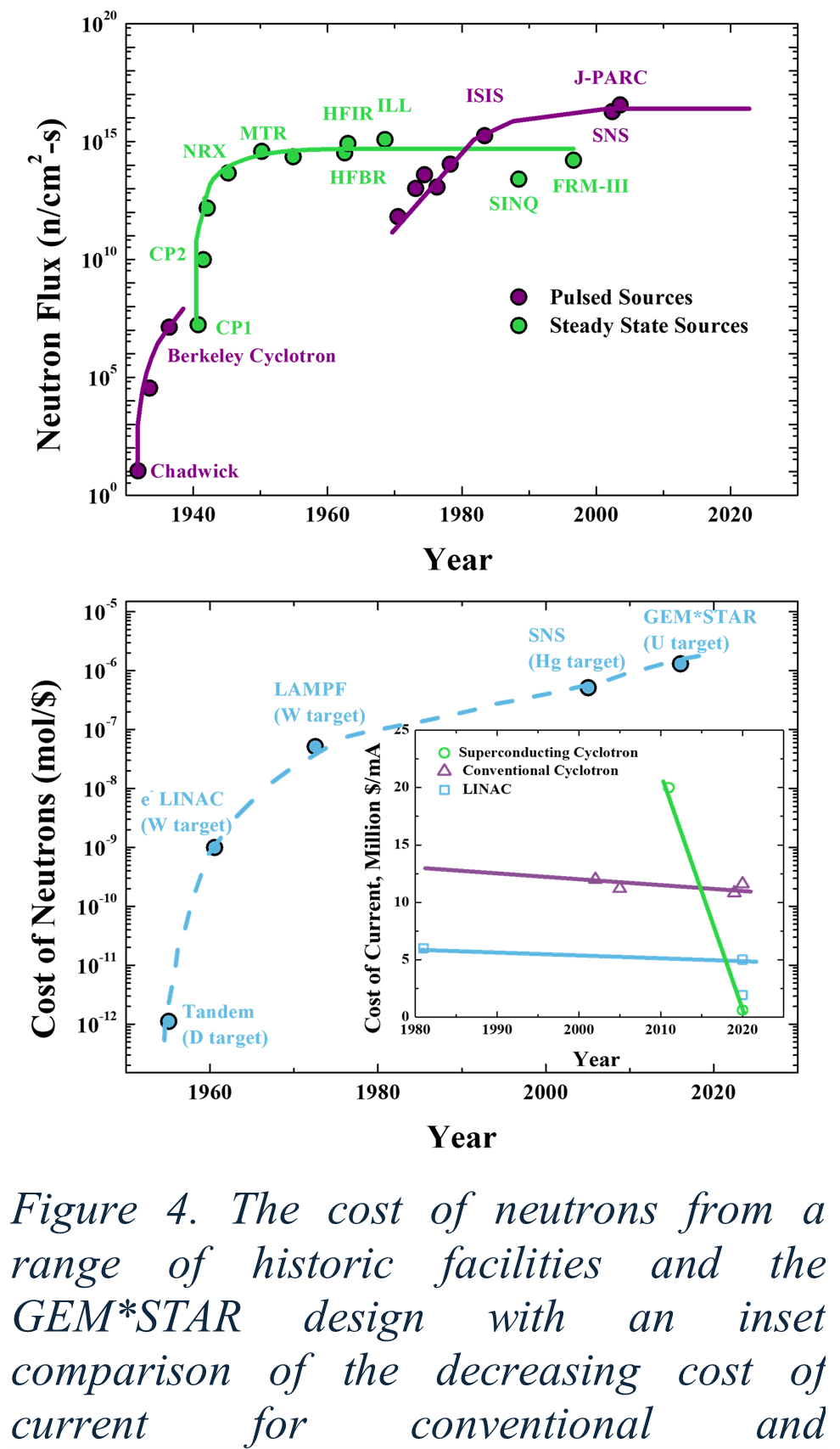
Among the strategies developed to mitigate high-level waste issues of fission power systems a well-studied and leading technology is the accelerator-driven subcritical (ADS) reactor. This technology has several benefits, including a large processing volume within the subcritical reactor capable of processing a wide range of the worst waste products, and being a sub-critical system, the capital investment and facility licensing are significantly less imposing than equivalent critical reactor systems. The ADS system is composed of an accelerator driver, which provides very high energy protons onto a target showering neutrons into the subcritical system. While the subcritical ADS systems technology is quite versatile in its waste mission, with its ability to tailor spectrum and volumes for both legacy waste and anticipated fuel wastes, they do have several technical challenges whose solutions will impact the larger overhang of system cost. In this NEWTON program, we simultaneously address two of the major historically identified obstacles to ADS adoption: low maturity of the ADS driver and its high cost, by both leveraging and extending recent progress in research and commercial high-current cyclotrons. Use of multiple modified commercial cyclotrons as compared to the previously assumed single linear accelerator will have a number of add-on benefits including cost-of-current and reduced beam trips leading to enhanced system availability. Beyond adoption and improvement of this technology our NEWTON Team realizes that optimizing ADS system economics requires a comprehensive systems approach, with interactive efforts in the areas of accelerator design, tailored target development, and an optimized subcritical reactor design. Our approach will enable economic ADS by reducing the cost-per-neutron of the driver, and further benefits through low cost and reliable target design, and high machine availability through multiple driver/accelerator optimization. Ultimately, this systems-driven focus on improving technologies to improve economic performance is a direct path to a long-sought nuclear waste solution using ADS. |