
High-Temperature Creep and Radiation-Resistant Copper Alloys
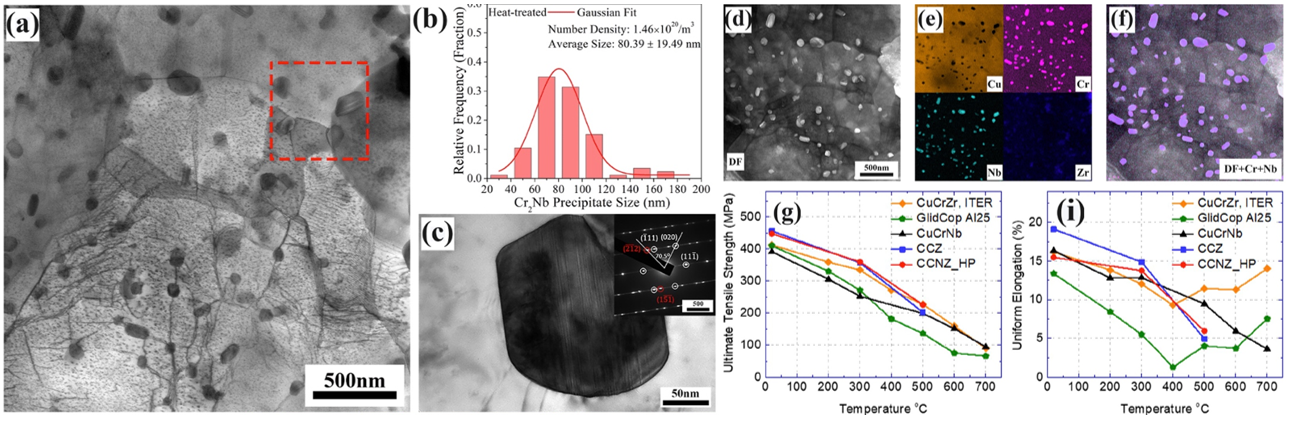
Figure : (a) TEM micrograph and (b) the size distribution of Cr2Nb precipitates for the heat-treated sample. (c) TEM micrograph of a Cr2Nb precipitate with selected area electron diffraction pattern inset. (d) dark field TEM micrograph of the same region in (a). (e) EDS maps of Cu, Cr, Nb, and Zr element corresponding to the dark field TEM micrograph. (f) overlay of dark field TEM, Cr and Nb EDS maps. (g,h) comparison of SSJ-3 tensile properties.
|
Lead P.I. - Dr. Lance Snead The development of next generation fusion systems will require high-strength, high-thermal conductivity, radiation-tolerant HHF materials. Unfortunately, commercially available copper alloys have primarily been designed for low-temperature application and suffer from pronounced creep above 300-400°C. Moreover, little effort has been placed on irradiation resistance. One metallurgical approach to realize a superior alloy involves introduction of planar interfaces or distributed secondary phases to impair creep while retaining strength. It is this alloying approach outlined by Zinkle45, combined with the approaches to irradiation tolerant microstructures as outlined by Zinkle and Snead46 that are being applied to develop new high-temperature creep and irradiation resistant cast alloys as part of an UT-K/ORNL/SBU collaboration. For maximized Kth alloying content of solute atoms should remain below about 1% and second phase precipitates or particles should also be low, on the order of <10%. From an irradiation-resistance standpoint, of increasingly important as we move to power producing reactors, the inclusion of very high densities of fine-scale precipitates akin to those in nano-structured steels are also desirable in order to provide a high density of sinks (target size 10 nm) for mobile defects. Specifically, CCNZ alloys were developed Following this work on cast copper alloys the SBU team od developing a series of sintered S-CCNZ alloys through DCS of similar microstructure determined by complimentary TEM, XRD and SAXS, conductivity and mechanical properties. Moreover, under certain conditions significantly higher densities of fine BCC Cr and FCC Cr2Nb precipitates were revealed. A snapshot microstructure of cast and sintered CCNZ of near-identical microstructure is provided in the Figure, indicating an average Cr2Nb precipitate phase around 80 nm and tensile properties of case and sintered product similar and superior to alloys such as Glidcop and ITER grade CuCrZr. It is noted that long-duration creep-rupture testing of these alloys is ongoing at SBU. |