
Composite Shield Materials for Fusion
|
Lead P.I. - Dr. Lance Snead
Tokamak shielding must mitigate threats to the superconducting coils: neutron cascade damage, heat deposition and organic insulator damage due x-rays. Current shield solutions use combinations of high-Z, low-Z, and absorbers such as W, H2O, and 10B. Unfortunately, as H2O is avoided for compact reactors and B-compounds suffer from irradiation instability and burnout, there are currently no hi-performance shielding materials to enable the potential performance enhancement offered by HTS technology. This situation is not unique in our transition from ITER to power systems, with current systems such as the divertor, diagnostics, etc. having unsuitable performance or projected lifetimes, though advanced shielding is currently not an active research area. While conventional materials could be utilized to bring damage and heat within acceptable limits, this will certainly and significantly add to reactor radial build and cost. Our EMREL team in concert with fusion core designers are defining novel shield architectures, and moving these systems from concept, through fabrication, property quantification, and engineering scale-up to proof of performance including neutron irradiation. Our proposed shield technology leverages a processing breakthrough recently developed by our team[2-5], whereby metal hydrides are entrained in irradiation stable ceramics[4]. Figure 1 shows desirable attributes of such a composite. The key to our high performance composites is the entrainment of high neutron absorbing and neutron moderating metal hydrides within a fully dense ceramic or metal matrix. The figure below describes the challenge in processing both ceramic matrix and metal matrix shield composites without dissociating the hydride phase. Currently developed materials include MgO-matrix HfH2 composites and a cryosteel variant. |
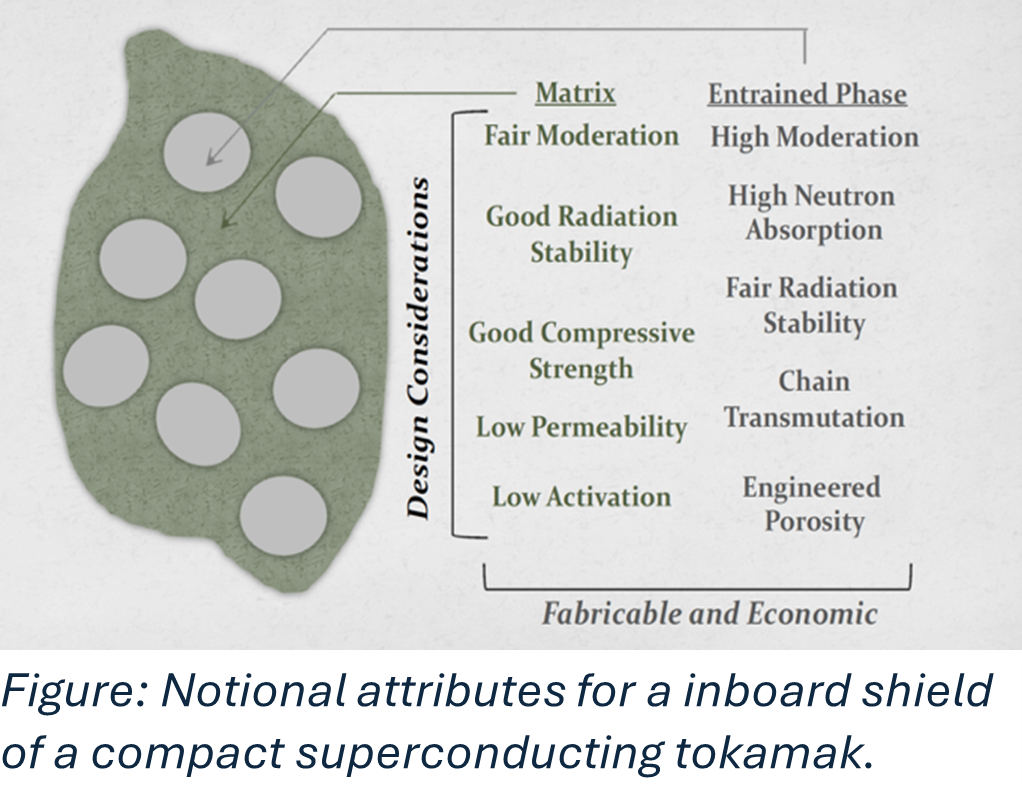
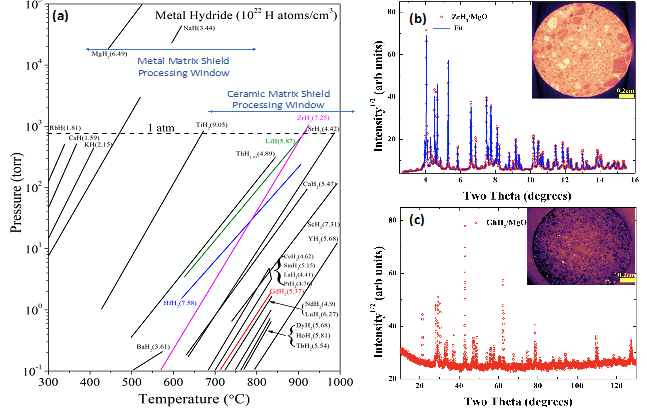 Figure: (a) Plateau pressure for metal hydrides (hydrogen density, atoms/cm3, are
provided in parenthesis), (b and c) Composites of MgO-ZrH2 and an ENTRAINED Shield MgO-GdH2, respectively.
Figure: (a) Plateau pressure for metal hydrides (hydrogen density, atoms/cm3, are
provided in parenthesis), (b and c) Composites of MgO-ZrH2 and an ENTRAINED Shield MgO-GdH2, respectively.