|
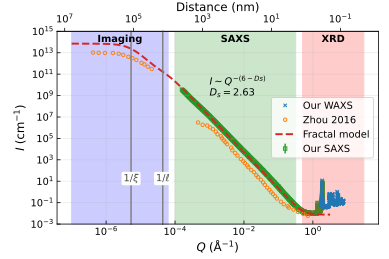
Figure: Scattering measurements on fine-grain nuclear graphite taken using neutrons
and X-rays. results using USAXS (green) and WAXS (blue) are compared with data presented
by Zhou et. al (orange). These measurements span vast length-scales covered by different
measurement techniques shown in real space on the top x-axis.
Lead P.I. - Dr. David Sprouster and Dr. Lance Snead
Since the original designs of nuclear reactors in the 1940s, graphite has been an
essential material for in-core components, it remains integral to the designs of the
next-generation reactors. Graphite, made from crystallized carbon, has the unique
property of efficiently scattering neutrons combined with a low absorption rate which
makes it ideal for use as a neutron moderator or reflector. Nuclear graphite is a
composite material formed by crystalline filler particles joined together with a disordered
graphite binder which creates a complex structure with noticeable porosity. Each grade
of nuclear graphite has a unique pore morphology that changes under irradiation by
neutrons. When damaged by irradiation, nuclear graphite initially undergoes densification,
and, upon further irradiation, the graphite reaches a so-called turnaround point in
which it begins expanding. This expansion leads to cracking and material failure,
which limits the material’s lifetime. The complex irradiation-induced changes of nuclear
graphite need to be quantitatively understood to accurately predict the lifetime of
graphite components. In this project, we aim to improve our understanding of nuclear
graphite’s response to irradiation by investigating the pore structure using scattering
and imaging techniques. We propose to combine ultra small angle x-ray scattering (USAXS)
with X-ray computed tomography (XCT) to nondestructively examine the morphology of
the pore structure using fractal mathematical models. Fractal models have a direct
correspondence to the probability of brittle fracture resulting from microcrack growth,
which is statistically represented using a Weibull distribution. We plan to develop
and evaluate a new methodology to nondestructively determine the Weibull parameters
for irradiated nuclear graphite, enabling the probability of failure to be predicted
under various irradiation doses and temperatures.
The major tasks for this project will be as follows. First, prepare unirradiated and
irradiated graphite samples for measurements. Second, reanalyze published datasets
collected using destructive tests to directly compare them with our nondestructive
techniques. Third, perform XCT on samples our group previously measured with USAXS
to optimize data collection procedures. Fourth, conduct XCT measurements on the remaining
samples. Fifth, measure all the samples with USAXS and investigate our methodology
for determining the Weibull parameters using a fractal model.
|
