Role of Point Defect Concentrations on the Rate of Intermetallic Phase Formations
|
Lead P.I. - Dr. David Sprouster
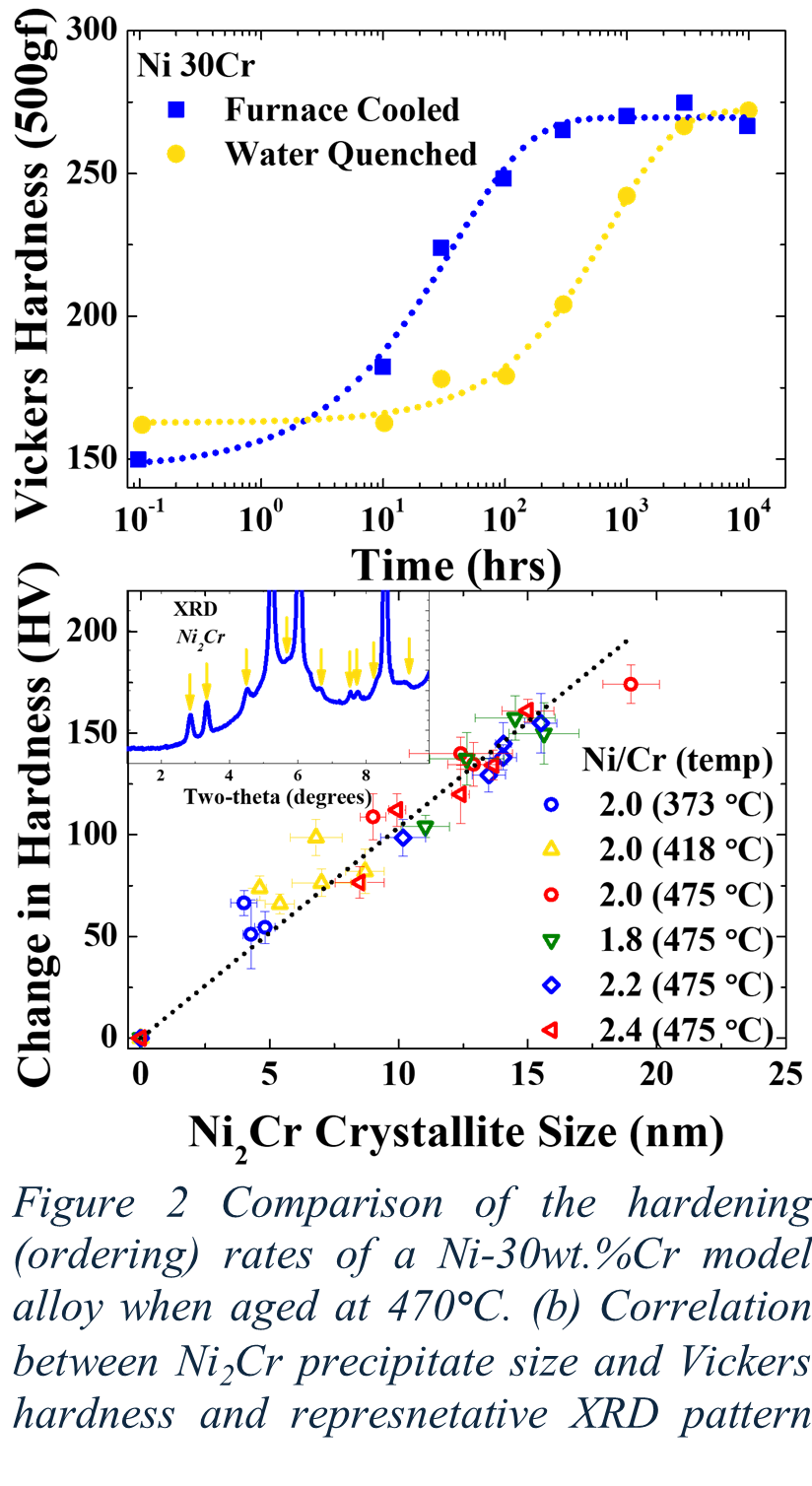
Previous data shows that the rate of formation of Ni2Cr is dependent on the processing conditions. Figure 3 (a) illustrates this behavior for water quenched vs. furnace cooled conditions for a representative model Ni-30 wt.% Cr alloy and demonstrates that furnace cooled material develops Ni2Cr at shorter times than water quenched material. Furthermore, recent structure-property results, utilizing XRD, show that hardness in model Ni-Cr alloys correlates directly to precipitate size rather than phase fraction, regardless of the alloy Cr concentration or aging temperature (Figure 3(b)). Given the complexity of the ordering kinetics and the deleterious consequences of Ni2Cr formation, there is a critical need to define relationships between defect types (vacancies, interstitials and dislocations) and defect concentrations with the rate of intermetallic phase. By fundamentally understanding nucleation and growth mechanisms we can usher in a new era of tailored microstructures for performance in a wide range of alloy systems beyond Ni-Cr alloys and predict degradation of existing alloys. It is hypothesized that the nucleation and growth rate of Ni2Cr phase, as well as average precipitate size, can be controlled by the cooling rate, aging temperatures and by intentionally introducing defects (1D, 2D and/or chemical defects) to inhibit atomic migration and subsequent nucleation. Based on the preliminary results above in Figure 3, where the rate of Ni2Cr phase formation is sensitive to the defects present, this hypothesis is plausible. However, the type(s) and number of defects that promote the growth of nm sized Ni2Cr phases are not well understood or easily accessible. Synchrotron-based XRD in concert with mechanical testing are used to characterize the type and number of defects as functions of processing time, temperature and alloy content. By uncovering the fundamental defects and phenomena that control the nucleation and saturation limits of the Ni2Cr precipitates it will be possible to effectively tailor microstructures for desired mechanical properties.
|