Sintered Nanostructure Alloys for Fusion High Heat Flux Application
|
Lead P.I. - Dr. Lance Snead Another class of alloys of particular interest for interfacing with HHF’s are castable nanostructured alloys (CNAs), put forward by Tan, Katoh, and Snead-ref below) representing a special class of dispersion-strengthened RAFM steels containing microstructural features enhancing creep and irradiation resistance. In comparison with ODS steels whose dispersions are achieved through a powder metallurgy process, CNAs are primarily strengthened by MN or MC, e.g., (V,Ta)N,C formed in the casting/thermomechanical treatment process. On this basis, it has been posited that the CNAs lie in between RAFM steels and NFAs in terms of sink strength, as illustrated in the figure to the right. While CNAs provide significant advantages relative to ODS given there conventional processing, as with the advanced copper of the previous section, their use in HHF structures may best be enabled through sintering.
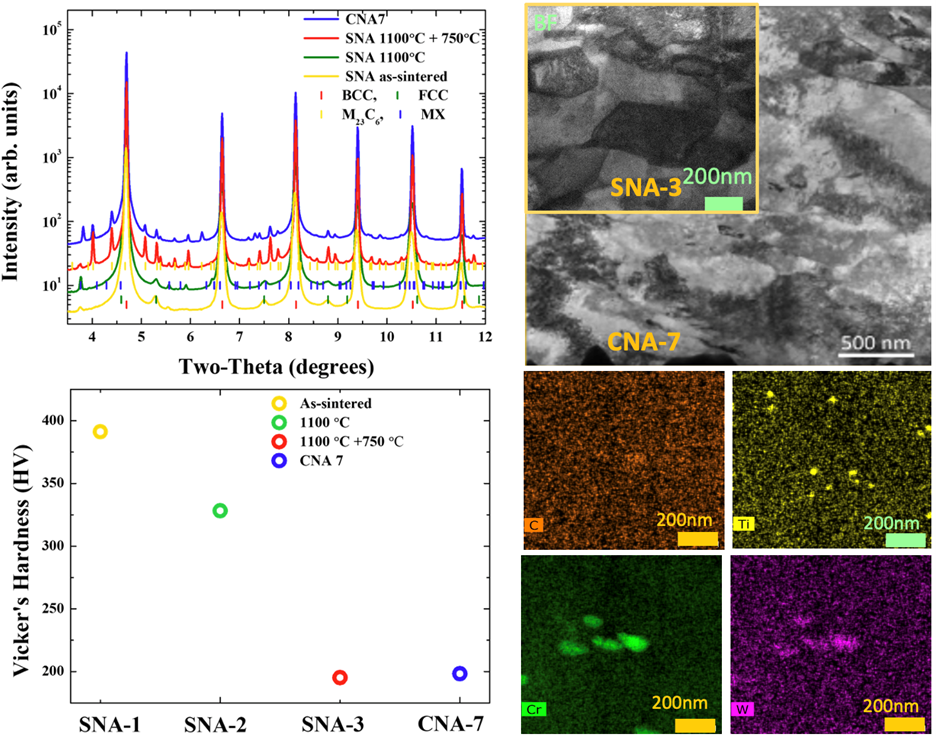
As part of ongoing research we have developed methods to optimize DCS parameters to achieve microstructures near-identical to castable nanostructured alloys (CNA) developed for improved creep and irradiation resistance. Specifically, among the alloys developed, the so-called CNA7 example alloy is presented in the figure below: here, 20 gm of powder, ~24.6mm average particle size of gas atomized CNA7 (8.77Cr 1.46W 0.57Mn 0.08V 0.05Ta 0.13Ti 0.10Si 0.09C) were uniaxially loaded at 50 MPa into a 25 mm graphite die designed for a direct current sintering system (Sinterland LABOX-3010KF, Japan). The sample was heated at a rate of 100°C/min to 1000°C, and held at temperature for 10min prior to ambient cooling. Following sintering, the compact was loaded into a box furnace, annealed at 1100°C for 2hrs, and quenched in water. A second post-sintering heat treatment was applied at 750°C for 2hrs followed by unloading and ambient air cooling. The fabrication process and microstructural properties were quantified through a combination of electron microscopy, multimodal x-ray characterization, hardness, tensile, and are now undergoing thermal creep and neutron irradiation. Results confirm that sintered CNA microstructures (so-called SNA) are achievable, with additional hardening realized through post-sinter aging. A comprehensive description of microstructure and properties of this sintered material as compared with the CNA alloys developed by Tan has been submitted for publication.
Figure: Comparison of cast and sintered nanostructured ferritic martensitic steel. CNA produced by ORNL and SNA produced under this grant. (A) XRD analysis indicating phase matching and similarity in phase fraction. (B) As-produced alloys of similar chemistry SNA-3 and CNA-7 result in similar hardness, with post-process heat-treatment resulting in decrease in hardness, yield and ultimate tensile strength. (C) Similarity in grain structure from TEM image of ORNL CNA-7 alloy from published literature51 with SNA-3 alloy. (D) STEM-EDS Imaging of fine, high-density Ti and W-Cr-rich precipitates of SNA-3 alloy. These results highlight DCS as a viable fabrication route and highlight that these methods have future promise to develop graded structures with SNA material on top of a sintered CCNZ substrate, a significant step in designing realistic structures required for future devices. References: Tan, L., Katoh, Y. & Snead, L. L. Stability of the strengthening nanoprecipitates in reduced activation ferritic steels under Fe2+ ion irradiation. Journal of Nuclear Materials445, 104-110 (2014). Tan, L., Katoh, Y. & Snead, L. L. Development of castable nanostructured alloys as a new generation RAFM steels. Journal of Nuclear Materials511, 598-604, |
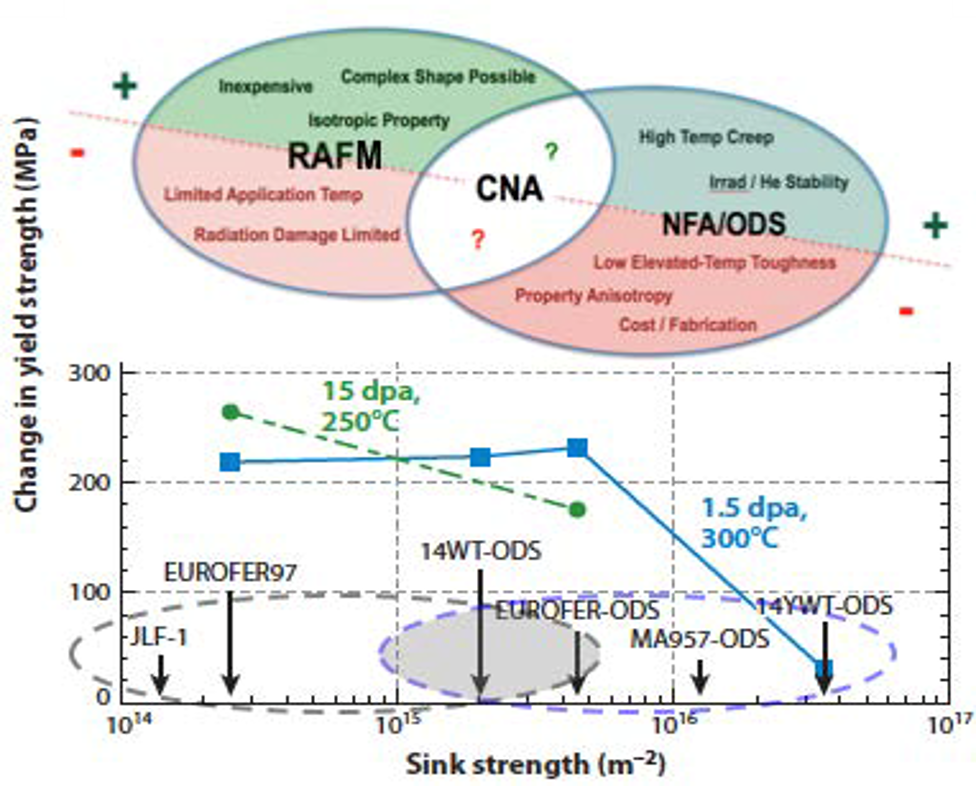 Figure: Irradiation hardening behavior and sink strength of CNAs compared to RAFM
and NFA/ODS alloys; reproduced from Ref. 1
Figure: Irradiation hardening behavior and sink strength of CNAs compared to RAFM
and NFA/ODS alloys; reproduced from Ref. 1