


MAR 110, Shark Biology & Conservation
Stony Brook University, SoMAS
 Course Title: Shark Biology & Conservation
Course Designator, Section: MAR 110
Credits: 3
Pre-requisites: None
Semester, Year: Summer 2026, 7/21-7/31
Modality: In-person, two-week intensive course
This is an in-person course, delivered at the Southampton Marine Station. Both the lecture and class-exercise take place during the assigned meeting times. Due to the nature of this two- week intensive course, all in- person meeting times are required to pass this course. Students must be mindful of all course expectations, deliverables and due dates.
Mode of Instruction: Lectures and Labs
Meeting Time: 7/21-7/31, Week 1: Tuesday- Friday, Week 2: Monday- Friday 10:00 am- 3:30 pm
Classroom Location: Stony Brook Southampton, Marine Station Classroom 215
Instructor Information
Instructor Name: Marissa DeBonis, MPS
Instructor Email: marissa.debonis@stonybrook.edu
Office Hours: Wednesday- Friday 3:30- 4:30 pm
Office Location: Southampton campus, Natural Sciences 119
Required Course Materials
Shark Biology and Conservation: Essentials for Educators, Students, and Enthusiasts. 2020. Daniel C. Abel and R. Dean Grubbs
Course Description
Sharks have lived in New York waters for millions of years and play an important role in balancing our intricate marine ecosystems. MAR 110 provides an in-depth exploration of the diversity, biology, and conservation of sharks, focusing on current scientific research and practical skills development. This short-term intensive course is specifically designed for both undergrads & motivated high school students wishing to earn college credit.
Learning Objectives
 Throughout this course, students will:
● Summarize how evolution has resulted in anatomical, physiological, and morphological variation among shark species with focus on their unique adaptations that allow them to live in their different habits.
● Demonstrate the ability to analyze Baited Remote Underwater Video (BRUV) data, formulate research questions, and design a BRUV deployment plan.
● Summarize and evaluate a scientific article, acquiring foundational skills essential for navigating and comprehending scientific literature in the field.
● Describe the ecological significance of sharks and current conservation challenges.
● Develop and apply effective communication strategies of conveying complex scientific topics to the general public, stakeholders, and policy makers by creating diverse media forms related to elasmobranch conservation.
SBC Learning Objectives for SNW:
● Exemplify the process of conducting a scientific literature review and deciphering scientific articles.
● Explain the methods scientists use to explore natural phenomena including observation, hypothesis development, measurement and data collection, experimentation, evaluation of evidence, and employment of data analysis or mathematical modeling.
● Explain the application of scientific data, concepts, and models in one of the natural sciences.
Assessments
|
Assessment/Assignment/Exam |
Points |
Dates |
|
Exams (2) |
30 |
7/24 7/31 |
|
Assignments (2) |
20 |
TBD |
|
Final Project (Scientific Summary & Evaluation + Presentation) |
25 |
7/27 & 7/31 |
|
Lecture Review Questions (6) |
18 |
Daily |
|
Participation/ Attendance |
7 |
N/A |
|
Total |
100 |
|
Assessment Descriptions
● Exams (15% each)
o Two cumulative, closed-book exams will be administered—one each Friday of the course. Exams will assess your understanding of material from lectures, readings, and in-class activities. Question formats will include a mix of multiple choice and short answers.
● Assignments (10% each)
o Shark Dissection Worksheet
▪ Complete a guided worksheet during our shark dissection lab to deepen your understanding of elasmobranch anatomy, adaptations, and internal systems.
o BRUV Analysis & Worksheet
▪ Learn about Baited Remote Underwater Video (BRUV) systems as a shark research method. You’ll analyze real BRUV footage, evaluate limitations of this method, propose improvements, and generate your own research questions. We will design BRUVs in class and deploy them during our boat trip. This is a two part assignment.
● Lecture Review Questions (3% each, 6 total)
o After each lecture, you will complete a short set of review questions to reinforce your understanding of the material. These must be submitted on paper or submitted on Brightspace at the start of the next class. No late submissions will be accepted. There are 6 total review assignments throughout the course.
● Species Group Project (25%)
o In this collaborative project, each group will be assigned a shark species to explore in depth. Although the species topic is shared, each student will complete their own independent research and contribution. This project will include both individual and group components:
▪ Week 1: Group Organization: Groups will meet to assign roles and responsibilities. Each member will take one of the following sections:
● Anatomy & Physiology
● Behavior
● Ecology
● Threats
● Conservation
▪ Independent Work: Each student will independently research their section and complete:
● A one-page Scientific Summary & Evaluation of a peer-reviewed scientific paper relevant to their species and topic area. (10%)
● Independent creation of their presentation slides covering their assigned section. (5%)
▪ Final Group Presentation: Toward the end of the course, groups will reconvene to organize their slide decks and plan the order and flow of their presentation. Each member will present their section individually as part of the group’s overall presentation on the last day of the course. Each individual will only have FIVE MINUTES for their sections; each group will have 20 minutes total. (10%)
● Participation/ Attendance (7%):
o Active participation is vital in this hands-on course. You are expected to:
▪ Attend all lectures and field activities
▪ Engage in class discussions and ask/answer questions
▪ Collaborate meaningfully during group work, dissections, and boat trips
▪ Participation will be assessed based on involvement, preparedness, and contributions to group work and in-class tasks.
Boat Trips:
o You must wear close toed shoes at all times on our boat trips (crocs, dive booties, old sneakers). You cannot take your shoes off to go in the water. No sandals, flip flops, or TEVAS.
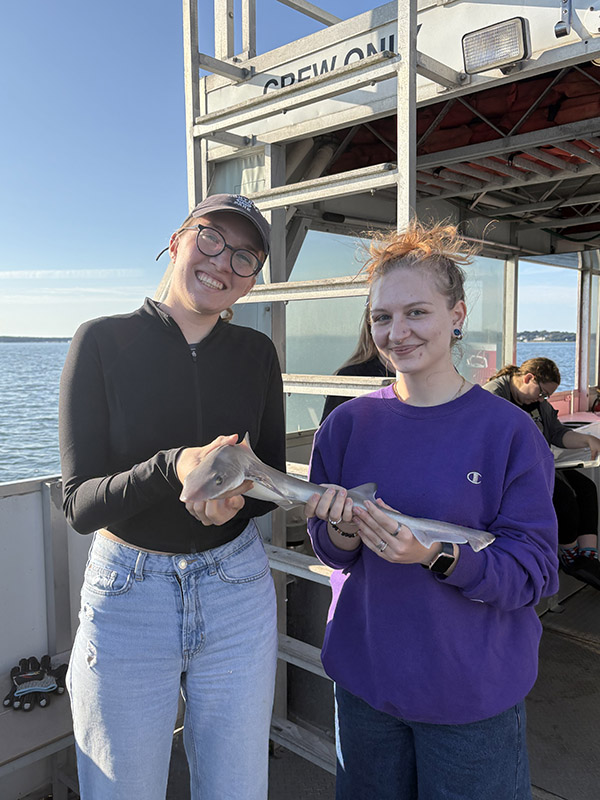
o There is no swimming during our trips. We will be seining (fishing with nets) and will be going into the water up to chest height. Please wear photo appropriate clothing/ bathing suits, and bring a change of clothes for after class.
o We will be staying in the bay for our trips, so you shouldn't need any sea sickness medication. If you choose to take some, I recommend taking it the night before and the morning of the trip.
o You are welcome to bring a small snack, though I recommend eating during our lunch break before we go. NO BANANAS ON THE BOAT.
Communication and Feedback on Assignments
My preferred method of contact is via email at marissa.debonis@stonybrook.edu. If you would like to talk on the phone, or meet virtually, please email me so that we can set up a mutually agreeable time. When emailing me about the class, please include the course name (MAR 110) into the subject line.
As your instructor, I plan to interact and engage with you on a regular basis throughout the course to support your learning. I will provide weekly direct instruction related to the course’s learning objectives, respond to your questions, grade and/ or provide feedback on your submitted course work. Regular announcements or changes to the schedule will be posted in Brightspace. By default, you will receive an email notification when the announcement is posted and will continue to get them unless you modify your notifications. I recommend that you keep this notification on.
You can expect the following response times for feedback:
- Grades and feedback on assignments and tests will be provided no more than 3 days after the due date.
Grade Scale
|
Letter Grade |
Percentage/Points |
|
A |
94-100 |
|
A- |
90-93 |
|
B+ |
87-89 |
|
B |
83-86 |
|
B- |
80-82 |
|
C+ |
77-79 |
|
C |
73-76 |
|
C- |
70-72 |
|
D+ |
65-69 |
|
D |
60-64 |
|
F |
0-59 |
Additional information
Course Schedule
The possibility exists that unforeseen events (weather) will make schedule changes necessary. Any changes will be clearly noted in Brightspace Announcements or through Stony Brook email.
|
Week |
Dates |
Topic/Activities |
Readings (due prior to class) |
In-class Activity |
Graded Assignment Due |
|
1 |
7/21 |
Intro, Evolution, Diversity |
Text Ch 1 & 2 |
Group Project Day 1
|
|
|
|
7/22 |
Functional Anatomy and Physiology |
Text Ch 3 |
Dissection |
Lecture Review Questions From Lecture 1 |
|
|
7/23 |
Reproduction & Shark Science |
Text Ch 4-6 |
Shark Science and BRUV Design |
Lecture Review Questions from Lecture 2 |
|
|
7/24 |
EXAM 1 |
|
Boat Trip |
Dissection Worksheet Due Lecture Review Questions from Lecture 3 |
|
2 |
7/27 |
Ecological Significance |
Text Ch 9 |
Sharks or Nah? |
Scientific Summary & Evaluation Due (On Brightspace) |
|
|
7/28 |
Threats |
Text Ch 11 & 12 |
BRUV Analysis |
Lecture Review Questions from Lecture 5 |
|
|
7/29 |
Threats and Conservation |
|
|
|
|
|
7/30 |
Conservation |
|
Group Project Day 2 |
Lecture Review Questions from Lecture 6 |
|
|
7/31 |
EXAM 2 |
|
Presentations |
Presentations Due
BRUV Worksheet Due
Lecture Review Questions from Lecture 7 |
Student Success Resources:
How to Be a Successful Student in This Course
There are multiple resources, university offices, and help desks that are available to assist you with everything from advising, tutoring, accessibility and much more.
Review some Academic Success Strategies and visit the Student Resources page for links to resources on campus.
For MAR 110:
- Complete all assigned readings each week.
- Come to class on time, and focused
- Ask questions when you are confused about a topic or course expectation.
Wellness & Support Statement
Stony Brook values student well-being, including mental health, and recognizes that a variety of factors can impact emotional wellness and academic success including stress, anxiety, depression, substance use, sexual violence, family or relationship concerns, and political conflict. Resources are available if you experience challenges or wellness concerns that affect your ability to be successful in class, and you are encouraged to reach out for help when you need it.
In the event of a short-term absence from class, students are encouraged to communicate immediately and work directly with instructors. However, if a student is struggling with an extended absence due a hospitalization, family illness or death, they are encouraged to reach out to the Student Support Team.
Technical Requirements and Assistance
D2L Brightspace is Stony Brook University’s digital learning environment. It is used for the facilitation of communications between faculty and students, submission of assignments, and secure posting of grades and feedback in your courses. To access Brightspace, go to mycourses.stonybrook.edu and use your SBU NetID and password. If you are unsure of your NetID, visit Finding Your NetID and Password for more information.
Sometimes submitting coursework via a tablet and/or mobile device can be challenging. Computers equipped with the appropriate software are available for use at the various SINC site computer labs. Both physical and virtual labs are available. You can also borrow a computer through SBU’s Laptop Loan Program.
Visit the Technical Requirements page for additional information regarding hardware and software options.
Please use the following information if you need technical assistance at any time during the course or to report a problem with Brightspace:
Brightspace Support via SUNY Helpdesk
- Phone: 1-844-673-6786
- Submit a ticket or chat online
Stony Brook University: Academic Technology Services
- Phone: 631-632-9800
- Email: AcademicTechnologies@stonybrook.edu
Privacy Policies
This course utilizes various educational technologies to enhance the learning experience.
You can access links to the privacy policies of the tools and platforms used at Stony Brook University on the Syllabus Addendum
webpage.
Course Policies
AI Policy
Academic dishonesty will not be tolerated. Any instance will be reported to the Academic Judiciary Committee, typically resulting in an F for the course.
The use of artificial intelligence (AI) tools is permitted in limited and clearly defined ways. AI tools include, but are not limited to, generative AI platforms (e.g., Microsoft Copilot, Google Gemini, etc.), AI-powered grammar and editing tools, and discipline-specific AI applications. AI may be used only for the following purposes or stages of work: brainstorming topics, outlining, grammar checks. AI use is not permitted for: drafting final responses, completing exams, generating analyses, writing reflections, etc. These limitations are designed to support learning while ensuring that core intellectual work remains your own. If you are unsure about whether a particular use of AI is appropriate, please check with the instructor before proceeding.
Please be aware that AI tools can produce biased, misleading, or inaccurate results. You are responsible for critically evaluating and confirming the accuracy of any AI-generated content used in their coursework. You should also consider data privacy implications, as many AI platforms may retain or reuse user-provided content. Do not upload copyrighted materials, original work, or personal information unless explicitly permitted. Please also research and consider the environmental impact of AI usage and its ability to stifle your own independent thinking and creativity.
Late Work Policy
Attendance is required for all activities. Due to the nature of this course, missing one day of the course will result in a negative impact of two letter grades. All assignments must be submitted by the due date to receive full credit. While not ideal, please let me know ahead of time if there will be an issue handing something in on time. Assignment due dates are there for multiple reasons such as giving me time to get comments back to you so you can use them for future work and giving us the ability to have meaningful conversations in class about the assignment.
For laboratory assignments submitted late without prior approval, the following penalties will apply:
- Up to 24 hours late: 25% deduction
- More than 24 hours and up to 48 hours late: 50% deduction
- Assignments will not be accepted more than 48 hours late.
Technical issues, scheduling conflicts, or competing coursework do not automatically constitute grounds for an extension. It is the student’s responsibility to plan accordingly and communicate proactively.
The final presentation will not be accepted late, except in cases of documented extenuating circumstances. To be eligible for consideration, students must provide official documentation, such as:
- A note from a medical provider, or
- Verification through the Student Accessibility Support Center (SASC)
Please note: Technical difficulties with personal technology are not an excuse for late assignments or for reading/activities not being completed. Make it good practice to save your work periodically to the cloud to be sure none of your work is lost.
University Policies
Student Accessibility Support Center Statement
If you have a physical, psychological, medical, or learning disability that may impact your course work, please contact the Student Accessibility Support Center, Stony Brook Union Suite 107, (631) 632-6748, or at sasc@stonybrook.edu. They will determine with you what accommodations are necessary and appropriate. All information and documentation is confidential.
Students who require assistance during emergency evacuation are encouraged to discuss their needs with their professors and the Student Accessibility Support Center. For procedures and information, visit Environmental Health and Safety.
Academic Integrity Statement
Each student must pursue his or her academic goals honestly and be personally accountable for all submitted work. Representing another person's work as your own is always wrong. Faculty is required to report any suspected instances of academic dishonesty to the Academic Judiciary. Faculty in the Health Sciences Center (School of Health Professions, Nursing, Social Welfare, Dental Medicine) and School of Medicine are required to follow their school-specific procedures. For more comprehensive information on academic integrity, including categories of academic dishonesty please refer to the academic judiciary website.
Critical Incident Management
Stony Brook University expects students to respect the rights, privileges, and property of other people. Faculty are required to report to the Office of Student Conduct and Community Standards any disruptive behavior that interrupts their ability to teach, compromises the safety of the learning environment, or inhibits students' ability to learn. Faculty in the HSC Schools and the School of Medicine are required to follow their school-specific procedures. Further information about most academic matters can be found in the Undergraduate Bulletin, the Undergraduate Class Schedule, and the Faculty-Employee Handbook.
Accessibility
Stony Brook University is committed to ensuring a supportive, inclusive, and equitable learning environment for all members of our community, which includes upholding the principles of Title II of the Americans with Disabilities Act (ADA). As a student in this course, it is important to recognize your role in ensuring that all classmates, including those who use assistive technologies, can fully engage with and comprehend the course content. Therefore, any digital materials you create and share, such as assignments, presentations, or shared documents, must be designed to be digitally accessible using the most up to date version of the WCAG 2.1 Level AA guidelines. Accessible practices include, but are not limited to, providing alternative text for images, using clear heading structures, and ensuring captions for any video or audio you incorporate. Guidance and assistance in making your digital content accessible can be found on the Accessibility Resources for Students page. For additional support, please visit Deque University.
Understand When You May Drop This Course
If you need to drop or withdraw from the course, it is your responsibility to be aware of the tuition liability deadlines listed on the registrar’s Academic Calendar. Before making the decision to drop/withdraw you may want to [contact me or] refer to the University’s policies:
Incomplete Policy
Under emergency/special circumstances, students may petition for an incomplete grade. Circumstances must be documented and significant enough to merit an incomplete. If you need to request an incomplete for this course, contact me for approval as far in advance as possible. You should also read the University’s policies that apply to you:
Undergraduate Incomplete Policy
Course Materials and Copyright Statement
Course material accessed from Brightspace, Zoom, Echo 360, VoiceThread, etc. is for the exclusive use of students who are currently enrolled in the course. Content from these systems cannot be reused or distributed without written permission of the instructor and/or the copyright holder. Duplication of materials protected by copyright, without permission of the copyright holder is a violation of the Federal copyright law, as well as a violation of Stony Brook’s Academic Integrity.