


Meet Our Students
One of the biggest reasons that Stony Brook Southampton is such a vibrant place is our students. Their curiosity, creativity and determination help fuel everything we do. Taking advantage of opportunities in academic programs in the marine sciences, sustainability, health professions, creative writing, film and television, our students come from all walks of life to make Stony Brook Southampton the remarkable place that it is. Come meet some of them!
Jump Ahead:
Zarin Khan: Finding Room to Write
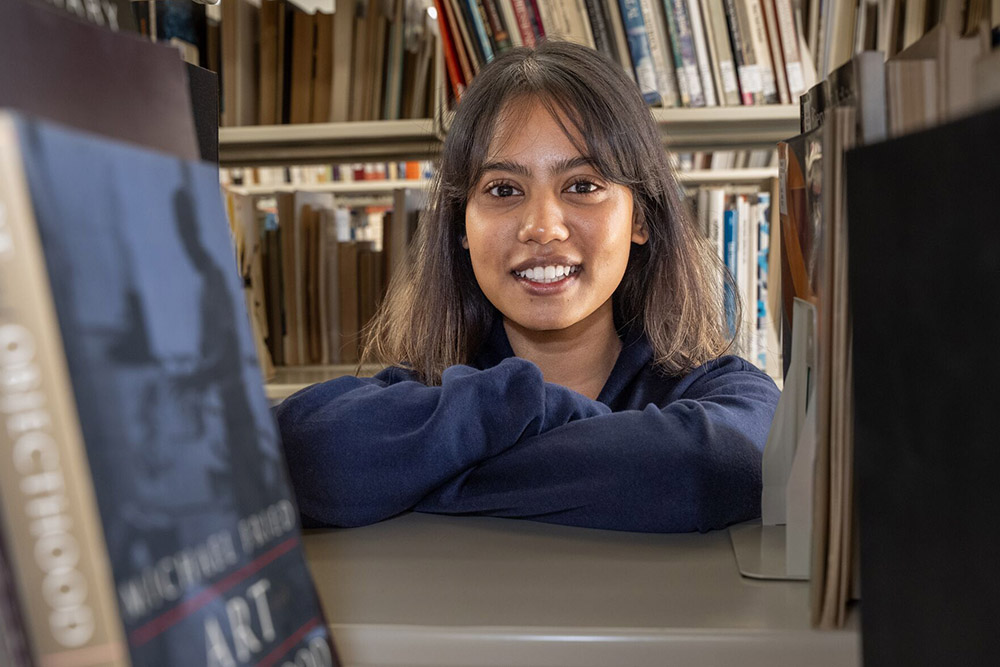
When Zarin Khan moved from the Bronx to Stony Brook University’s Southampton campus, the pace slowed, the landscape changed and Khan found the space and time she needed to focus on her writing.
“I finally have the time to actually be a student and write,” Khan said. “In the city, everything was always go, go, go. Here, I get to breathe.”
Khan is a student in the MFA program in creative writing with a concentration in poetry. She came to Stony Brook after she earned her undergraduate degree at Baruch College, where she majored in English and minored in journalism and psychology. As a student of South Asian descent, Khan said she felt pressure to pursue more traditional career paths like law, medicine or engineering. “With an English degree, it felt like it wasn’t enough,” she said. “So I thought, if I’m going to do this, I need to really commit. I want to go all the way.”
Graduate school became a way to deepen that commitment. Rather than a traditional master’s program, Khan sought an MFA that emphasized creative production, workshops and publication.
“I wanted to write my own work, not just analyze other people’s,” she said. “Workshops sounded better to me. It felt more honest to what I actually wanted to do.”
Program location also was important to her. Khan had lived in New York City her entire life and was not ready to leave it behind completely. Stony Brook’s MFA program, with coursework split between Manhattan and Long Island, offered a gradual transition.
“I wanted something different, but I wasn’t ready to jump straight out of the city,” she said. “That first year in Manhattan gave me time to understand Stony Brook and prepare for Southampton.”
During her first year, Khan took classes on the Manhattan campus while working long hours to support herself. At times, she worked up to 50 hours a week while attending night classes and managing work obligations.
“I didn’t have any time to write,” she said. “Between work, commuting and paying bills, there was nothing left.”
In her current second year in the program, she relocated to Southampton after securing a resident assistant position that included housing. She was later promoted to a student life administrator role.
“It felt like a lot of gain and not a lot of loss,” she said. “Financially, practically and creatively, it just made sense.”
Resident students at Southampton live in suite-style housing with full kitchens available in the residence halls, creating a more independent living environment.
“It feels like an actual house,” Khan said. “Compared to other campuses where everything feels cramped, this is spacious. You cook for yourself. You have room.”
The campus’s small size also fosters relationships between students. The library serves as a central gathering place. “Because it’s smaller, you end up making real friendships,” Khan said. “If you’re willing to get out of your room, you find people.”
Southampton’s proximity to the water has influenced Khan’s daily life and her creativity. During the warmer months, the beach just minutes from campus became a regular retreat.
“I went almost every night,” she said. “After 5 pm, when parking restrictions end, I’d go watch the sunset, walk or read. It became a ritual. I’d never seen deer before. Or wild turkeys. Just being out of the city feels like a whole different country.”
Those observations, along with having greater time to spend on her writing, has changed her approach to her craft.
“That’s the biggest thing,” she said. “I have time. And kindness feels more present here. People want to give you opportunities.”
Khan credits mentors on the Southampton campus, including Laura Lyons, facilities liaison; Frank Imperiale, associate director of the Stony Brook Southampton campus; and Richard Czyzyk, interim director for student life for Stony Brook Southampton, for supporting her academic and professional growth. In Manhattan, MFA faculty member Robert Lopez played a formative role.
“He taught me restraint,” Khan said. “Not over-explaining. Trusting the reader. Even small things, like how punctuation in an email changes tone. Those conversations stick with you.”
This year, Khan is taking poetry workshops on the Southampton campus with her thesis advisor, Molly Gaudry, while also teaching Introduction to Creative Writing on Stony Brook’s main campus, which has helped her clarify her future plans.
“I want to teach college students,” she said. “I love being in the classroom.”
After completing her MFA, Khan hopes to publish her thesis work, continue teaching and eventually pursue a PhD.
Southampton offers a balance she had not experienced before. “I get to have a real student experience here,” she said. “I built close friendships. Moving here helped me grow financially, creatively and personally.”
“I’m genuinely happy I made the move,” Khan added. “In every sense, it just worked.”
Cosette Bedoya: Building Confidence and Community
For Cosette Bedoya, a graduate student in Stony Brook University’s Speech-Language Pathology program at Southampton, the path to her future career began long before graduate school — and long before college.
Raised on Long Island, Bedoya grew up receiving speech services alongside her brother, an experience that later informed her interest in language and communication. While she did not enter high school with a clear plan for her future career, her exposure to communication support at a young age, combined with six years of learning American Sign Language, led her down a path of speech-language pathology.
“I didn’t really know what I wanted to do at first,” Bedoya said. “But going deeper
into these things felt right.”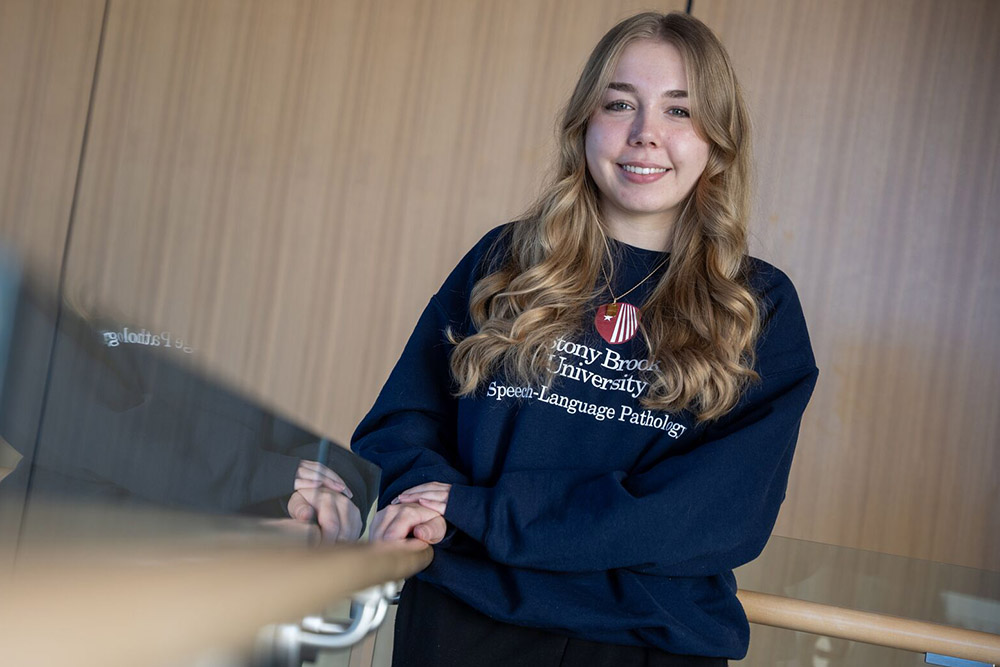
During Bedoya’s undergraduate years at SUNY New Paltz, where she majored in communication disorders with a minor in deaf studies, she began to articulate her academic goals more clearly. Her work in undergrad allowed her to connect classroom research with her major coursework and reinforced her interest in advocacy and culturally informed care.
When entering graduate school at Stony Brook, Bedoya’s career path took a slight turn.
“I think when I came into grad school, I thought I wanted to work with kids,” she said. “But after the observations I made and having that hands-on experience, I’ve wanted to look more into the medical side.”
One of the defining aspects of the Speech-Language Pathology program at Southampton is its early clinical exposure. Bedoya began clinical observations in her first semester, rotating through a variety of settings, including Stony Brook Southampton Hospital, an autism disorders clinic and a preschool placement. She noted that being able to observe across medical, educational and clinical environments so early in the program was especially meaningful.
“The experience that I’ve gained has been really big for me,” she said, particularly compared to her peers at other programs who must wait longer to begin clinical work.
Her time spent at Southampton Hospital, in particular, helped clarify her evolving interests. Observing swallowing evaluations for patients with traumatic brain injuries highlighted the breadth of the profession.
“I don’t think people realize how much speech-language pathologists can do,” she said.
Beyond academics, Bedoya is deeply involved in campus life as a Student Life assistant, a role that allows her to live on campus while supporting residential students through programming, event coordination and leadership. Being in a commuter-heavy campus environment, she saw the position as an opportunity to build community for both herself and others.
“I initially didn’t know anyone on Southampton campus,” she said, noting that working in Student Life has helped to bridge that gap.
Balancing graduate coursework, clinical placements and administrative responsibilities has been challenging, but Bedoya credits the campus environment for helping her to grow more confident in herself and her abilities.
“My confidence in myself and pushing myself out of my comfort zone has grown from the challenges,” she said.
She also emphasized the importance of support systems, pointing to her cohort, suitemates and faculty as key resources. “If I ever have an issue or concern, I can always go to faculty to express that,” she said. “They’re always open-minded and there for all of us.”
Bedoya specifically highlighted faculty leaders Renee Fabus, chair and program director, and Joy Kling, director of clinical education, as well as Interim Director for Student Life Richard Czyzyk, for their mentorship and support. She noted that efforts to strengthen connections between the Southampton campus and Stony Brook’s main campus have helped her feel more integrated within the larger university community.
Looking ahead, Bedoya hopes to pursue a career on the medical side of speech-language pathology, with a long-term goal of opening her own private practice.
“I’m going to learn so much more after I graduate,” she said, “but I do think that my experiences now are forging my future.”
Ankita Nagpal: Finding Her Voice
When Ankita Nagpal boarded a flight from India to the United States, she brought with her a passion for writing and a sense that she needed time and community to grow into the writer she hoped to become.
She had never been to the United States. She had never visited Stony Brook University, yet she had decided Stony Brook was the place where she would commit to the work of writing and grow as a writer.
Nagpal is now a third-year student in Stony Brook University’s MFA in Creative Writing and Literature program. She lives in Brooklyn with her husband and spends much of her week on the
university’s Southampton and Manhattan campuses for her classes in creative writing,
and the Stony Brook campus for her assignments as a teaching assistant for the BFA
program. Nagpal was born in a small village in India and completed an undergraduate
degree in telecommunications engineering at the University of Mumbai. Writing had
always been present in her life, but the idea of pursuing it felt unreachable due
to the expectations surrounding her.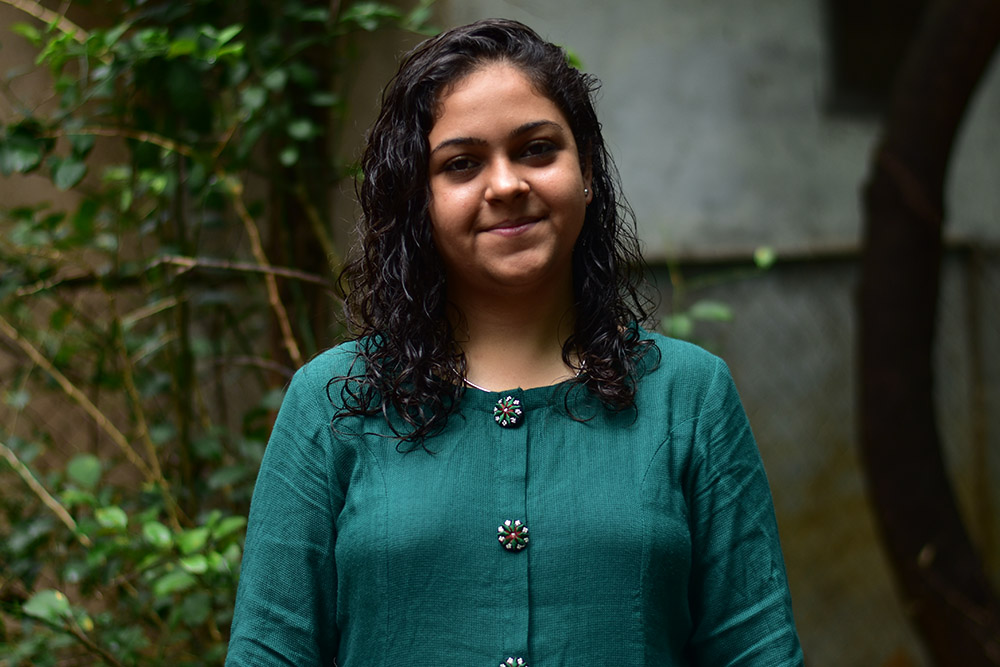
“There is this pressure to pursue a practical career,” she said. “You choose a STEM field because it pays the bills. That is one of the reasons that I went to school for engineering.”
After graduating, she spent six years moving through different fields. She worked as a content curator with TEDxGateway, and shifted into Java development at the Bombay Stock Exchange, writing trading algorithms for private clients. She completed a diploma in astronomy and astrophysics, and later worked in content marketing, eventually leading a team.
During those years she gained professional experience and a clearer understanding of what she was missing. “I listened to myself,” she said. “I thought, okay, it has to be writing.”
She began preparing applications for creative writing programs in the United States, the United Kingdom and Canada. She read the work of faculty members from thousands of miles away and tried to determine which voices aligned best with her own.
A conversation with former MFA Program Director Molly Gaudry, who was leading the program at the time, became a pivot point. “She was one of the few who was being honest with me,” Nagpal said. “She said this is a program for people who are serious about writing. It is not for you if you want to come here and party and have fun. You have to care about your work.”
That honesty mattered, as did the program’s structure. Stony Brook’s MFA is multidisciplinary and allows students to take classes across fiction, nonfiction and poetry. “The program’s ideology is that each genre informs the other,” she said. “Something that I learned in poetry would change how I write fiction. That kind of flexibility and generosity made me choose Stony Brook.”
She credits several of the faculty who have shaped her writing, including Amy Hempel, Susan Scarf Merrell, Molly Gaudry, Karen Bender and Julie Sheehan. She described discovering their work while still in India and feeling a connection across distance. She also noted the impact of Robert Lopez, whose classes in Manhattan often become social gathering opportunities for students who stay after class to talk about writing or meet for dinner or drinks nearby.
While creative writing programs can often carry reputations for competitiveness, Nagpal said that her experience at Stony Brook has been the opposite.
“I’ve often heard that in some programs peers will give unhelpful feedback, or misinform each other,” she said. “That is not something that I have ever seen happen here. There is so much community, and groundedness.”
Her cohort is spread across workshops, literature courses and required practicums. Students cross paths in Southampton, Manhattan and Stony Brook. They attend Writers Speak events and meet peers from the film and television program.
“One of my classmates officiated my wedding,” she said. “Everyone is very thoughtful and kind. It sounds unreal, but I think this is one of the few programs that has such a supportive environment.”
Nagpal entered the MFA as someone without formal academic training in writing, and said the program reshaped nearly every part of her process. She now thinks more about character development, structure, rhythm and how each sentence carries meaning.
“I went from being a genre writer to a literary writer, focusing more on characters and on plot,” she said. “My sentences are more rhythmic. I am drawn to experimental, surrealist writing and the program is pulling me back to poetry. That would not have happened in a single-track MFA.”
Her growth has been influenced by her work as a communications assistant at Stony Brook’s AI Innovation Institute. She also recently finished the first draft of her novel, which draws from family history and blends fiction, memoir and prose poetry.
Nagpal describes her time at Stony Brook as demanding but transformative.
“So much of my writing has changed,” she said. “This program has given me space to grow into the person that I had hoped to be.”
Rocco Maner: From Shark Week to SoMAS
Growing up on the shores of the St. Lawrence River in Alexandria Bay, near the Thousand Islands border crossing of Canada and the United States, Anthony ‘Rocco’ Maner is no stranger to life in a water town. Watching Shark Week and the Discovery Channel during those formative years, he was further mesmerized by how amazing the underwater world looked through a SCUBA diver’s perspective.
Now, as a Marine Sciences major in the School of Marine and Atmospheric Sciences (SoMAS), Maner gets to explore that world in an experiential way every day.
“I have been interested in marine science since I was very little,” said Maner. “Getting
to experience that first-hand had long been a goal of mine.”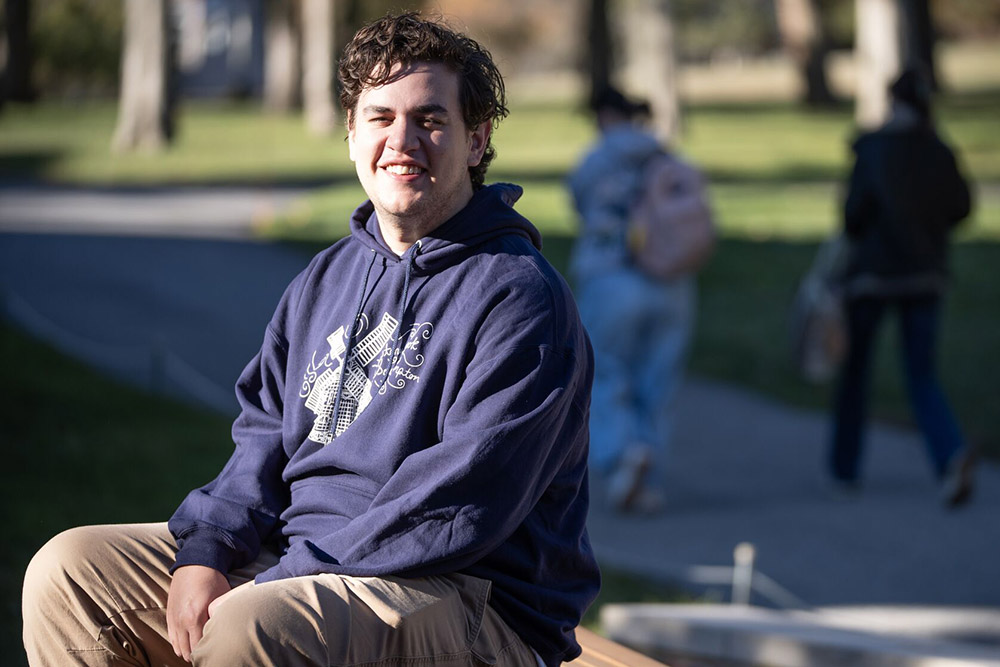
Maner said his favorite classes have been Marine Apex Predators: Ecology and Conservation (MAR 373) and Ichthyology (MAR 380).
“Both classes went into great detail about the biology/ecology of fish and marine mammals as well as how important conservation efforts are to protecting these incredibly important marine species,” he said.
Maner credits Kurt Bretsch, advanced senior lecturer, SoMAS, with playing a huge part in helping me learn more about marine sciences as a field and how integral conservation is to the work marine scientists do, and Richard Czyzyk, interim director for student life at Stony Brook Southampton, for motivating him to contribute to making the Southampton campus better for residents and commuters alike.
"We’re glad to have Rocco continue at the Southampton campus this spring as a Semester by the Sea student,” said Bretsch. “His high level of engagement in his classes, leadership and contributions to student programming as an RA, and service on the Student Advisory Committee are valued by all."
“Rocco shines as a residential student leader while supporting students across our communities,” said Czyzyk. “He brings a genuine passion to the RA role that inspires others to get involved in campus programming and to find their sense of belonging, both as a Seawolf on the land at Stony Brook and by the sea in Southampton. He’s a constant, positive reminder of why I show up each day ready to serve the students of Stony Brook University.”
Czyzyk specifically cited Maner’s motivation to connect others to the Seawolf traditions.
“Under his leadership, he and others will participate in this year's annual Roth Regatta to represent the very best of what our Southampton campus has to offer,” added Czyzyk. “I'm looking forward to seeing him and the students shine at this annual event.”
Outside of his studies, Maner enjoys hiking, fishing and occasionally spending time playing his favorite video games, and is thrilled to have found a welcoming home for his studies in Southampton.
“Southampton is definitely a unique environment within the Stony Brook world,” he said. “It’s so much smaller than the main campus and the community is very close-knit. Also, I love how naturalistic Southampton campus is. It’s a breath of fresh air.”
Maner hopes to further explore the field of marine conservation in the semesters ahead. He also encourage students to considering Stony Brook Southampton as an option.
“It has been an amazing experience that I am so grateful to have, especially as a Marine Science student,” said Maner. “Student life and my major have made it well worth it.”
— Robert Emproto