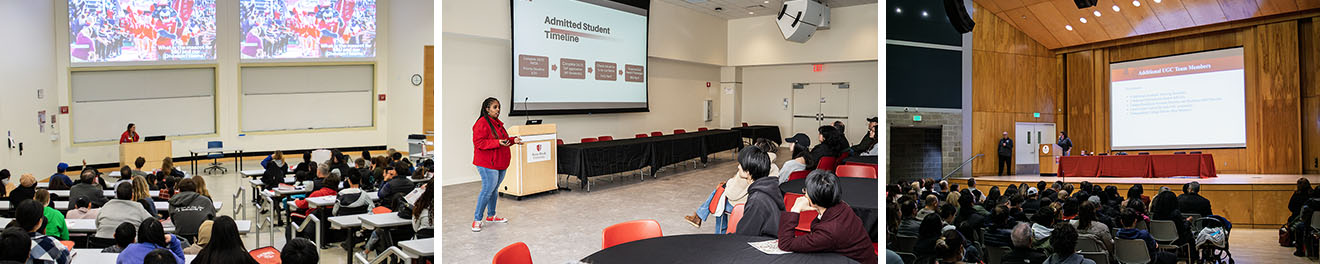
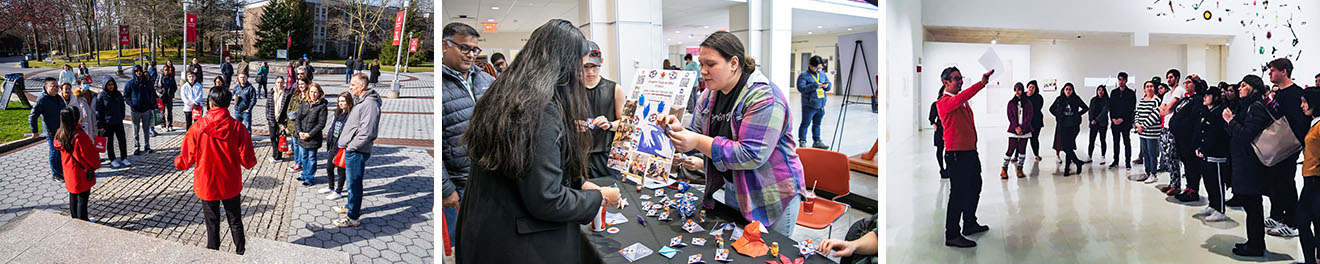
Campus Tours (tours will be available starting at 12 pm)
Student tour guides will walk you around our picturesque campus.
Tour residential communities and learn about our housing options.
Financial Aid Walk-In Questions (available starting at 12 pm)
Speak with members of our Financial Aid team.
Take a tour of our creative facilities, including ceramic, sculpture, printmaking,
lithography, painting, photo darkrooms, lighting studios, digital classrooms and our
new Future Histories Studio. We will also tour current studio exhibitions and installations.
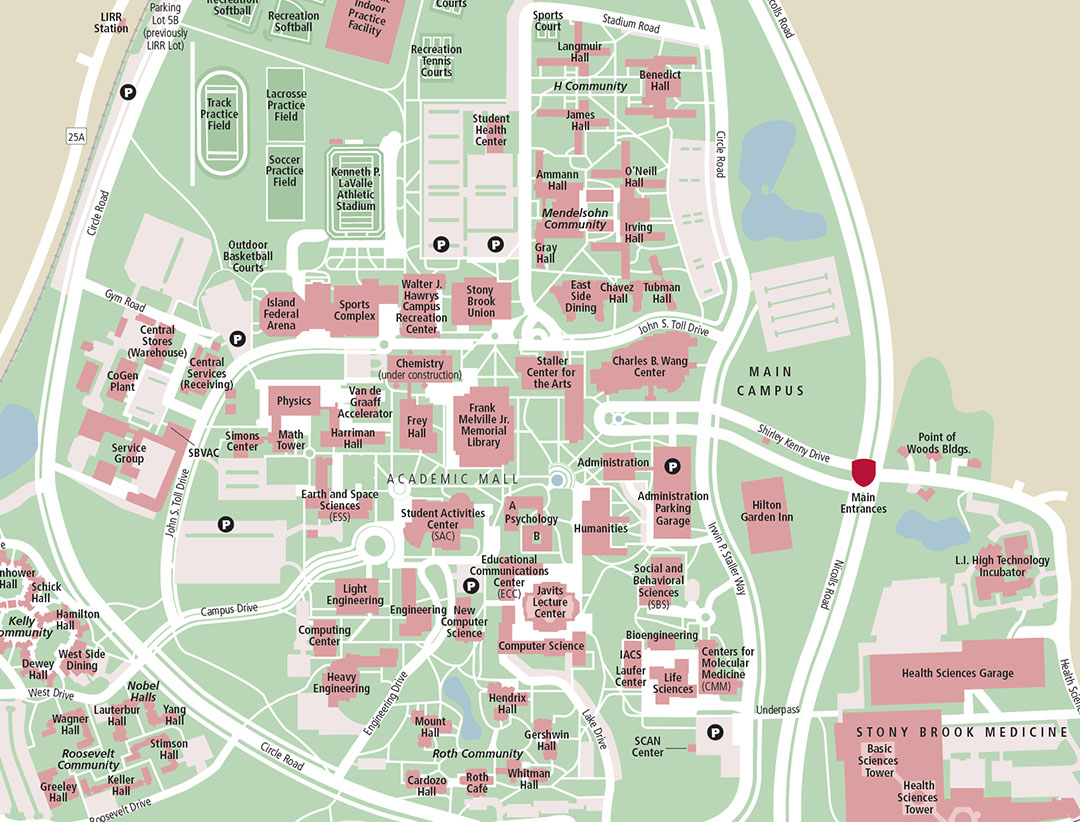
Meet up in the Staller Center Lobby in front of the Paul W. Zuccaire Gallery, tours
begin on the hour at 1 & 2 PM.
An opportunity to explore the Undergraduate Instructional Laboratories in the Centers
for Molecular Medicine. These tours will be hosted by faculty members from the Life
Sciences Departments and feature current student perspectives, including the opportunity
to speak directly with students involved in undergraduate research. Tours will be
ongoing from 1 - 3 PM.
See the original instrument with which MRI was developed. See the laboratories where
chemistry lab courses are taught. Tour led by chemistry faculty. Tours will be ongoing
from 1 - 3 PM.
Tour the Vibrational Spectroscopy Laboratory in the Department of Geosciences and
learn how we use a variety of scientific instruments to learn about extraterrestrial
samples from the Moon, Mars, and asteroids. The lab tour will include descriptions
of the techniques we use to study samples of other planets and what we can learn from
the analyses. Admitted students will also have the opportunity to touch a piece of
the Moon! Each tour should last roughly 20-25 minutes and will begin every half hour
starting at 1pm and ending at 3pm.
Join us for a virtual tour of the Turkana Basin Institute two state-of-the-art facilities
in NW Kenya where Seawolves train in field sciences related to human origins. Learn
about our semester and summer abroad programs, faculty and student projects, what
it's like to live at research bases in Africa, and how you can get involved. Tours
begin on the hour at 1 & 2 PM.
Explore the Frank Melville Jr. Memorial Library, Stony Brook's main library and a
hub for academic resources and student services. Learn about our extensive collections,
specialized databases, research assistance, collaborative study spaces, and technology
services designed to support student success.
Music Tour (1 pm & 2 pm only)
Our Music department is home to a number of student groups, including the University
Orchestra, the Stony Brook marching bands, jazz ensembles, and the Stony Brook Chorale,
as well as offering individual instrumental and voice lessons, several minors, and
the possibility for double majors. Students will see several spaces in the Music Building,
including a performance/rehearsal space, the Percussion studio, a sample teaching
studio. Each tour should last about 20 minutes. Meet up at the Wang Center Welcome
Table, tours begin on the hour at 1 & 2 PM.
Self guided tour of the gallery from 1 - 3 PM. Graduate MFA thesis exhibition will
be on view.
Physics & Astronomy Lab Tours
Faculty and students will be available to discuss our undergraduate program. Lab tours
will be conducted in various labs. Students can sign up for the lab tours in the Physics
building's main lobby. Attendees can also participate in an astronomy simulation or
telescope tour.
School of Communication and Journalism Tour (starts at 2:30 pm)
Tour SoCJ state-of-the-art facilities, including multimedia newsrooms, broadcast studios,
and editing suites. Meet at the SoCJ information table at 2:30 pm if you are interested
in attending.
School of Health Professions Open Labs (starts at 2 pm)
Tour the School of Health Professions' specialized laboratories and simulation facilities
where students develop clinical skills in realistic healthcare environments.
Visit the UNITI Cultural Center, a vibrant hub for promoting diversity, equity, and
inclusion on campus. Learn about multicultural programs, leadership development opportunities,
and community-building initiatives that celebrate the rich diversity of the Stony
Brook community and foster a sense of belonging for all students.
College of Engineering and Applied Sciences: Open Labs (starts at 1:30 pm)
Explore hands-on learning opportunities and specialized equipment used for Chemical & Molecular Engineering students in their unit operations laboratory sequence. This space introduces students
to essential industry practices by operating units such as pumps, fluidized beds,
and heat exchangers. Students also gain practical experience performing reactions
vital to the food and biotechnology industries.
Secure IoT Embedded Systems and Digital Systems Prototyping Lab
Explore hands-on learning opportunities and specialized equipment used for Electrical Engineering and Computer Engineering students focusing on secure interconnectivity and device prototyping. Within this
space, upper-division students program FPGAs to solve complex problems where standard
microcontrollers fall short. The lab provides critical experience in digital systems
at the register transfer level using tools like VHDL and PLDs.
Embedded Systems Design Lab
Explore hands-on learning opportunities and specialized equipment used for Electrical Engineering and Computer Engineering students to build complex systems around microcontrollers. Throughout their coursework,
students learn to interface with a variety of input and output devices, ranging from
simple switches to advanced environmental sensors. These skills culminate in practical
final projects such as custom HVAC interfaces, data loggers, and digital guitar tuners.
Explore hands-on learning opportunities and specialized equipment used for Electrical Engineering and Computer Engineering students to design, build, and analyze analog electronic circuits. Each dedicated
station is fully equipped with digital storage oscilloscopes, signal generators, and
soldering tools for comprehensive testing. Students utilize this space throughout
their academic journey, starting with simple digital clocks and advancing to complex
analog circuit topologies.
Explore hands-on learning opportunities and specialized equipment used for Biomedical Engineering students across all three program specializations. The facility supports wet labs
for cellular studies, biomechanical testing of biological tissues, and electrical
circuitry analysis for bioimaging. Additionally, students develop vital innovation
and prototyping skills utilizing 3D design software, 3D printers, and microcontrollers.
Construction & Geotechnical Materials Characterization Laboratory
Explore hands-on learning opportunities and specialized equipment used for Civil Engineering and Engineering Science students to evaluate construction materials and soils. Students conduct industry-standard
tests to measure the load capacity of structural elements made from steel, wood, and
reinforced concrete. The laboratory also introduces essential geotechnical techniques
used to characterize ground composition for designing safe foundations and tunnels.
Coastal & Hydraulic Engineering Research Laboratory
Explore hands-on learning opportunities and specialized equipment used for Civil Engineering and Engineering Science students studying fluid mechanics and hydraulics. The facility highlights a state-of-the-art,
80-foot combined wave and bi-directional current flume used to simulate real-world
coastal phenomena. This advanced instrumentation supports critical experiments focused
on coastal structures, beach morphology, and marine renewable energy harvesting.
Explore hands-on learning opportunities and specialized equipment available to all engineering majors for bringing personal designs and class projects to life. This collaborative maker
space is fully stocked with 3D printers, electronics workstations, a Cricut Maker
3, and a comprehensive build area. Students can attend training workshops to gain
the confidence needed to safely operate the machinery and finalize their prototypes.
Explore hands-on learning opportunities and specialized equipment used for Civil Engineering, Engineering Science, and Mechanical Engineering students to master fundamental fabrication practices. Through dedicated coursework,
students gain practical experience in sheet metal working, drilling, turning, milling,
and welding by machining their own projects from raw materials. Once trained, students
can return to this shop to independently fabricate custom parts for their culminating
Senior Design projects.
Mechanical Engineering Manufacturing Lab
Explore hands-on learning opportunities and specialized equipment used for Mechanical Engineering students to bridge the gap between theoretical design and real-world feasibility.
The lab features both subtractive CNC milling systems and additive FDM manufacturing
techniques so students can directly produce their own custom parts. Participants also
employ basic metrology techniques to evaluate the accuracy of their creations and
the efficacy of different manufacturing processes.
Center for Thermal Spray Research
Explore hands-on learning opportunities and specialized equipment used for Engineering Science students to study the fundamentals of thermal spray materials and technology. This
facility, established through a major National Science Foundation grant, has enabled
significant breakthroughs in materials science and engineering processes. Students
can investigate the mechanics of layered structures and hybrid architectures that
combine ceramics, metals, and polymers for advanced durability and unique functionalities.
Interacting Robotic Systems Lab
Explore hands-on learning opportunities and specialized equipment used for Computer Science and Computer Engineering students to pursue the creation of intelligent robotic systems. The facility features
multiple mobile robot platforms and state-of-the-art manipulators used to research
physical interaction between agents, objects, and humans. Students investigate advanced
projects ranging from sensor-based grasp planning and dexterous robot design to VR-based
interactive guidance and multi-robot coordination for search and rescue operations.