SBU-led Paper in Nature Explores the Stability of Quantum Systems
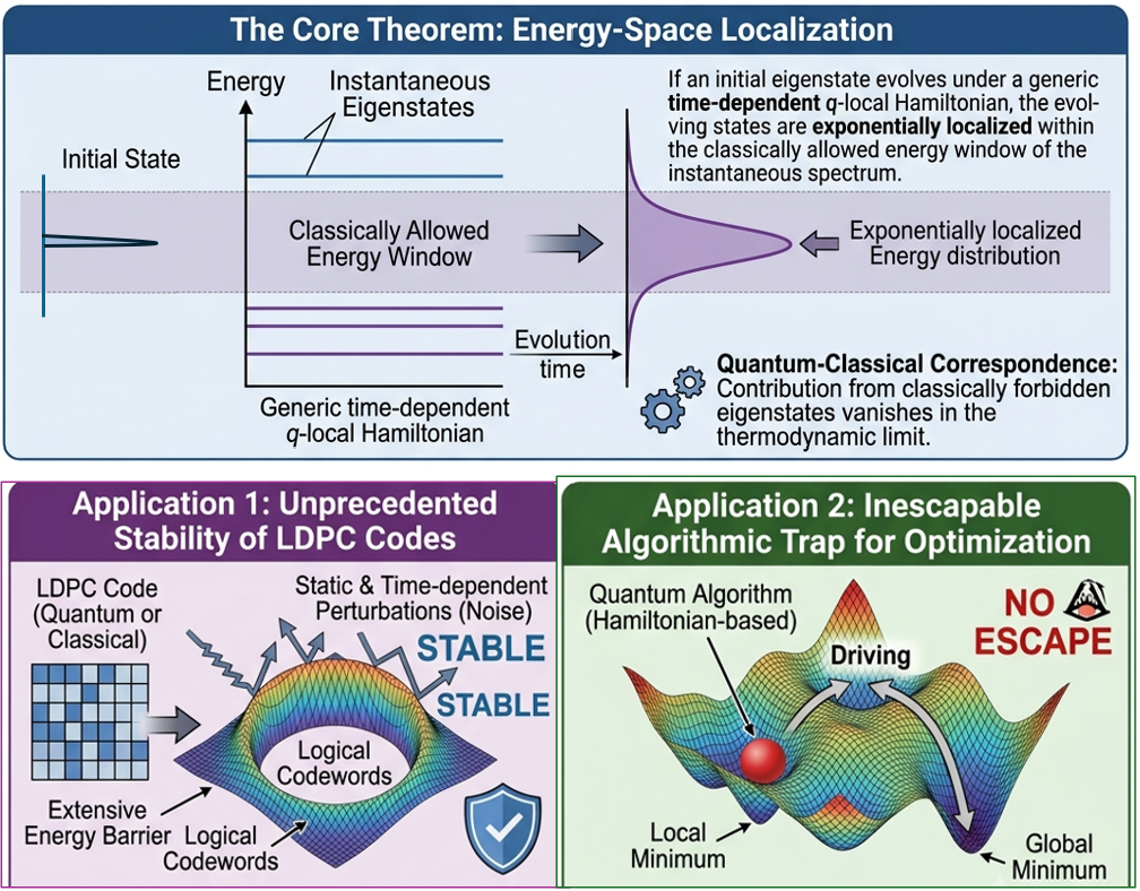
A new study led by Stony Brook University researchers Tzu-Chieh Wei and Hongye Yu and published in Nature Communications, “Universal energy-space localization and stable quantum phases against time-dependent perturbations,” offers a striking new perspective on the stability of quantum systems. The researchers demonstrate a universal phenomenon known as energy-space localization, showing that certain quantum systems can remain remarkably close to their original state even when subjected to disturbances that change continuously over time.
The work addresses a longstanding challenge in quantum physics: while stability against fixed, static perturbations is relatively well understood, determining whether quantum systems can withstand general time-dependent disturbances has proven considerably more difficult. The researchers’ results establish that, for systems with sufficiently large energy barriers, quantum states can remain localized for exponentially long periods despite these changing perturbations.
The findings have important implications for both quantum information and computation. In particular, the study demonstrates how this stability can help protect quantum information encoded in certain low-density parity-check (LDPC) error-correcting codes, potentially providing valuable insight into how quantum systems can withstand realistic, time-varying noise.
At the same time, the remarkable stability revealed by the work presents an intriguing paradox: what protects quantum information can also hinder quantum optimization. In some computational problems, large energy barriers can trap a quantum system near a suboptimal solution, preventing it from reaching better ones.
By connecting quantum dynamics, error correction, and computational complexity, this elegant theoretical work provides a powerful new framework for understanding—and ultimately harnessing—the extraordinary stability of quantum systems.