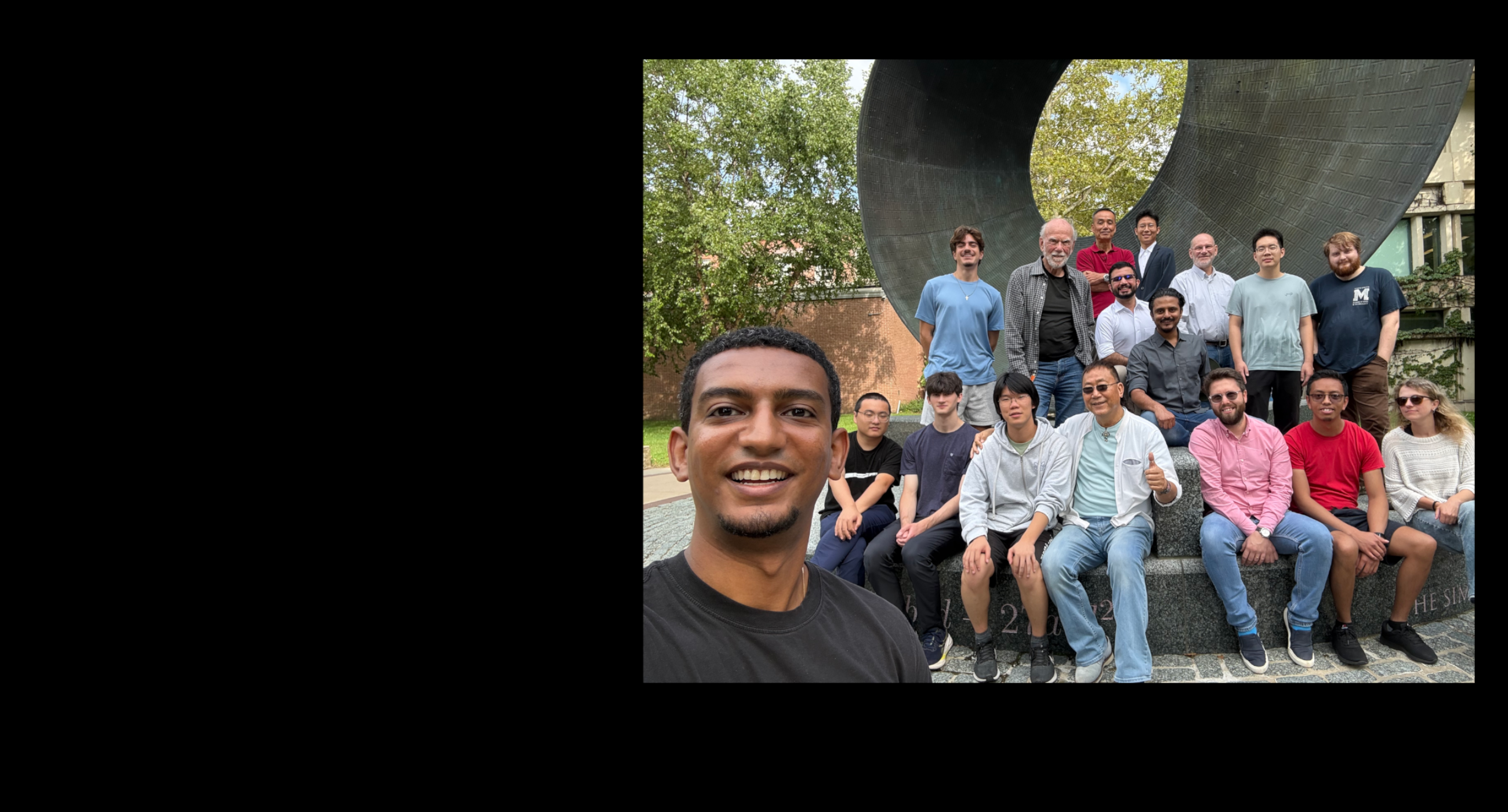
The Neutrino and Nucleon decay (NN) Group at Stony Brook University was founded on
Prof. Jung's DOE Outstanding Junior Investigator award in 1991. It pursues two intertwined
scientific objectives: the discovery of rare phenomena in the neutrino sector and
precision measurement of the parameters that govern neutrino oscillations. More specifically,
the group aims to characterize the lepton mixing matrix, measure the CP-violating
phase, determine the neutrino mass ordering, and search for proton decay and supernova
neutrino bursts. These goals sit at the frontier of particle and astroparticle physics
because answering them could reveal why the universe contains more matter than antimatter
and test the Standard Model at its deepest level.
The group's primary current experiment is T2K (Tokai-to-Kamioka), a long-baseline
neutrino oscillation experiment in Japan with a 295 km baseline between J-PARC and
the Super-Kamiokande far detector. T2K measures muon (anti-)neutrino disappearance
and electron (anti-)neutrino appearance. The group has been involved in T2K from its
inception, contributing to detector design, beamline and flux prediction, event selection,
and oscillation analysis. The group played a leading role in the upgrade of the T2K
near detector ND280, centered on the novel Super Fine-Grained Detector (SuperFGD).
This technology provides unprecedented granularity for tracking and vertex reconstruction.
Beyond the detector hardware, SBU members lead event selection development for the
upgraded ND280, and work on detector calibration and systematic uncertainties. A particular
focus is the first measurement of outgoing neutron kinematics from neutrino interactions
in the relevant energy range, a capability unique to the SuperFGD that will substantially
improve neutrino energy reconstruction. The group also participates in joint analyses
combining T2K data with those of NOνA (Fermilab) and Super-Kamiokande, exploiting
the complementary characteristics of each experiment to extract oscillation parameters
with greater precision than any single experiment can achieve independently.
Looking to the next generation, the group is a member of the Deep Underground Neutrino
Experiment (DUNE), a flagship international project with a near detector at Fermilab
(Illinois) and far detectors 1,300 km away at the Sanford Underground Research Facility
(South Dakota). DUNE will study an intense neutrino beam across this baseline for
approximately 20 years, with primary goals of definitively measuring the CP-violating
phase, determining the neutrino mass ordering, and searching for nucleon decay with
sensitivity well beyond current limits. Over 1,000 collaborators worldwide are involved.
The NN Group contributes to ProtoDUNE, the second far-detector module employing a
vertical-drift liquid-argon TPC strategy, and his proposing a novel software framework,
called GUNDAM, for its oscillation analysis.
The group has a long history in large-scale neutrino and nucleon-decay experiments.
It contributed to Super-Kamiokande, the 50 kton water Cherenkov detector in Japan
that produced the first definitive evidence for atmospheric neutrino oscillation,
and to K2K (KEK-to-Kamioka, 1999-2004), the first accelerator-based experiment to
confirm those oscillations with a controlled beam. Earlier still, the group was engaged
in R&D for major proposals including UNO (Underground Neutrino Observatory), a 650
kton water Cherenkov detector proposed by Prof. Chang Kee Jung that would have been
13 times the volume of Super-Kamiokande, and the CAPTAIN program, which measured neutron
cross-sections on liquid argon relevant to future LArTPC detectors.