


NN group is heavily involved in the Tokai to Kamioka (T2K) experiment, one of the flagship current-generation neutrino oscillation experiments. T2K is a long-baseline accelerator neutrino oscillation experiment located between Tokai and Kamioka, Japan with a baseline of 295km. Its experimental goal is to discern neutrino oscillation parameters (δCP, θ23, Δm²23) with 2.5 degree off-axis measurement of an accelerator-produced muon-neutrino beam. Neutrino beam is produced from high-energy protons using the J-PARC proton accelerator. It is detected by the near detector 280m downstream from the beamline (creatively named ND280) and measured again by the far detector, Super-Kamiokande. Neutrino oscillation parameters can be extracted from an analysis of event rates at the far detector. Click here to see an interesting video about the T2K Experiment.
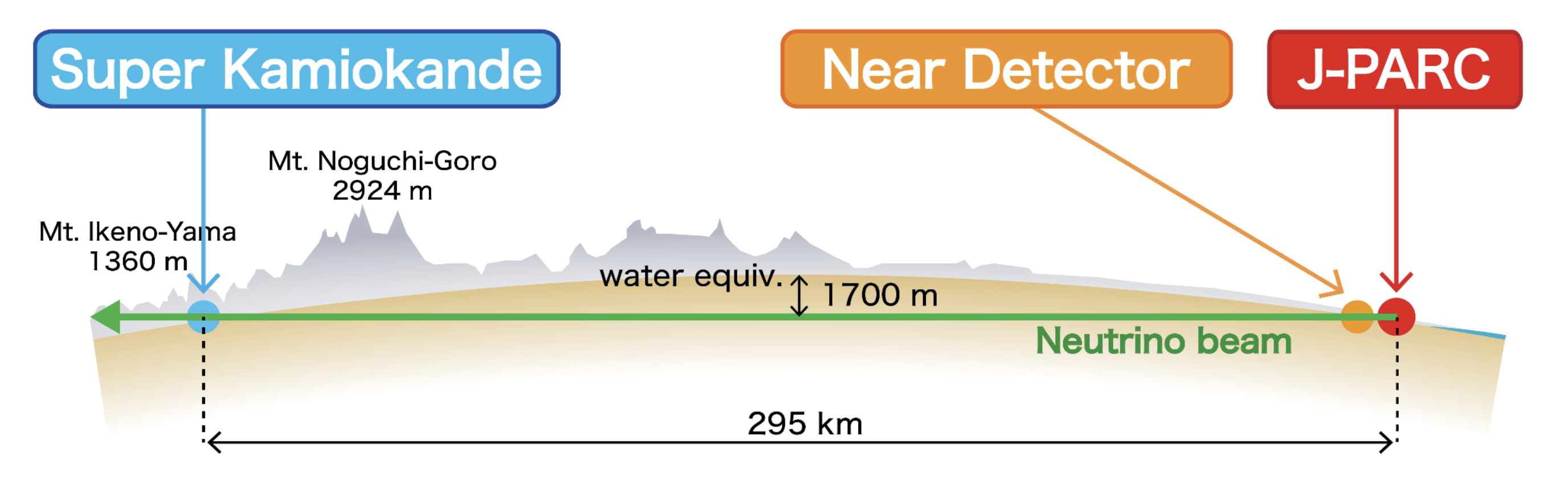
T2K is responsible for some of the most precise measurements of oscillation parameters. The latest analysis, published in [1], rejects CP conserving values of δCP at above 90% significance.
![χ2 profile for various CP values from latest T2K result. Shaded regions correspond to the Feldman-Cousin corrected confidence intervals. [1]](/physics/_images/nngroup/chi2valuesforvariousdeltacp.png "χ2 profile for various CP values from latest T2K result. Shaded regions correspond to the Feldman-Cousin corrected confidence intervals. [1]")
[Figure: χ² profile for various values of δCP from latest T2K result. Shaded regions correspond to the Feldman-Cousins corrected confidence intervals. [1]]
Historically, NNGroup has been heavily involved in every aspect of T2K since its inception. We have worked on the detector design, beamline and target design, flux prediction, event selection and oscillation analysis, both T2K standalone and with other experiments. Our group members who work on T2K have experiences in many parts of the experiment, and we welcome the academic freedom in choosing new research directions. Below, we will share some of the current work we are carrying out.
ND280 Upgrade
Stony Brook played a major role in the upgrade of the near detector ND280 for T2K. Specifically, we have been involved in the design, installation and commissioning of the novel 3D readout scintillator detector SuperFGD. SuperFGD is an active neutrino target made up of 2 million 1cm³ scintillator cubes crossed by wavelength-shifting fibers from all 3 dimensions. The fibers are read out by some 50 thousand Silicon PhotoMultipliers to reconstruct neutrino interaction tracks. Fiber readout of scintillator light enables high spatial and time resolution for neutrino kinematics studies. This design significantly increases efficiency for proton tracking at lower momentum. For the first time, SuperFGD also enables us to reconstruct outgoing neutron kinematics on an event-by-event basis.
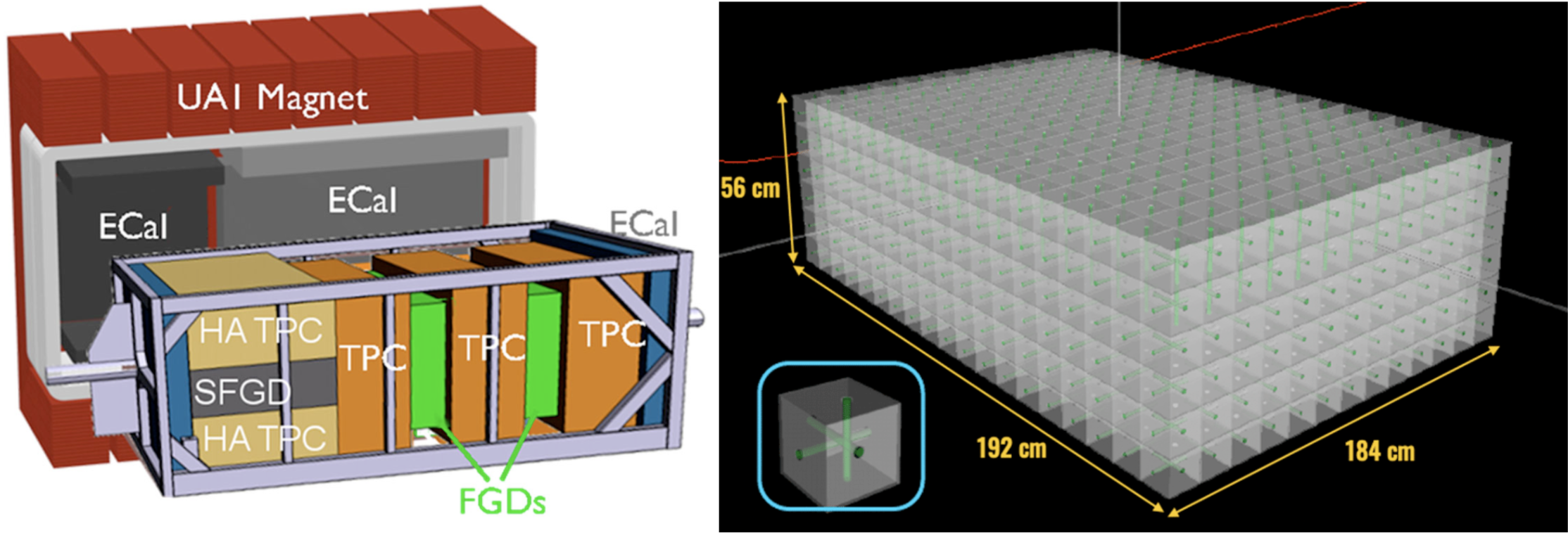
[Figure: Left: Upgraded ND280 Geometry. Right: SuperFGD Schematics]
NN group contributed towards the installation of SuperFGD between 2022-2024, sending many of its members to Tokai to install the detector on-site. We also play a major role in the operation and calibration of the detector. The following photo was taken in 2023 in Tokai, Ibaraki showing many NN group members and T2K collaborators with the assembled SuperFGD.
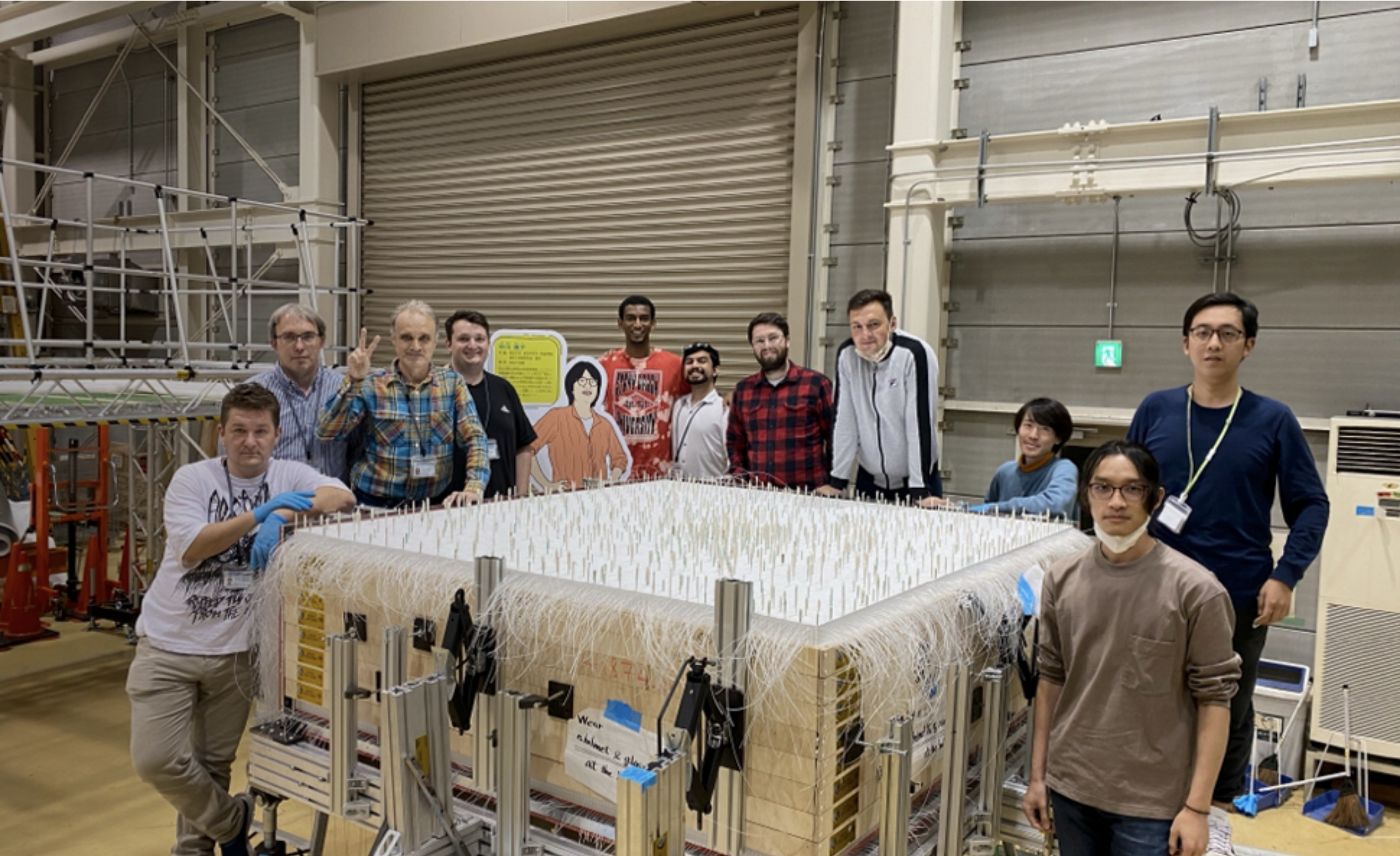
[Figure: The SuperFGD assembly team in Tokai, including NNGroup members]
Members of the group have the opportunity to operate, maintain and analyze data from the SuperFGD. Several of our members are detector experts and work on low-level analysis of SuperFGD data such as calibration and track reconstruction. The SuperFGD is at a crucial point where first data results are being prepared, and we welcome contributions to this effort.
Near Detector Analysis
Typically, NDs in neutrino oscillation experiments are used to constrain the systematic parameters for the FDs and perform cross-section studies. This makes it very important to develop neutrino selections for ND samples. Currently, Stony Brook members play major roles in sample development for the upgraded ND280. Our group is active in the development of new ND selections taking advantage of the SuperFGD detector.
One of the most interesting works we are doing is neutron selection. Low energy protons produced by neutron secondary interactions can be accurately tagged by SuperFGD, enabling us to probe into the kinematics of outgoing neutrons from neutrino interaction. This would be the first time neutron kinematics are studied at this energy range. It will have a profound impact on neutrino energy reconstruction, one of the fundamental limiting factors to neutrino oscillation studies to date.
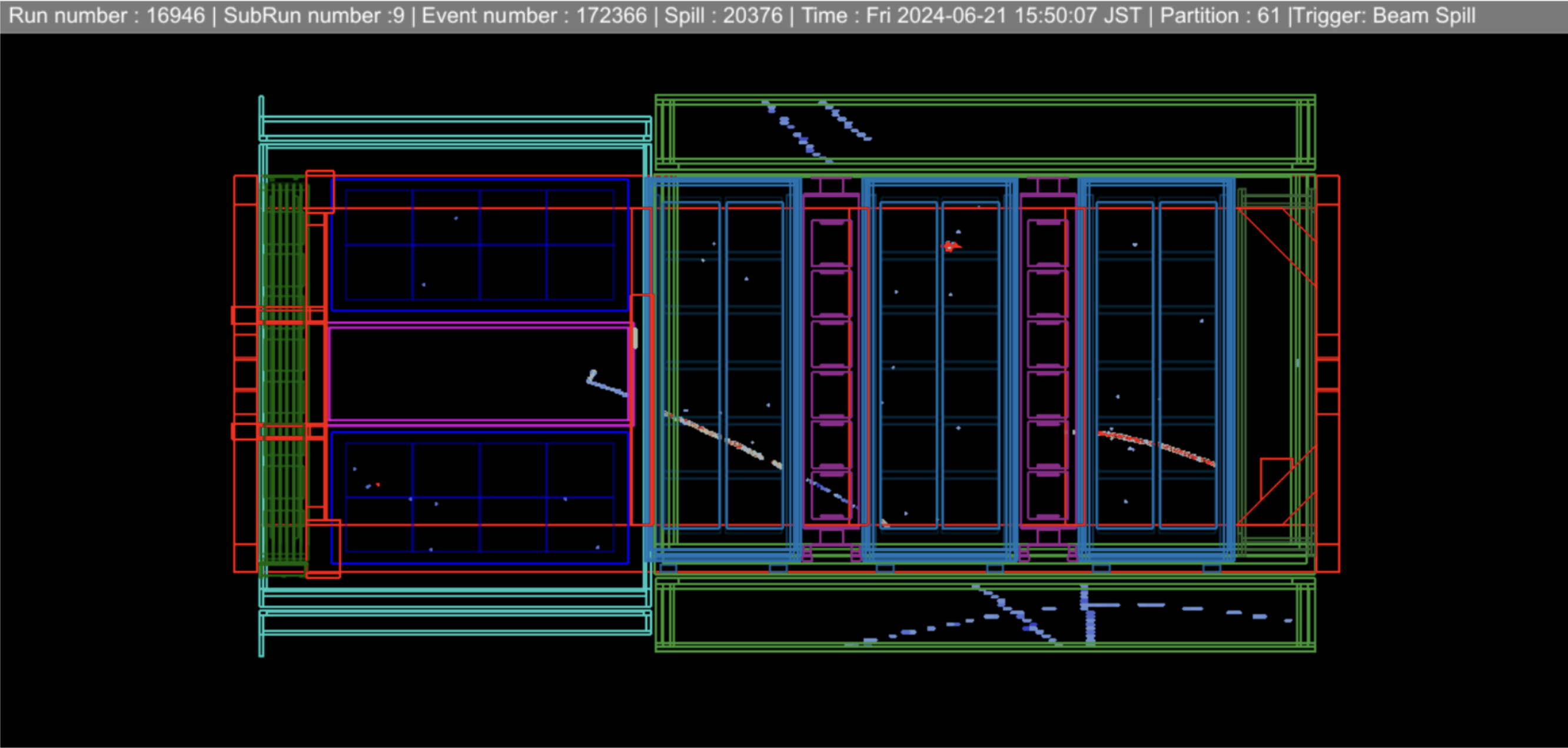
[Figure: Upgrade ND280 event display showing a neutrino interaction candidate inside SuperFGD]
NN group members also lead the effort for other ND selections at T2K, including CC-inclusive, and are actively developing detector systematic uncertainties for the upgrade.
Combined Analyses with Other Experiments
NN group also participates in combined neutrino analyses between T2K and 2 other flagship experiments: NOνA at FermiLab and Super-Kamiokande. Joint data analyses take advantage of the peculiarities of both experiments to extract oscillation parameters more precisely than each individual experiment can achieve. The results of the first round of combined analyses with Super-K are published in [2].
![Credible Region of sin^2theta23 and delta_CP with different datasets in the SuperK-T2K Joint Analysis, figure taken from [2]](/physics/_images/nngroup/sindelta.png)
[Figure: Credible Region of sin²θ23 and δCP with different datasets in the SuperK-T2K Joint Analysis, figure taken from [2]]
The joint analysis with Super-K will combine the accelerator neutrino dataset from T2K and atmospheric neutrino dataset at Super-K. Due to the similarity in neutrino interaction models, and the fact that both experiments use the same detector, the combined analysis can reduce the cross-section and detector systematics to a level not achievable by naively combining datasets from individual experiments. Historically, NNGroup has been particularly active on the combined analysis with Super-K, and we welcome new contributions going forward.
The joint analysis with NOνA is another area our group has explored. T2K and NOνA are the only 2 active long-baseline neutrino experiments. NOνA’s 2GeV neutrino beam is produced at Fermilab, Chicago and is delivered to the far detector in Minnesota 810 km away. The higher beam energy and longer baseline means NOνA has a stronger ability to constrain mass ordering. The joint fit combines analysis tools from both experiments into a unified framework to correlate systematics and unify interaction models wherever possible. Results from the first analysis have been announced by KEK and FermiLab separately in Feb 2024.
Development of New Fitting Tools
New fitters are being developed to accommodate the ever-growing need for neutrino oscillation analysis, which involves fitting hundreds of parameters across many data samples. NNGroup is working on one such tool called GUNDAM. GUNDAM is meant as a flexible fitting tool to be employed across many future neutrino experiments, and is currently being used for near detector analysis at T2K.
GUNDAM, standing for Generalized and Unified Neutrino Data Analysis Methods, is a suite of applications which aims at performing various statistical analysis with different purposes and setups. It has been developed as a fork of xsllhFitter, in the context of the Upgrade of ND280 for the T2K neutrino experiment. The GUNDAM source code is officially available at the GUNDAM-organization on GitHub.
The applications are configurable with a set of YAML/JSON files (see the configuration documentation) so users do not need to modify the code for each new study. A lot of time and efforts are usually invested by various working groups to debug and optimize pieces of codes doing generic tasks, and GUNDAM lets that work be distributed to all users. GUNDAM is designed for maximum flexibility to accommodate various physics fitting needs and makes sure that optimizations and debugging benefit all analyses.
References
[1] Abe, K., & Others. (6 2025). Results from the T2K experiment on neutrino mixing including a new far detector μ-like sample.
[2] Abe, K., & Others. (2025). First Joint Oscillation Analysis of Super-Kamiokande Atmospheric and T2K Accelerator Neutrino Data. Phys. Rev. Lett., 134(1), 011801. doi:10.1103/PhysRevLett.134.011801