


Pamela A. Pfeil
BA in History to Serving others!
A higher education leader, U.S. Army veteran, and student success advocate, Pamela
is dedicated to fostering connection, purpose, and belonging throughout the college
experience. As Associate Director of Military and Veteran Student Services at Stony
Brook University, Pamela leads initiatives that support military-affiliated students
and promote their academic success, engagement, and overall well-being.
Throughout their career, Pamela has championed student veterans, military-connected
students, and nontraditional learners, recognizing that student success extends beyond
the classroom. Their work emphasizes creating inclusive, supportive environments where
students feel valued and empowered to reach their full potential.
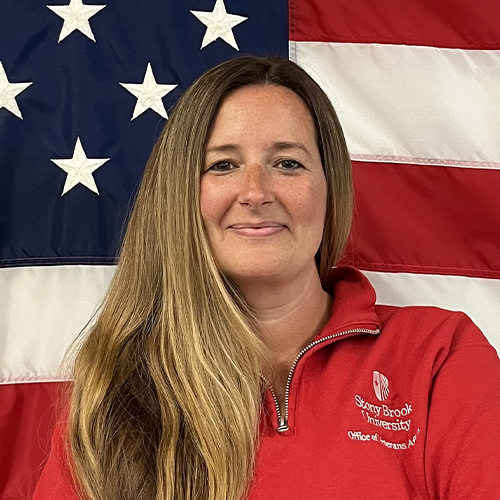
Interview with Pamela A. Pfeil
When you were studying History at Stony Brook, did you have any idea that it would eventually connect to the work you're doing today?
I actually started college as a music performance major. That was the only path I saw my life taking: becoming a music teacher. I never had a Plan B, nor did I ever think it was something I wanted to consider. It was the only thing I ever wanted to do.
During my freshman year at Stony Brook, I was deployed with the Army Bands to Iraq in support of Operation Iraqi Freedom. I was gone for about a year and a half. When I returned to Stony Brook, I was a little lost. I wasn't at a point in my life where I wanted to pick up my instrument every day after having just played so regularly in a combat zone. It was a time in my life when I needed space and time to figure things out.
I ended up dropping that major and doing something I think an undergraduate liberal arts degree is really meant for: exploring who I was beyond this one detail of who I thought I was. I took a lot of different core classes and discovered that I had a strong interest in history. As I explored different subjects, history was what I kept coming back to. Those were the classes I was most drawn to.
I always said that my favorite thing about being an undergraduate was sitting in a great history lecture that felt like watching a documentary. I could take notes for days and just keep learning about the past. At the time, I had no idea how that interest would connect to my future or career. I was still searching for myself and figuring out what my future would look like, and this was just one step in that journey.
Ultimately, getting involved in so many things on campus was where I was really able to find my direction. My higher education experience helped save me when I returned as a combat veteran. It showed me that I could do meaningful work in that space and help others navigate similar transitions.
You’ve had a pretty unconventional path from the military to higher education and now Veteran’s Affairs. Looking back, what has your History degree given you that you didn’t expect?
One of the most valuable things I think a history degree has given me is the ability to navigate the world we live in today. In 2026, we have so much information at our fingertips, but so many people struggle to recognize what is factual and what isn't. I feel like I see that more and more.
Whenever I come across a fact, a tidbit of information, or an article, my very first thought is, "What is the source of this?" For a long time, I didn't realize that not everyone thinks this way, but I think that mindset really comes from having a history degree. You're trained to recognize what solid research looks like and how to evaluate information critically.
The way I've carried that into my everyday life is by asking the people around me. I'll say to my students at work, my kids at home, or my husband, "What's the source?" Okay, you've shared that information with me, but what's the source? So much of that comes from having a history degree and being trained to research, evaluate, and understand information.
You work with students who are navigating some pretty complicated transitions and systems. How has being trained to look at context, understand different perspectives, and piece together a story from evidence shaped the way you do that work?
For me, I feel that, in every part of me, I understand how important the work we do in this office is. Working with military-connected students and student veterans is incredibly meaningful because they bring so much to our college campuses, our classrooms, and our communities. The value and impact they bring are enormous, but they represent a very specific population, especially at a traditional institution like Stony Brook that isn't situated near major military installations.
As the leader of this office, it is my job to tell their story and tell it effectively. I need to help others around me recognize their impact and understand why this work matters. You can't simply walk into a meeting, stand on a table, and shout, "But they're important!" That doesn't accomplish anything. Another example is when people in this line of work say, "Well, it's the right thing to do." That's a lovely sentiment, but it's not the substance of the argument.
I think what I bring to these conversations is data and national trends to support what I'm saying. I've done extensive research, become deeply engaged in the national community, and tried to be a collector of information about this student population. A lot of that comes from my training as a historian. When you can back up what you're saying with solid, credible information, it's much harder for people to dismiss the value of what you're advocating for. You've demonstrated that value and shown them why it matters.
I also love how my history degree prepared me to communicate that information. If you sit down in a meeting and simply present a list of data points and facts, it can be a little boring. But I feel that being a historian has given me the ability to take all of that information, bring it together, and turn it into a story that I can tell. For me, that is one of my greatest assets in this work and a big part of why I've been successful in what I do.
What's changed for you—and for the work you do—since that 2025 profile? What are you working on now that you're particularly excited about?
Right now, I'm working on a really exciting initiative. At a broader level, SUNY has asked all of its campuses to focus on improving retention among next year's first-time, full-time student cohort. This is something Stony Brook is always working toward, but the initiative has given us an opportunity to dedicate additional resources to that effort.
I'm currently serving as the strategic lead for the Student Affairs portion of this campus-wide initiative. One of the really exciting aspects of this work is the opportunity to collaborate across divisions. At a university as large as Stony Brook, we often find ourselves working within our own divisions and the relationships we've established there. This initiative has allowed me to meet and work with so many people I hadn't had the opportunity to collaborate with before. Even after all these years working with student veterans from the U.S. military, I've had very little reason to work with some of our Academic Affairs colleagues, for example. Now, we're working together to think creatively about strategies we can implement to help students succeed.
Although the initial push for this work was focused on retention, what we're really doing is developing strategies for student success. We're looking at how we can make students feel that they belong here and that they have a community at Stony Brook.
It's sometimes counterintuitive, but because Stony Brook is such a large university, it's easy for students to get lost here. How do we make the university feel smaller for them? How do we recognize that many of our students are incredibly academically focused while still helping them feel connected and that they belong? For some students, that connection might not come through traditional social activities, but that doesn't mean we can't find other ways to build a sense of belonging.
We currently have a team working on these strategies, and it's incredibly exciting. These students will be arriving on campus very soon, and we're looking forward to following this cohort throughout their entire first year and seeing how we can build meaningful relationships with them.
You've now been recognized as one of the 40 Under 40. When you think about the student you were at Stony Brook and the professional you've become, what do you think that student would be most surprised to see you doing today?
I feel like questions like this often get thrown around: What would you tell your younger self? What would your younger self think?
My husband and I have collectively experienced our fair share of loss in this life, and, in some unexpected way, that has been a blessing because it has allowed us to recognize just how short life is. You never know what tomorrow will bring, so you need to enjoy the time you have together.
Because of that, I feel like I've put a lot of meaning into everything I do. The work I do is very meaningful to me. It's not driven by tasks or paychecks. Obviously, we all have to work hard to make a living, and that's important, but I continue to serve our country, which has been an anchor throughout my entire adult life. It's something I'm incredibly proud of.
At the same time, we have teenagers, and we make an effort to travel with them, have new experiences, seek out adventures, and try not to take everything too seriously.
When I think about that often-scary world of being an undergraduate, especially as I was transitioning out of a combat zone without really knowing how that experience would translate into the rest of my adult life, I remember how lost so many veterans can feel during that transition. I feel like Stony Brook was a place that really helped ground me. I'm so grateful I found my way back here and that I get to come to campus every day and make this my job.
I think my younger self would feel a tremendous sense of relief knowing how things turned out. And I think she'd be pretty happy to know she's a very happy 40 Under 40 honoree.
When you hear someone say, ‘What can you actually do with a History degree?’—what's your answer?”
I usually tell people that you can pretty much do anything with a history degree, and I really believe that's the case. I don't think that applies only to history degrees, either. Of course, there are people with very specific career goals that require a particular skill set. I don't think I could go directly from earning a bachelor's degree in history to becoming a plumber. I don't think you'd be very happy if I did that! I'd probably need some additional training to make that work, although I might know which sources to turn to for that information.
In general, though, I think a history degree, like many other liberal arts degrees, provides an incredibly valuable foundation. One of the wisest people I know, Mr. John Levy, once told me that a bachelor's degree teaches you how to learn. That's exactly what I think my history degree taught me: how to learn.
I also think it makes you a better citizen of your community and of the world. It helps you become someone who can go out and appreciate the finer things life has to offer. I think so much of that stems from the well-rounded education you're able to receive through a degree like this.