
Brick by Brick: The Future of 3D Concrete Printing
As construction technology continues to evolve, students in the Printing Structures Vertically Integrated Projects (VIP) team at Stony Brook are working at the intersection of materials, mechanics, and automation to build on previous cohorts’ printer development by testing the system and creating sustainable 3D-printable concrete mixtures.
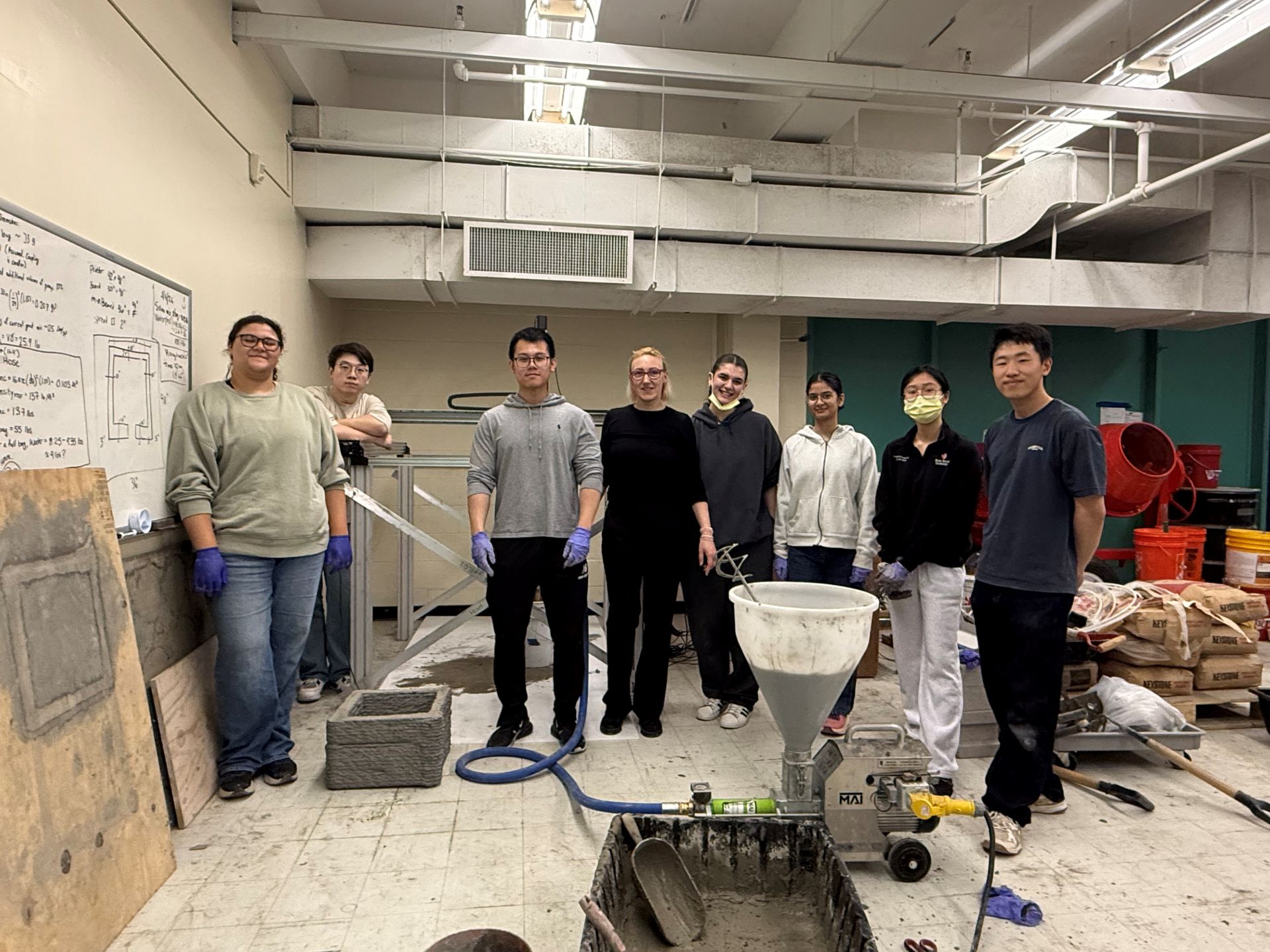 From left to right: Mariz Baselios, Hongyang Li, Zhonge Zhu, Dr. Marija Krstic, Eleni
Pitsoulis, Juee Bodhke, Helen Zhang, Junsung Lee
From left to right: Mariz Baselios, Hongyang Li, Zhonge Zhu, Dr. Marija Krstic, Eleni
Pitsoulis, Juee Bodhke, Helen Zhang, Junsung LeeDesigned to be both a research and educational tool, the project challenges students to rethink how structures can be built, shifting away from traditional construction methods and exploring more unconventional approaches to construction. What began as a technical project has grown into something more exploratory, giving students the opportunity to explore how structures can be designed, tested, and brought to life.
Marija Krstic, assistant professor in the Department of Civil Engineering, leads the Printing Structures VIP team with a focus on the design, development, and optimization of an intermediate-scale 3D concrete printer. The project began several years ago as a student-driven initiative without a specific real-world application, with earlier teams building the printer from the ground up.
Alongside this effort, Krstic also leads a separate NSF-funded project with Alexander Orlov, professor of Materials Science and Chemical Engineering, focused on 3D-printed sustainable shelters in Ukraine using locally demolished materials, in collaboration with partners in Poland and Ukraine. While the projects are distinct, Krstic aligned the two efforts to give students hands-on experience.
“I aligned the two efforts so students could gain meaningful experience: we developed proper printing code, tested all equipment, and worked extensively on 3DCP mixtures. These mixtures incorporate various supplementary cementitious materials (SCMs), recycled aggregates, and chemical admixtures,” said Kristic.
A significant aspect of the project involves developing viable concrete mixtures that can be successfully printed while maintaining structural integrity. The team experiments with a range of materials, including supplementary cementitious materials (SCMs), recycled aggregates, and chemical admixtures, to optimize both performance and sustainability. These mixtures must strike a balance between fluidity to be extruded through the system and stability to hold their shape once deposited.
At its core, this system is designed to move and control materials with the utmost precision. The concrete is prepared in a mixer, then pumped through a hose and into an extrusion system. The flow is regulated before it is deposited layer by layer through the printer’s nozzle. Each step is carefully controlled and coordinated to ensure consistency as even slight variations in timing or material flow can affect the final structure.
3D concrete printing is already being explored for applications such as rapid construction and temporary shelters.
“I wouldn’t say it works everywhere, but for shelters and quick projects it can be very useful,” Krstic said.
For Dr. Krstic, this project extends beyond a working system to giving students hands-on experience with experimental engineering. From sourcing components and materials to testing different concrete mixes, each step requires careful coordination and iteration.
“Concrete is very time sensitive,” noted Kristic, emphasizing how even minor inconsistencies can affect an entire print. The team’s long-term goal is to build a system that can be reproduced across different environments, bridging the gap between technology and real-world use.
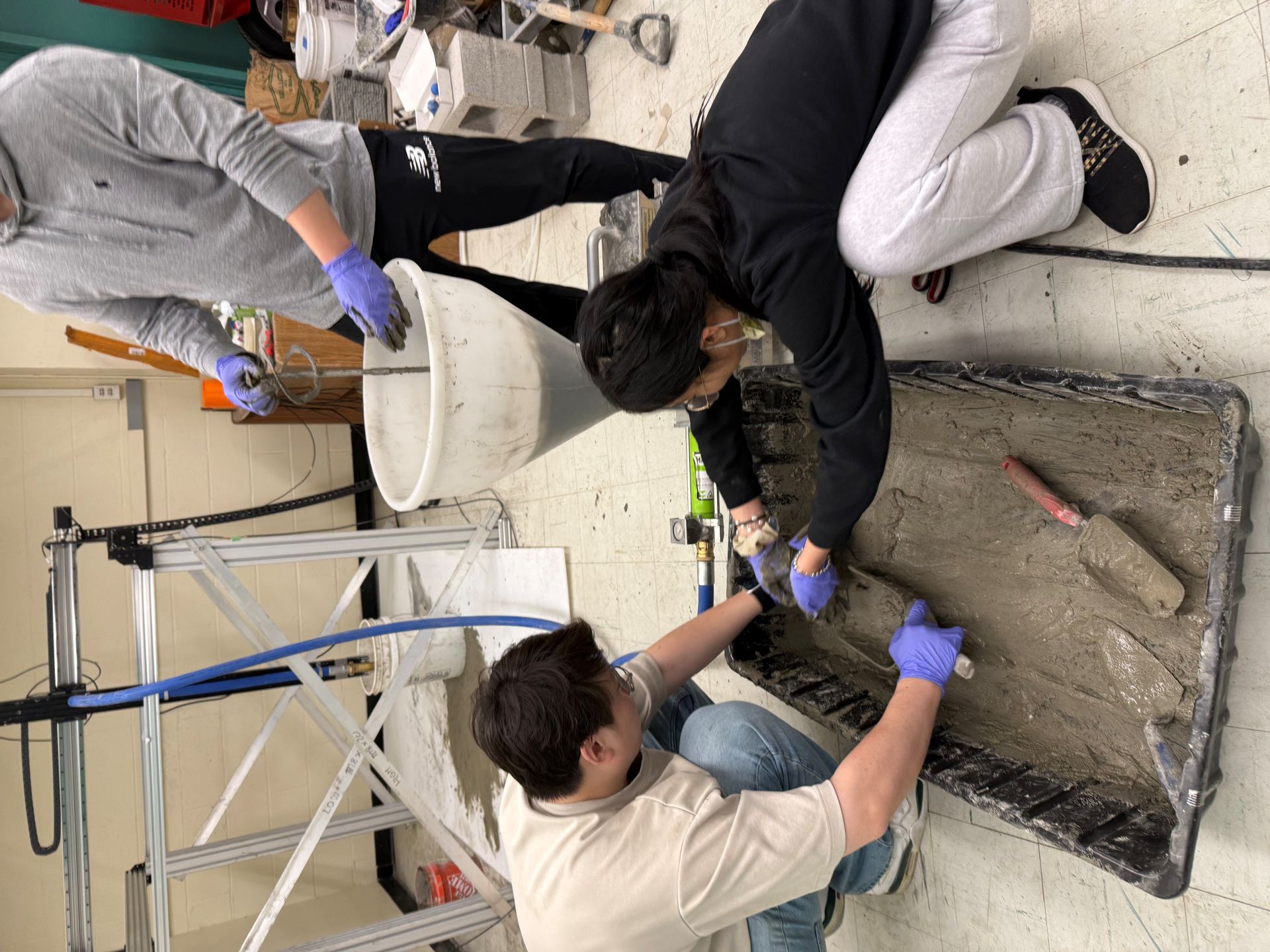 Concrete mix being put through a funnel and into a pump, where the hose carries it
and the print head deposits it
Concrete mix being put through a funnel and into a pump, where the hose carries it
and the print head deposits itThis project also faced a range of challenges. Budget constraints required the team to source and assemble individual components rather than rely on pre-built systems, with the addition of delays in obtaining the materials and equipment needed furthering complexity. Working with concrete itself introduces a difficulty of its own as it is highly-time sensitive and requires careful handling throughout the process. Even slight oversights such as improper cleaning of equipment can affect the entire batch.
For the students, despite these challenges, researching and developing products that make an impact on the environment is what keeps them going.
“However, the whole process is still extremely rewarding once you see a final product that could have the capabilities of affecting people’s lives for the better”, says Andres Cuesta Eurea, a junior majoring in Civil Engineering.
The project provides students with hands-on experience across engineering, from materials development to system design and testing.
While the VIP project is rooted in education and experimentation, it also reflects broader efforts to rethink how materials and construction methods can evolve toward more sustainable and efficient practices. The Printing Structures team highlights how innovation in engineering often begins with exploration, iteration, and a willingness to build something entirely new.
Janice Huang, CEAS Student Assistant had an opportunity to interview members of the Printing Structures team:
The Interview
Janice: Please introduce yourself.
Andres Cuesta Eurea: Hello, my name is Andres Cuesta Eurea, I’m currently a junior Civil Engineering major, and I’m a member of the Printing Structures VIP team.
Zhongke Zhu: My name is Zhongke Zhu, and I am a junior in Civil Engineering.
Junsung Lee: Hello, my name is Junsung Lee and I’m majoring in Engineering Science, with an expected graduation year of 2026.
Anthony Florio: My name is Anthony Florio, and I am a freshman majoring in Civil Engineering.
Emilia Schneiderman: My name is Emila Schneiderman, a Civil Engineering student.
What is your role on the Printing Structures VIP team, and what have you been working on?
Andres: I have collaborated on evaluating more environmentally conscious concrete mixes for 3D printed structures.
Emilia: I have been working on developing and refining sustainable concrete mix designs that balance flowability, buildability, and strength. By incorporating supplementary cementitious materials such as slag to partially replace Portland cement, we aim to improve the sustainability of mixtures.
Zhongke: I help with mixing the concrete, setting up the printer and worm pump before each print, and performing flow table tests to quantify the flowability of the concrete.
Junsung: I assist graduate students in operating the 3D concrete printer and measuring and scaling the materials used in the concrete mixtures.
Anthony: I am responsible for preparing cement-based materials for mixture design and testing, ensuring accurate batching and mixing to evaluate the performance of the printer.
What has been the most challenging part of your work so far?
Andres: Mixing concrete during lab sessions can be challenging due to the physical effort required and the importance of a uniform mix for successful printing.
Zhongke: Mixing the concrete by hand has been the toughest part. Concrete is an extremely sensitive material. It is difficult to get a uniform mix, so we often end up adding more water than what the mix design specified.
Junsung: This project requires strength, since students are responsible for mixing the 3DCP evenly. Moreover, we have to clean all lab equipment carefully so that the mixtures can't be solidified inside the tools, causing trouble for the 3D printer. However, since we collaborate and divide the work in every lab, we can overcome these challenges.
Anthony: The most challenging part has been ensuring precise measurements of all materials. Even slight deviations can significantly affect the quality and performance of the mixture.
What skills have you developed through this experience?
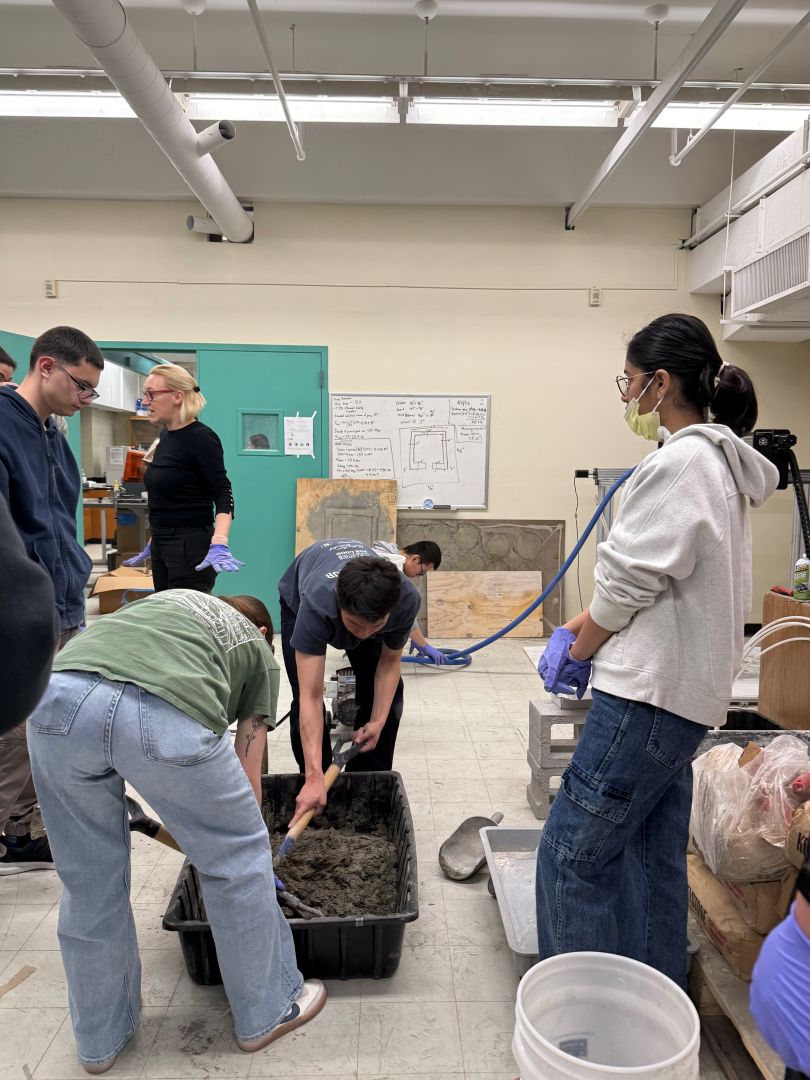 Students mixing a new concrete mixture.
Andres: This project has strengthened my understanding of how materials behave in real-world construction beyond the classroom.
Emilia: This project has strengthened my technical understanding of material behavior and additive materials that are not discussed in my coursework, while also improving my ability to analyze results, adapt to challenges, and apply these concepts to a real-world project.
Zhongke: I have learned how to make concrete from scratch, set up the equipment for printing, and better understand supplementary cementitious materials (SCMs), which replace a portion of the cement. I am also gaining intuition on fine-tuning the concrete during mixing to get a more desired consistency for proper printing.
Junsung: I have learned how different materials interact in concrete mixtures. Moreover, with the use of liquid such as superplasticizer and viscosity modified admixture, we could modify the amounts of water which will be used in the mixture.
Anthony: I have developed stronger teamwork and communication skills, along with technical skills related to material preparation and measurement accuracy.
How has this experience differed from a traditional class or lab?
Zhongke: In a traditional lab, we follow standardized experiments with known or expected outcomes. Here, we are doing research and developing sustainable mix designs that are actually useful.
Junsung: In a traditional lab, we follow experiments where results are clear. However, this project involves trial and error. With each failure, we modify the experiment and we see the new progress every week.
Anthony: This experience is more hands-on and application-based than a traditional class. Unlike a typical lab, this project involves contributing to a larger team goal and solving real-world problems.
Has being part of this team or project influenced your career goals or interests?
Andres: This experience has expanded my perspective on Civil Engineering and how impactful research efforts and teamwork are when it comes to advancing technology and communities.
Zhongke: Yes, this project has made me more interested in becoming a structural engineer.
Junsung: This project has strengthened my passion for Civil Engineering, and has given me a clearer understanding of my potential career paths.
Anthony: Yes, this experience has increased my interest in construction technology, particularly 3D printing in Civil Engineering.
What has been the most rewarding part of working on this project?
Andres: It has been extremely rewarding to see how our knowledge translates into real-world applications and make informed decisions in practical settings.
Emilia: It has been an especially rewarding experience to see our work take physical form each week through successful prints, and watching experimental mix designs transform into tangible printed elements.
Zhongke: Seeing a successful print and knowing that a new mix design worked has been very rewarding. So far, we have had success replacing 10% of cement with silica fume. We are now working on further replacing cement with Ground Glass Pozzolan (GGP) and slag to make concrete more sustainable. The goal is to maintain or improve the flowability and buildability of our best mixes to date. Honestly, the most rewarding part is just being able to contribute to that goal.
Junsung: Last semester, we could see the success of that printer creating 20 layers of structures, and it felt most rewarding. Whenever I could see the progress of the lab and the printed structures, it has been the most rewarding part. It surprises me that the structures that can be printed with layers are strong enough.
Anthony: The most rewarding part has been gaining practical knowledge while improving my ability to work as part of a team.