



Non-ionizing radiation is lower energy radiation that is not energetic enough to detach electrons from atoms or molecules, whether in matter or living organisms. This spectrum includes ultraviolet (UV), visible light, infrared (IR), microwave (MW), radio frequency (RF), and extremely low frequency (ELF). Found in many workplaces, non-ionizing radiation can present a health risk to exposed employees if not managed effectively. Contact the Radiation Safety Office at radiationsafety@stonybrook.edu to request assistance or additional information.
MRI
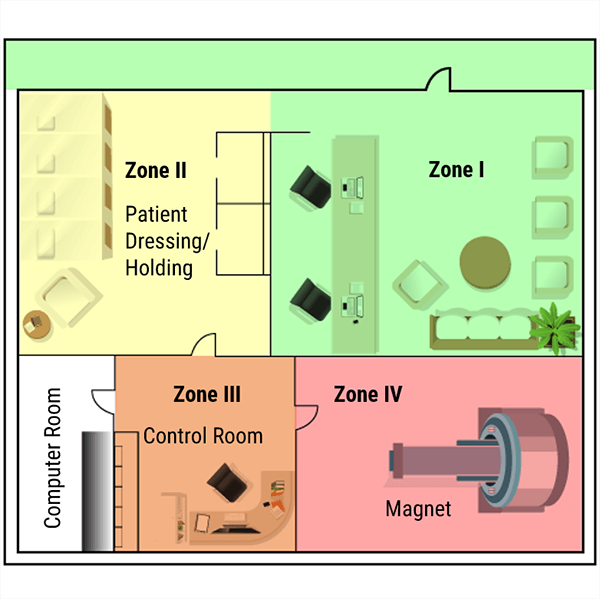
Personnel who access MRI zones I and II are considered Level 1 personnel. All Level
1 personnel are required to complete annual MRI Safety Training. Please visit our training course list and description webpage for more information. If you feel like this training is applicable to you and you have not yet been enrolled,
please contact Radiation Safety at radiationsafety@stonybrook.edu or call (631) 632-6410. Personnel who access all MRI zones are considered Level 2 personnel. All Level 2 personnel
are required to complete annual MRI Safety Training. Please visit our training course list and description webpage for more information. If you feel like this training is applicable to you and you have not yet been enrolled,
please contact Radiation Safety at radiationsafety@stonybrook.edu or call (631) 632-6410.
Dr. Button is a medical physicist with more than 30 years’ experience. He is certified by the
American Board of Medical Physics in MRI Physics and Diagnostic Imaging Physics and
the American Board of Radiology in Diagnostic Imaging Physics. As the Magnetic Resonance
Safety Officer (MRSO), Dr. Button oversees the safe operation of MRI systems at Stony
Brook.
Lasers
The laser safety programs at Stony Brook University and Stony Brook Medicine oversee
the safe use of lasers to mitigate hazards in research and clinical environments. Please visit the lasers webpage for more information.
Other Non-Ionizing
Electronic devices may emit radiation from the non-ionizing regions of the electromagnetic
spectrum such as radio waves and microwaves. Regulatory agencies such as the Environmental
Protection Agency (EPA), Federal Communications Commission (FCC) and Occupational
Safety and Health Administration (OSHA) address the health concern of these radiations
and provide best practices for consumers. Cellphones and other wireless devices emit Radio Frequency (RF) energy waves. RF energy
is a type of non-ionizing radiation. Government agencies have addressed the important
issue of safety by setting safety guidelines that limit RF exposure from wireless
devices, and they continue to study the effects of long-term exposure to low levels
of RF. Since 1996, the Federal Communications Commission (FCC) has required that all wireless
communications devices sold in the United States meet its minimum guidelines for safe
human exposure to radio frequency (RF) energy. All wireless devices sold in the US
go through a formal FCC approval process to ensure that they do not exceed the maximum
allowable SAR level when operating at the device’s highest possible power level. Stony Brook uses wireless products that comply with FCC RF exposure limits. Wireless
access points are installed in accordance with manufacturer instructions to ensure
that they meet safety guidelines for personnel exposure. For more information about health concerns related to the installation and use of
wireless devices, please visit the following websites:
DIRECTOR OF RESEARCH SAFETY AND RADIATION SAFETY OFFICER
Michelle Kehoe | (631) 632-9676 | Michelle.Kehoe@stonybrook.edu