


Dean of the College
David Wrobel
Dean, College of Arts and Sciences
Professor of History
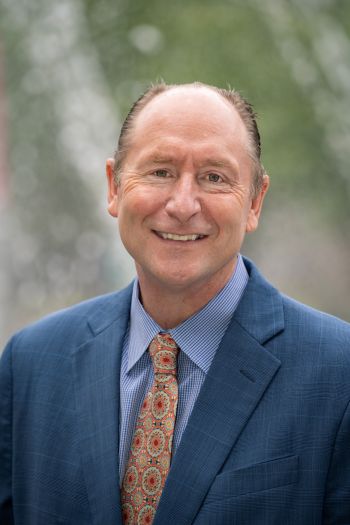
An experienced administrator and renowned scholar of American history, David holds master’s and doctoral degrees in American Intellectual History from The Ohio University and earned a bachelor of arts degree in history/philosophy from the University of Kent, Canterbury, England. He is a historian of the American West and American thought and culture, and has been recognized for excellence in teaching, research, and service.
A strong proponent of student success and mentorship, David is known for his work with teachers around the country, participating in and directing many teacher institutes sponsored by the National Endowment for the Humanities, U.S. Department of Education, National Council for History Education and other organizations.
David is the author of several books including: America’s West: A History, 1890-1950 (2017); Promised Lands: Promotion, Memory and the Creation of the American West; and The End of American Exceptionalism: Frontier Anxiety from the Old West to the New Deal as well as numerous co-edited collections, articles, and essays. His current book project is John Steinbeck’s Country: A Writer’s Defense of Democracy. David serves on the editorial board for the Steinbeck Review and on the Board of the National Steinbeck Center.
Prior to joining SBU, David served as dean of the Dodge Family College of Arts and Sciences at the University of Oklahoma (OU) where he was also the David L. Boren Professor and Merrick Chair of Western American History. As dean, he worked with his team on several significant achievements, including securing the largest gift in OU history to name the college; the funding of a new Life Sciences building; the founding of a new quantum research center; and the creation of a new College Student Success and Advising Center. He was also pivotal in creating scholarships and programs to enhance support for underserved undergraduates, attract top graduate students, and support faculty research and creative activity. David was the inaugural recipient of the David L. Boren Professorship, one of the most prestigious honors at OU, and received the Arts and Sciences Holden Award for Teaching Excellence.
David’s other honors include the Western Heritage Award for his nonfiction book, Global West, American Frontier: Travel, Empire and Exceptionalism from Manifest Destiny to the Great Depression; and research fellowships from Yale University’s Beinecke Library, the Huntington Library, the Newberry Library, and the American Philosophical Society. He is past president of the Western History Association, the American Historical Association’s Pacific Coast Branch, and of Phi Alpha Theta, the National History Honor Society.
In addition to serving as dean of the College of Arts and Sciences at Stony Brook, David is a professor in the Department of History.
An Interview with Dean David Wrobel
What was your major as an undergraduate student?
History and Philosophy. The History major came quite naturally. I visited many historical sites in England with my mother as a kid and wondered what people's lives had been like in those places and at different times. I enjoyed reading works of history from a very young age.
The philosophy interest developed in college in courses on Aesthetics and Philosophy in Literature. It was this combination of my interest in the landscapes of other people's lives in the past, and the big philosophical issues that underpin how we understand our place in the world that guided me towards my particular interest in the history of ideas.
Why did you select your particular area of research?
I'm drawn to the big questions: How does democracy endure? How do the principles of democracy coexist with notions of national exceptionalism? How do people connect to the places they live?
The American West became my regional landscape for exploring the big questions. Now I am trying to explore those questions through the lens of one of America's most widely read authors of the 20th century, John Steinbeck.
Tell us about one of your mentors.
Joseph A. (Andy) Fry, an historian of American foreign relations, who was my department chair and faculty mentor at UNLV. Andy modeled what it is to be a principled and dedicated academic leader, while remaining an active and engaged scholar. He exhibited fairness, patience, grace under pressure, and deep dedication to his university, which helped make every member of the UNLV History faculty feel strongly connected to and proud of their department and their colleagues.
Andy built community and exemplified the model of the servant leader. He also remains a highly accomplished and productive scholar in retirement, and was a dedicated and popular teacher. He showed me by example what it is to be a committed scholar/teacher/administrator.
Tell us about your teaching and leadership style.
As a teacher, I've had the good fortune, for much of my professional career, to work closely with high, middle, and elementary school teachers in numerous workshops sponsored by, e.g., the National Endowment for the Humanities, US Dept of Education, National Council for History Education. I've learned so much from these talented educators about how to teach more collaboratively, democratically, and inclusively. I've shared my knowledge about what to teach (e.g., new approaches in American history), and in return have learned so much about how to teach.
With regard to administration: my approach parallels my development as a teacher. I like to listen and learn, and then consult and collaborate, so that I can help develop and direct initiatives that reflect the collective needs of groups of people, whether students, faculty, or staff, or all of those groups together. Administrative initiatives work when they reflect those larger needs, and administrators succeed when they understand that their role is to improve the lives and life chances of the people they work for.
What’s the biggest change in higher education since you started your career?
The biggest and best change in higher ed that I've experienced is, without a shadow of a doubt, is the increased commitment to supporting and facilitating student success, at both the undergraduate and graduate levels. Universities are so much better attuned to student needs, to a wide range of different learning styles and strategies, and to providing the services that build student confidence and connections.
Higher education 50 years ago, even 20 years ago, was too often driven by primitive social darwinist notions of the survival of the fittest--a sort of sink or swim attitude to student success. In the past generation, faculty and administrators turned first to strategies for promoting undergraduate success, and in the past decade have elevated their emphasis on strategies for promoting graduate student success.
As educators, we should set a high bar for our students, because they are immensely talented; but we must also set a high bar for ourselves in supporting the varied learning styles of our students and must be committed to being strong and supportive mentors.
What is your role as College of Arts and Sciences Dean?
I'm committed to facilitating the success of our students, faculty, and staff in CAS and for setting the tone for the College--one marked by a spirit of collaboration, innovation, excellence, and kindness. CAS's ambition is to be the leading edge and exemplar of Stony Brook's bold ASPIRE 2025 strategic plan and to help ensure that every one of our 27 departments, from the Arts and Humanities, to the Social, Behavioral, Natural, and Physical Sciences, is positioned to thrive in the areas of research and creative activity excellence, and student success. My job is to help make that happen.
What do you feel sets Stony Brook apart from other universities?
Stony Brook has excellent momentum in its research and learning missions. The university is experiencing success upon success at present in both areas, by thinking boldly and strategically about the research mission and ways to support faculty, and by making a full commitment to accessibility and social mobility. And, Wolfie the Seawolf is a pretty cool mascot!
What are you enjoying most about Long Island? Hidden gems you’ve discovered?
Colosseo Pizza in Port Jeff--who knew salad pizza could taste so good! Walks on the beach with the family and the dogs – I've never seen a deer running along a beach before!
Musical artists?
I've been collecting contemporary music (rock, alternative, indie, etc) for most of my life and have a collection of about 4,000 albums. A few favorite albums and artists of the past decade:
- The War on Drugs--their past four albums, including the Grammy-winning 2014 album, Lost in the Dream, are all brilliant.
- Nathaniel Rateliff and the Night Sweats second album, Tearing at the Seams (2018)--what an incredible live band.
- Natalie Merchant (formerly the lead singer of 10,000 Maniacs), Keep Your Courage (2023)--what a wonderful surprise; a reminder of her songwriting brilliance and beautiful voice.
- Surprise song of the past year or so: The Rolling Stones, with Lady Gaga and Stevie Wonder, Sweet Sounds of Heaven, from their 2023 album Hacknew Diamonds. Truly amazing performance!
Current read?
I'm currently reading the final volume of Stephen King's mammoth saga The Dark Tower. I find King strangely relaxing. I'm almost always re-reading one of John Steinbeck's works.
What’s your best day?
A little early morning English Premier League action (I'm a lifelong Arsenal supporter), followed by some writing (whether an administrative report or an article/essay/book chapter), then some tennis (I've been playing all my life), a family walk on the beach, with the dogs, and a live band in the evening. Maybe a slice of Colosseo salad pizza.
If you were to give advice to your younger self, what would it be?
The advice would be to take chances, be bold as a learner, ask tough questions, talk to people who seem different from you, don't let your comfort zone define you and limit you.
What message do you want to share with our students?
First, that SBU/CAS is your intellectual and professional home and every member of the CAS team—faculty, staff, administrators, and student employees--is here to help ensure that you feel connected and supported.
Next, that you have an incredible landscape of options and opportunities to draw on, from across a wide range of disciplines that span the Arts, Humanities, Social Sciences, and Sciences. So get involved and engaged: connect with your faculty through office hours, connect with each other to build supportive learning communities. And aim high—your role is to not just assimilate the knowledge that already exists in your chosen area/s of study, but to participate in the process of creating new knowledge and understanding and applying it to make our communities stronger.
Great education is not a spectator sport. Be a full participant in what promises to be a wonderful academic and professional journey.