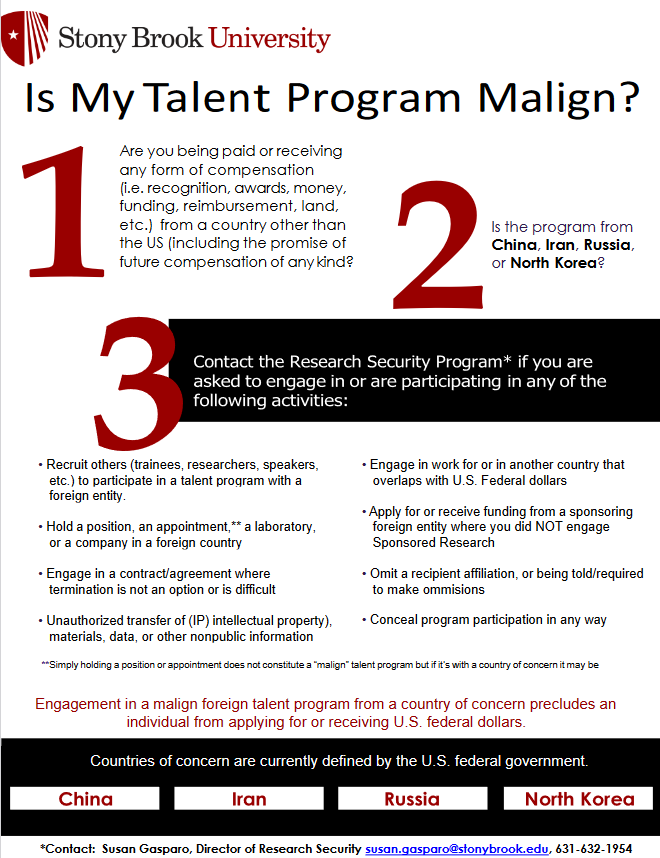
Foreign Talent Recruitment Programs
Policy on Malign Foreign Talent Recruitment Programs & Foreign Talent Recruitment Programs
Policy on International Engagements
Overview
Federal research sponsors require researchers to disclose certain foreign affiliations, appointments, and external activities. In addition, many federal agencies prohibit participation in Malign Foreign Talent Recruitment Programs (MFTRPs) as a condition of receiving federal research funding.
The Office of Research Security (ORS) assists faculty, staff, and other researchers in understanding federal sponsor requirements, evaluating proposed international activities, and identifying when additional review may be appropriate.
Important: Participation in an international collaboration, visiting appointment, conference, or other academic activity does not automatically constitute participation in a Foreign Talent Recruitment Program (FTRP). Most routine international academic activities are not prohibited.
Common Considerations
What Is a Foreign Talent Recruitment Program (FTRP)?
A Foreign Talent Recruitment Program (FTRP) is a program, position, or activity sponsored by a foreign government or foreign-affiliated organization that provides compensation or other benefits in exchange for research-related activities.
Benefits may include:
- Research funding
- Salary or consulting compensation
- Honorary appointments
- Laboratory support
- Complimentary travel
- Equipment or research resources
- Other financial or in-kind support
Participation in an FTRP is not automatically prohibited, but it may need to be disclosed to federal sponsors and the University.
What Is a Malign Foreign Talent Recruitment Program (MFTRP)?
Federal law prohibits participation in certain Malign Foreign Talent Recruitment Programs by individuals participating in federally funded research.
Generally, these programs require researchers to:
- Transfer non-public research or intellectual property.
- Conceal participation from their institution or sponsor.
- Recruit other researchers.
- Establish foreign laboratories or appointments that conflict with federal award obligations.
- Duplicate federally funded research.
- Accept restrictions that create conflicts of commitment or conflicts of interest.
The prohibition is based on the specific statutory criteria established by Congress and implemented by federal agencies.
What Activities Are NOT Considered Foreign Talent Recruitment Programs?
Many routine international academic activities are not considered Foreign Talent Recruitment Programs.
Examples include:
- Publishing research.
- Presenting at conferences.
- Participating in open scientific collaborations.
- Serving on peer review panels.
- Advising international students.
- Participating in professional societies.
- Serving as a visiting scholar or taking a sabbatical.
- Receiving academic awards and honors.
- Participating in U.S.-supported international scientific exchanges.
Whether an activity qualifies depends on the specific facts and sponsor requirements.
Federal Sponsor Requirements
Many federal agencies now require investigators and senior/key personnel to:
- Certify they are not participating in a Malign Foreign Talent Recruitment Program.
- Disclose certain foreign appointments and affiliations.
- Report outside support and professional activities.
- Update disclosures when circumstances change.
Requirements vary by sponsor.
Related Guide: Federal Sponsor Research Security Requirements
How ORS Can Help
ORS can assist researchers by:
- Reviewing proposed international appointments.
- Discussing foreign affiliations.
- Reviewing sponsored research requirements.
- Interpreting sponsor guidance.
- Coordinating with Sponsored Programs.
- Providing research security consultations.
Researchers are encouraged to contact ORS before accepting international appointments or other activities when questions exist regarding sponsor requirements.
Frequently Asked Questions
Are all Foreign Talent Recruitment Programs prohibited?
No. Federal agencies distinguish between Foreign Talent Recruitment Programs (FTRPs) and Malign Foreign Talent Recruitment Programs (MFTRPs). While many federal sponsors prohibit participation in MFTRPs, participation in other FTRPs may be permissible but subject to disclosure requirements.
Does participating in an international collaboration make me part of an FTRP?
No. Routine international research collaborations, conferences, publications, and other scholarly activities generally do not constitute participation in an FTRP by themselves.
Should I contact ORS before accepting an international appointment?
Yes. ORS can help determine whether sponsor disclosure requirements or other research security considerations apply.
Related Guidance
| Reference Guide | Description |
|---|---|
| Federal Sponsor Research Security Requirements | Learn how federal agencies implement research security requirements throughout the proposal and award lifecycle. |
| Federal Sponsor Disclosure Requirements | Learn about sponsor-specific disclosure documents, certifications, and reporting obligations. |
| International Collaborations | Guidance for establishing and managing international research collaborations. |
| Foreign Sponsors | Guidance for research funded or supported by foreign sponsors or organizations. |
| Countries of Concern | Learn about countries that may require additional review because of federal research security, export control, sponsor, or institutional requirements. |
Federal References
- CHIPS and Science Act of 2022
- OSTP Guidelines for Federal Research Agencies Regarding Foreign Talent Recruitment Programs (February 2024)
- NSPM-33 Implementation Guidance
- Section 1286 of the John S. McCain National Defense Authorization Act
- Sponsor-specific guidance (NIH, NSF, DOE, DoD, NASA)
Need Assistance?
If you are considering participation in an international appointment, research program, or other activity sponsored by a foreign organization or government, or if you have questions regarding federal sponsor disclosure requirements or Foreign Talent Recruitment Programs, contact the Office of Research Security before accepting the appointment or beginning the activity.