


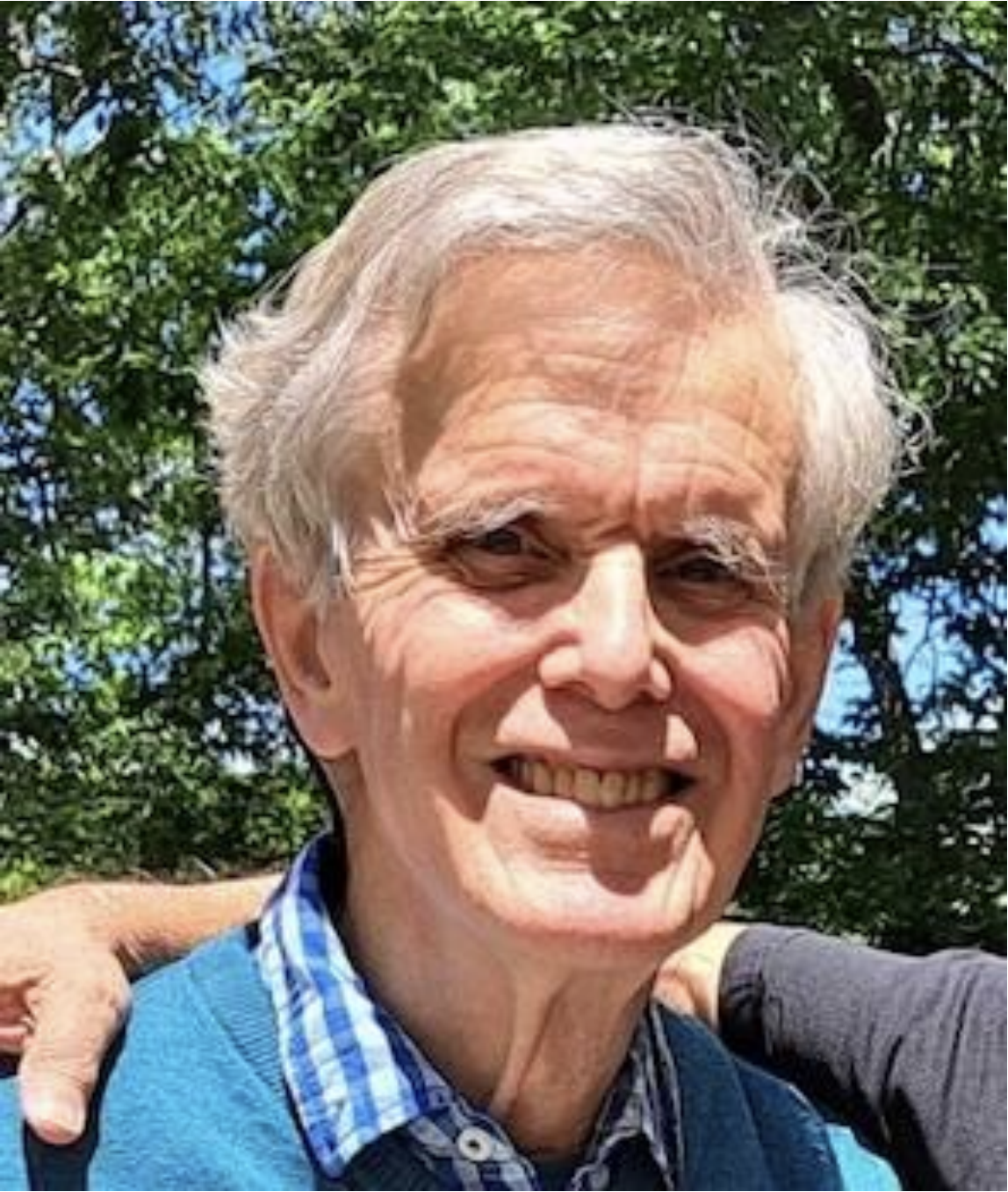
Phil Allen
Professor Emeritus/Research Professor
Physics and Astronomy
Office: Physics B 146
Curriculum Vitae. (Last updated: 2023 Apr 05)
Biography:
Philip Allen joined the faculty at Stony Brook in 1971, after spending two years doing
research at Bell Laboratories. He obtained a PhD from U. of Calif. Berkeley (1964-1969)
and a bachelor’s degree from Amherst College (1960-1964). In 2017 he retired, becoming
a Research Professor; he still lives in Stony Brook.
Research Statement:
Allen’s research has been focused on improving theories and assisting experiments
in solid state physics, in areas where theory had not been sufficiently developed.
Topics include the transition temperature of superconductors, the transport of electricity
and heat in metals, insulators, and amorphous semiconductors, and relaxation toward
equilibrium of electrons in solids driven by light or other perturbations. The underlying
picture usually involves quasiparticles, such as electrons and phonons. Many interesting
problems not yet fully solved involve the break-down of the quasiparticle description
due to excessive disorder or strong interactions.
Selected Publications:
- PB Allen, RC Dynes, Transition temperature of strong-coupled superconductors reanalyzed, Physical Review B 12, 905 (1975).
- P.B. Allen and J. L. Feldman, Thermal conductivity of disordered harmonic solids, Phys. Rev. B 48, 12581 (1993).
- P.B. Allen, Neutron Spectroscopy of Superconductors, Phys. Rev. B 6, 2577 (1972).
- P.B. Allen, Fermi Surface Harmonics: A General Method for Non-Spherical Problems. Application to Boltzmann and Eliashberg Equations, Phys. Rev. B 13, 1416 (1976).
- P.B. Allen and V. Heine, Theory of Temperature Dependence of Electronic Band Structures, J. Phys. C 9, 2305 (1976).
- P.B. Allen and M. Cardona, Theory of the Temperature Dependence of the Direct Gap of Germanium, Phys. Rev. B 23, 1495 (1981).
- P.B. Allen and W. H. Butler, Electrical Conduction in Metals, Physics Today 31, 44 (1978).
- P.B. Allen, Resistivity Saturation, in Physics of Transition Metals, Leeds, 1980 (Inst. Phys. Conf. Ser. No. 55) pp. 425-437 (1981).
- P.B. Allen and B. Mitrovic, Theory of Superconducting Tc, in Solid State Physics (F. Seitz, D. Turnbull, and H. Ehrenreich, eds.) Academic Press, NY, 1982, v.37, pp. 1-92.
- F.S. Khan and P. B. Allen, Deformation Potentials and Electron-Phonon Scattering: Two New Theorems, Phys. Rev. B 29, 3341 (1984).
- F.S. Khan and P. B. Allen, Sound Attenuation by Electrons in Metals, Phys. Rev. B 35, 1002 (1987).
- P.B. Allen, M. L. Cohen, and D. R. Penn, Total Dielectric Function: Algebraic Sign, Electron-Lattice Response, and Superconductivity, Phys. Rev. B 38, 2513 (1988).
- P.B. Allen and D. Rainer, Phonon Suppression of Coherence Peak in Nuclear Spin Relaxation of Superconductors, Nature 349, 396 (1991).
- R.M. Wentzcovitch, J. L. Martins, and P. B. Allen, Energy versus Free Energy Conservation in First Principles Molecular Dynamics, Phys. Rev. B 45, 11372 (1992).
- R.M. Wentzcovitch, W. W. Schulz, and P. B. Allen, VO2: Peierls or Mott-Hubbard? A View from Band Theory” Phys. Rev. Letters 72, 3389 (1994).
- P.B. Allen and J. Kelner, Evolution of a Vibrational Wavepacket on a Disordered Chain, Am. J. Phys. 66, 497 (1998).
- P.B. Allen, J. L. Feldman, J. Fabian, and F. Wooten, Diffusons, Locons, Propagons: Character of Atomic Vibrations in Amorphous Si, Phil. Mag. B 79, 1715 (1999).
- P.B. Allen, Metals with Small Electron Mean-Free Path: Saturation versus Escalation of Resistivity, Physica B 318, 24 (2002).
- T. Sun and P. B. Allen, Lattice thermal conductivity: Computations and theory of the high-temperature breakdown of the phonon-gas model, Phys. Rev. B 82, 224305:1-14 (2010).
- P.B. Allen, T. Berlijn, D. A. Casavant, and J. M. Soler, Recovering hidden Bloch character: Unfolding electrons, phonons, and slabs, Phys. Rev. B 87, 085322:1-10 (2013); erratum Phys. Rev. B 87, 239904 (2013).
- P.B. Allen, Improved Callaway model for Lattice Thermal Conductivity, Phys. Rev. B 88, 144302 (2013).
- A. Kefayati, P. B. Allen, and V. Perebeinos, Nonlocal thermal transport modeling using the thermal distributor, Phys. Rev. B 105, 235402 (2022).