


Proofs, Papers, and Mentorship: Nicholas Smirnov’s Journey in Theoretical Computer Science
Coming into Stony Brook interested in software engineering and pure mathematics, Nicholas
Smirnov quickly discovered his passion for theoretical computer science while taking
his discrete mathematics course. Currently a junior double majoring in computer science
(on the honors track) and mathematics, Nicholas is heavily involved in algorithms
and computer systems research and is a teaching assistant for the honors discrete
mathematics course.
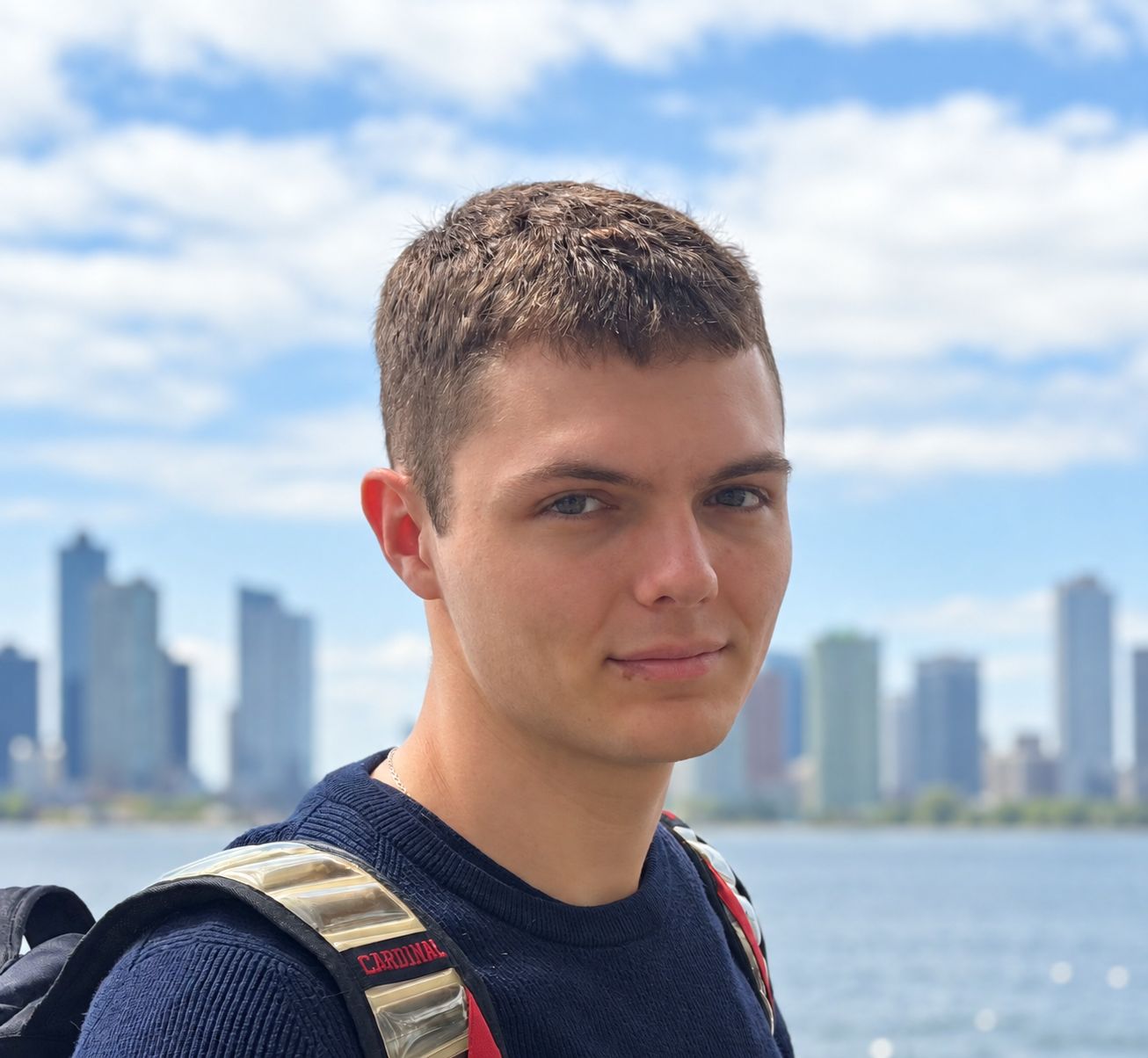
Nicholas is working on multiple research projects with Professor Michael Bender’s Algorithms Lab and Professor Erez Zadok’s Archival Storage Systems Lab, alongside Professor Pramod Ganapathi. He studies how algorithms behave under different types of memory storage, and he is specifically working on creating a long-term storage system to keep up with constantly evolving technological demands. He was drawn to these projects by a desire to create real-world applications across many fields, since algorithm and storage systems research has implications not only in industry but in nearly every field that relies on storing and processing large amounts of data.
In addition to receiving Stony Brook’s Grumman Engineering Scholarship Endowment in acknowledgment of his undergraduate research and landing a Research Experience for Undergraduates (REU) at UT Arlington, Nicholas has published his research in Ars Combinatoria, Integers, Discrete Mathematics Letters, and the Electronic Colloquium on Computational Complexity (ECCC). Though the publishing process often took months of waiting and hard work, he attributes these successful publications to his research mentors and encourages others who hope to publish during their undergraduate years to start research early.
Nicholas is a dedicated teaching assistant with ample experience guiding students who are new to discrete mathematics and the honors track. He helps them develop a solid foundation in the logical reasoning needed to succeed in fields like artificial intelligence (AI) and theoretical mathematics. His one-on-one teaching style allows him to give personalized support to students of all backgrounds and learning styles.
Nicholas emphasizes the importance of building close relationships with professors through lecture discussions and office hours. These relationships can give students interested in graduate school, REUs, and internships a head start with strong recommendation letters and applications. Above all, he encourages students to be curious, take initiative, and not be afraid to reach out since you never know which conversation might open the door to your next opportunity.
Read more about Nicholas’ experiences below in an interview with CEAS Student Assistant Claire:
The Interview:
Claire: Coming into Stony Brook, what made you choose your majors, and what kept you
committed to them? Were there any other interests or majors you considered pursuing?
Nicholas: I came into Stony Brook already interested in pursuing computer science and math, with a potential interest in software engineering. However, I really started developing an interest in theoretical computer science after taking a discrete mathematics course. I really enjoyed this class, as it showed me what mathematical computer science can be. The research opportunities I got involved with afterward further piqued my interest.
What research are you currently conducting, and what are you and your team working toward?
I'm working on multiple projects in two different labs: Professor Michael Bender's Algorithms Lab and Professor Erez Zadok's Archival Storage Systems Lab. I'm also working with Professor Pramod Ganapathi on algorithms research and the development of an algorithms textbook. My current project involves looking at how algorithms behave under varying memories. Typically, when people conduct algorithms research, they focus on classes of algorithms and how they vary in memory. I also became interested in file system research and how to develop a long-term storage system. The issue with long-term storage is that cryptography is constantly evolving; a system that is considered secure now may not be secure in the future. Thus, a long-term storage system is needed that can preserve data integrity.
What sparked your interest in the research you're doing across your labs?
Initially, I wanted to explore a variety of fields and their computer science applications to see what I was interested in. While trying to find my direction, I realized that I wanted to be able to create real-world applications for anybody, regardless of the field they work in. As I mentioned in my previous response, my current research focus, long-term security and storage, is applicable to everyone. Algorithms research can apply to various industries as well. What drives my interest is practicality.
How did you find these research opportunities? For example, did you cold email professors or connect with them through classes?
My approach was a bit unusual. I was invited to my current labs by the professors running them. After class, I would talk to my professors about their research, and through these conversations, they extended invitations for me to look around their labs and talk to their graduate students. These conversations mostly happened after lectures, but I also made an effort to actively attend office hours to get to know them.
You're very involved in the research scene on campus. Given how time-intensive research and manuscript writing can be, how do you balance them with your coursework and other commitments?
One of the biggest resources I've used to organize my tasks and responsibilities is Google Calendar. Setting aside time slots for research and schoolwork helps me determine what to prioritize. Schoolwork is my main priority, so I try to get it done as soon as possible to keep it from building up. With research, I don't spend all my time in the lab, but whenever I get ideas or bursts of motivation during my off time, like at lunch, I note them down and research them afterward. I also have a physical calendar from H Mart hanging in my room, and I sometimes write events and tasks on it.
What was the publication process like for you, from drafting the manuscript to choosing journals and going through review?
Publishing was quite a process. First, I needed something to publish. I come up with my research ideas by reading a few interesting papers, and from there, I pick some questions I like and answer them. I prefer to use my own voice in my writing, so I avoid using AI for the drafting process. Once I've completed my manuscript, I reread my paper multiple times to make sure my information is correct. The review timeline is the longest part. I submitted a paper in April, and it only just came out a couple of months ago in August. The peer reviewers' feedback was very useful and helped me catch an error that I was able to revise. After revising, my paper was accepted and published. My first paper wasn't very long, as it didn't have too much mathematical jargon. My second paper was longer, so to manage the writing load, I would dedicate small intervals of time to it instead of spending too many hours on the paper at once.
What advice would you give undergraduates who hope to get published?
Looking back at my experiences, I would say to get involved as soon as possible. Though this may sound a bit cliché, it's the best advice I have to offer. Research isn't as scary as you think. When you join a lab and see people around you who know so much, it's important to remember that you're just an undergraduate student; there's no need to be an expert. Starting early gives you a leg up, and if your goal is to publish, remember that publications can take months, so you'll need to keep that timeline in mind.
As a teaching assistant, what have you found most helpful for students learning a subject like discrete mathematics for the first time? Did you have a system that worked well?
Discrete mathematics is definitely a class many computer science majors don't expect. Going into CS, you'd expect more coding classes. Instead, you're thrown into pure math courses in your first years. However, learning something like discrete mathematics is important for fields like AI and theoretical mathematics. This class helps you develop your logical reasoning, and having that head start is really important for your computer science education. The course content itself was by far the most helpful, and students developing stronger articulation skills is a plus. It's not too hard to articulate your ideas, but creating a formal argument is harder than you'd think.
Every student understands the course content differently. When I was leading recitations, I realized that explaining something in multiple ways increases the likelihood that one of those explanations will resonate with a student. I was also very active on email to make sure that if anyone had questions, I could answer them right away. I noticed that this personalized, one-on-one approach was the most helpful for students.
What led you to seek funding for your research? Was it an independent funding effort, and if so, what did it support?
The scholarship I received was more of an academic support scholarship than a research grant. The Grumman scholarship helped finance my academics, and it encouraged me to further pursue research. It felt like my research was recognized and that I was seen. It gave me more motivation to pursue research in the applied computer science world.
Were there key moments in your research experiences that confirmed algorithms and theoretical computer science were the right direction for you? For example, a mentor, a peer, or a lightbulb moment?
Back in high school, I was involved with research programs at Columbia and NASA, but I wasn't drawn to a specific field. I was still interested in computer science-based research projects, though. In one particular instance, I remember looking into the formulas being used, and it was really cool to see where the data originated. Discrete mathematics was my catalyst and sparked my interest in the more theoretical side of computer science.
What do research programs like your REU at UT Arlington look for in applicants? How can students interested in similar programs prepare strong applications?
Over the summer, I participated in UT Arlington's REU, which was a research program and internship combined into one. The experience was basically a summer job, and in my opinion, the biggest factor nowadays is recommendation letters. Back in high school, when I was involved with the NASA programs, one of the key factors in my acceptance was my participation in olympiad competitions. In-depth experiences, strong recommendations, and an application tailored to the program's goals are crucial. For those interested in similar research programs, I would tell them to start early and go to office hours to build relationships with their professors. Specifically for REUs, a strong recommendation letter can speak to your past experiences and involvement. Being able to tie in your experiences to develop a strong "why" is also a big part of your application.
Are there any new updates or projects you'd like included in your student spotlight?
I'm currently starting my honors thesis with Professor Michael Bender and am considering different topics. I'm very grateful to Professor Bender, since meeting his students and graduate researchers is what familiarized me with the research world. I'm also working on a few independent math questions with some friends that we may submit in the future.
What general advice would you give to CEAS students and undergraduates?
Don't worry too much about what's not in your hands. The future is very uncertain, but no matter how uncertain it is, it will all work out in the end. Keep working and don't panic. Be aware of what's going on around you, but try to keep a positive mindset about the opportunities that will come in the future. Maintain a work-life balance, and don't spend too much or too little time on your work. As the semesters go on, your credit limit will also increase, but try to avoid burning out in your first semester.