




Engineering Artificial Intelligence - MS
The Matser of Science in engineering artificial intelligence (EAI) prepares specialists with comprehensive knowledge in all areas of this new disruptive and revolutionary technology. Gain knowledge in interdisciplinary foundations and practical experience in algorithims, sensors, hardware, control, and applications.
Overview
This program provides a comprehensive foundation in artificial intelligence by integrating core theory with practical engineering skills. Students develop a strong understanding of intelligent system design, including probabilistic reasoning, enabling machines to make decisions under uncertainty. This is complemented by in-depth study of machine learning and deep learning algorithms, preparing students to build models that learn from data, recognize patterns, and improve over time.
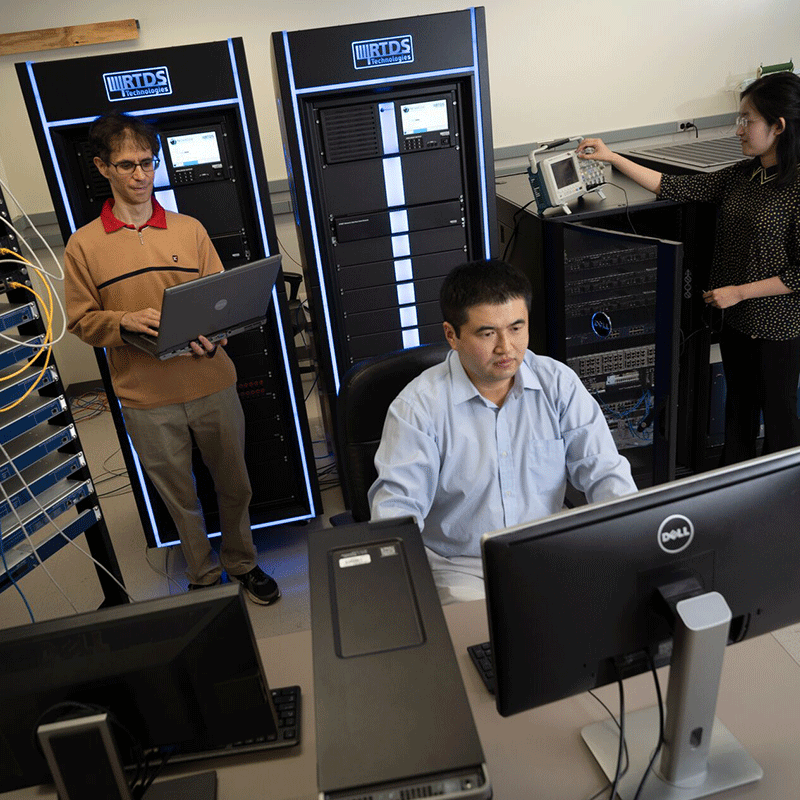
Beyond software, the program emphasizes the hardware and systems that support real-world AI. Students study sensor electronics and digital systems design, gaining insight into how data is collected, processed, and accelerated through specialized hardware. This systems-level perspective is essential for deploying AI in embedded and resource-constrained environments.
By combining expertise in algorithms, hardware, and applications, the program cultivates a well-rounded skill set. Graduates are equipped to design, implement, and deploy intelligent systems that address practical challenges, bridging the gap between theory and real-world impact.
Admissions Requirements
For admission to graduate study in the Department of Electrical and Computer Engineering, the minimum requirements are:
- A bachelor’s degree in electrical or computer engineering or computer science from an accredited college or university. Outstanding applicants in other technical or scientific fields will be considered, though special make-up coursework over and above the normal requirements for a graduate degree may be required.
- A minimum grade point average of B in all courses in engineering, mathematics, and science.
- Acceptance by both the Department of Electrical and Computer Engineering and the Graduate School.
Degree Requirements
2. At least 30 graduate credits with a cumulative and departmental grade point average of 3.0 or better. Among these 30 credits, at least six credits of ESE 599 (Research for M.S. students) must be included, with a maximum of 12 credits total taken from a combination of ESE 597, ESE 599, or ESE 698. Only 3 credits of ESE 698 may be used. Any non-ESE course requires prior approval by the Graduate Program Director before enrollment.
3. Common requirements: Students must finish a minimum number of credits in each of these subareas:
Foundations (6 credits):
ESE 503 (Stochastic Systems, 3 credits);
ESE 561 (Theory of Artificial Intelligence, 3 credits);
Methods (6 credits):
ESE 577 (Deep Learning Algorithms and Software, 3 credits);
ESE 588 (Fundamentals of Machine Learning, 3 credits);
Applications (3 credits):
ESE 564 (Artificial Intelligence for Robotics, 3 credits);
ESE 589 (Learning Systems for Eng. Appl., 3 credits);
ESE 590 (Practical Machine Learning & Artificial Intelligence, 3 credits);
Hardware (3 credits):
ESE 507 (Advanced Dig. Sys. Design & Generation, 3 credits);
ESE 525 (Modern Sensors in Artificial Intelligence Applications, 3 credits);
ESE 587 (Hardware Architectures for Deep Learning, 3 credits);
Elective (3 credits):
ESE 502 (Linear Systems, 3 credits);
ESE 507 (Advanced Dig. Sys. Design & Generation, 3 credits);
ESE 525 (Modern Sensors in Artificial Intelligence Appl., 3 credits);
ESE 533 (Convex Optimization & Eng. Appl., 3 credits);
ESE 537 (Mobile Sensing Systems & Appl., 3 credits);
ESE 543 (Mobile Cloud Computing, 3 credits);
ESE 558 (Digital Image Processing, 3 credits);
ESE 562 (AI Driven Smart Grids, 3 credits);
ESE 564 (Artificial Intelligence for Robotics, 3 credits);
ESE 568 (Computer and Robot Vision, 3 credits);
ESE 587 (Hardware Architectures for Deep Learning, 3 credits);
ESE 589 (Learning Systems for Eng. Appl., 3 credits);
ESE 590 (Practical Machine Learning & Artificial Intelligence, 3 credits);
ESE 592 (Distributed Computation, Control & Learning over Networks, 3 credits);
ESE 670* (Topics in Electrical Sciences, 3 credits)
AMS 580 (Statistical Learning, 3 credits);
MEC 529 (Introduction to Robotics, 3 credits);
CSE 538 (Natural Language Processing, 3 credits).
Any ESE or non-ESE course not listed above must be approved by Graduate Program Director
(3 credit maximum); approval must be obtained before enrollment. Non-regular courses
CANNOT count as an elective course.
Industrial Experience (at least 1, maximum 3 credits): ESE 597 Practicum in Engineering (Internship)
Research Experience (at least 6 credits): ESE 599: Research for M.S. students
Teaching Experience (not required but can be used, maximum 3 credits): ESE 698: Practicum in Teaching
4. Thesis Requirement: Students must satisfactorily complete a master’s thesis. The thesis must have two readers from
the department, including the advisor. Students must allow at least three (3) weeks for readers to review and provide comments prior
to submission.
5. In exceptional circumstances, the Graduate Program Director can approve a replacement
of ESE 597 with ESE 599, ESE 699 or ESE 698.
Credits for ESE 597 can only be applied toward the degree if the following requirements are satisfied:
Prior approval from the Graduate Program Director based on the student submitting a proposal and securing an advisor in the ECE Department as well as a contact person at the company involved. Approval will only be granted if it can be demonstrated that the faculty advisor will be kept in close touch with work on the project. To this end, practicum not in the local geographic area will be discouraged.
To obtain satisfactory credit the faculty advisor must verify that a substantial engineering project was undertaken and completed. This will be based on his close contact during the entire period of the project with the student and the contact person and upon reviewing a mandatory written report submitted by the student at the project's completion. The faculty advisor will determine the final grade for the course.
A candidate for the Master’s degree may petition to transfer a maximum of 12 graduate credits from another institution towards the master’s degree requirements. Students transferring from non-matriculated status are also limited to a maximum of 12 credits for the Master’s degree.
2. At least 30 graduate credits with a cumulative and departmental grade point average of 3.0 or better. Among these 30 credits, up to six credits may be from a combination of ESE 597 (Practicum in Engineering), ESE 599 (Research for M.S. students), or ESE 698 (Practicum in Teaching). Only 3 credits of ESE 698 may be used. Any non-ESE course requires prior approval by the Graduate Program Director before enrollment.
3. Common requirements: Students must finish a minimum number of credits in each of these subareas:
Foundations (6 credits):
ESE 503 (Stochastic Systems, 3 credits);
ESE 561 (Theory of Artificial Intelligence, 3 credits);
Methods (6 credits):
ESE 577 (Deep Learning Algorithms and Software, 3 credits);
ESE 588 (Fundamentals of Machine Learning, 3 credits);
Applications (3 credits):
ESE 564 (Artificial Intelligence for Robotics, 3 credits);
ESE 589 (Learning Systems for Eng. Appl., 3 credits);
ESE 590 (Practical Machine Learning & Artificial Intelligence, 3 credits);
Hardware (3 credits):
ESE 507 (Advanced Dig. Sys. Design & Generation, 3 credits);
ESE 525 (Modern Sensors in Artificial Intelligence Applications, 3 credits);
ESE 587 (Hardware Architectures for Deep Learning, 3 credits);
Elective (6 credits):
ESE 502 (Linear Systems, 3 credits);
ESE 507 (Advanced Dig. Sys. Design & Generation, 3 credits);
ESE 525 (Modern Sensors in Artificial Intelligence Appl., 3 credits);
ESE 533 (Convex Optimization & Eng. Appl., 3 credits);
ESE 537 (Mobile Sensing Systems & Appl., 3 credits);
ESE 543 (Mobile Cloud Computing, 3 credits);
ESE 558 (Digital Image Processing, 3 credits);
ESE 562 (AI Driven Smart Grids, 3 credits);
ESE 564 (Artificial Intelligence for Robotics, 3 credits);
ESE 568 (Computer and Robot Vision, 3 credits);
ESE 587 (Hardware Architectures for Deep Learning, 3 credits);
ESE 589 (Learning Systems for Eng. Appl., 3 credits);
ESE 590 (Practical Machine Learning & Artificial Intelligence, 3 credits);
ESE 592 (Distributed Computation, Control & Learning over Networks, 3 credits);
ESE 670* (Topics in Electrical Sciences, 3 credits)
AMS 580 (Statistical Learning, 3 credits);
MEC 529 (Introduction to Robotics, 3 credits);
CSE 538 (Natural Language Processing, 3 credits).
Any ESE or non-ESE course not listed above must be approved by Graduate Program Director (3 credit maximum); approval must be obtained before enrollment. Non-regular courses CANNOT count as an elective course.
Industrial Experience (3 credits): ESE 597 Practicum in Engineering (Internship)
4. To meet the 30-credit minimum, students may take from the following (maximum 3 credits
per course):
Research Experience (maximum 3 credits): ESE 599 Research for M.S. students
Reaching Experience (maximum 3 credits): ESE 698 Practicum in Teaching
Additional regular course (maximum 3 credits): any course listed under “common requirements,” not already used to fulfill another
requirement OR Any ESE or non-ESE course not listed above but approved by Graduate
Program Director (3 credit maximum; approval MUST be obtained before enrollment).
5. In exceptional circumstances, the Graduate Program Director can approve a replacement
of ESE 597 with ESE 599, ESE 699 or ESE 698.
Credits for ESE 597 can only be applied toward the degree if the following requirements are satisfied:
Prior approval from the Graduate Program Director based on the student submitting a proposal and securing an advisor in the ECE Department as well as a contact person at the company involved. Approval will only be granted if it can be demonstrated that the faculty advisor will be kept in close touch with work on the project. To this end, practicum not in the local geographic area will be discouraged.
To obtain satisfactory credit the faculty advisor must verify that a substantial engineering project was undertaken and completed. This will be based on his close contact during the entire period of the project with the student and the contact person and upon reviewing a mandatory written report submitted by the student at the project's completion. The faculty advisor will determine the final grade for the course.
A candidate for the Master’s degree may petition to transfer a maximum of 12 graduate credits from another institution towards the master’s degree requirements. Students transferring from non-matriculated status are also limited to a maximum of 12 credits for the Master’s degree.
Explore Your Future Career Opportunities
AI knowledge and skills are in high demand across industry and business. Many students with foundational knowledge of algorithms and software, particularly in deep learning, can secure high-paying job offers in finance and high-tech industries around the globe, including roles such as:
- AI Product Manager
- AI Researcher
- Machine Learning Engineer
- Cybersecurity Vision Engineer
- Data Scientist