


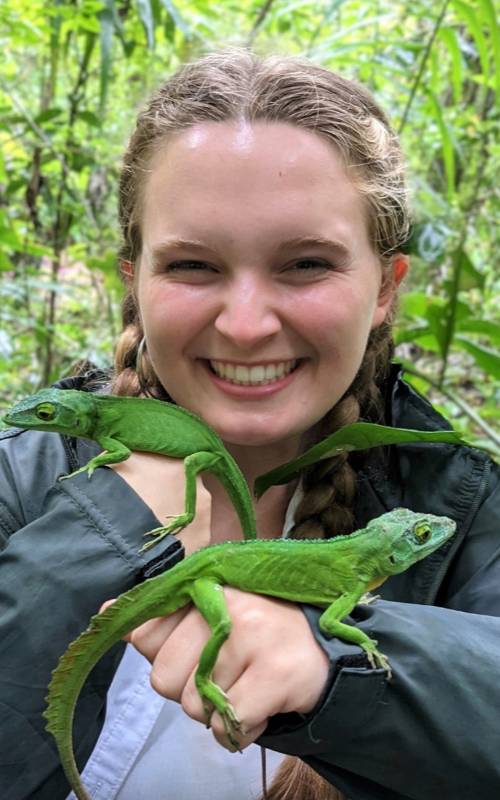
Anna Thonis, PRODiG+ Fellow
Ph.D., Stony Brook University 2024
Conservation and global-change ecology, herpetology, and species distribution modeling
Email: anna.thonis@stonybrook.edu
Office: LS677B
Research Summary:
Anna Thonis is a PRODiG+ Fellow in the Institute for Advanced Computational Science and the Department of Ecology & Evolution. She is also a Visiting Scientist in the Center for Biodiversity and Conservation at the American Museum of Natural History and Co-Chair of the IUCN Species Survival Commission’s Anoline Lizard Specialist Group. Prior to joining Stony Brook as faculty, Dr. Thonis was a Postdoctoral Researcher in the Department of Biology at New York University. Dr. Thonis received her B.S. in Environmental Science and M.S. in Biology from Rensselaer Polytechnic Institute in 2017 and 2018, respectively, and her Ph.D. in Ecology and Evolution from Stony Brook University in 2024.
Dr. Thonis' research focuses on understanding and predicting how biodiversity responds to global environmental change, particularly urbanization, species introductions, climate change, and extreme weather. She combines field-based ecological data with spatial, statistical, and computational modeling to investigate responses to environmental change across species, populations, and communities. She also works to understand and quantify the uncertainty inherent in ecological forecasting, with the goal of improving the reliability of models used to inform biodiversity conservation. Much of her research focuses on reptiles, particularly lizards and turtles, across the Caribbean and the northeastern United States. She leads long-term mark-recapture programs for Anolis lizards in Puerto Rico and Eastern box turtles in New York, designed to estimate demographic parameters and establish baselines for understanding how populations respond to environmental change. Her field research frequently incorporates community scientists and partnerships with local conservation organizations to generate large-scale ecological datasets while directly supporting biodiversity monitoring and conservation.