



World-Class Research Facilities Supporting Discovery and Innovation
Brookhaven National Laboratory (BNL) is home to some of the world’s most advanced scientific research facilities, providing cutting-edge tools for exploration across physics, materials science, nanotechnology, structural biology, energy research, and more. These state-of-the-art facilities—including the Relativistic Heavy Ion Collider (RHIC), National Synchrotron Light Source II (NSLS-II), Center for Functional Nanomaterials (CFN), and Laboratory for BioMolecular Structure (LBMS)—support a vibrant global research community and have enabled discoveries recognized with seven Nobel Prizes.
As a managing partner of Brookhaven Science Associates LLC, Stony Brook University plays an integral role in the governance and advancement of the Lab’s mission. Stony Brook faculty, postdocs, and students are deeply involved in research conducted at BNL’s facilities, collaborating through joint appointments and institutes to push the boundaries of knowledge. This partnership creates unparalleled opportunities for hands-on research, innovation, and education for the next generation of scientists.

RHIC
The Relativistic Heavy Ion Collider (RHIC) at Brookhaven National Laboratory is one of the world’s most powerful tools for exploring the fundamental building blocks of matter. Physicists from around the globe use RHIC to collide heavy ions, which are gold atoms stripped of their electrons, at nearly the speed of light. These high-energy collisions recreate conditions similar to those just after the Big Bang. For a brief moment, the collisions melt protons and neutrons, freeing their constituent quarks and gluons. By analyzing the thousands of particles produced, scientists gain valuable insights into the structure of matter, the forces that hold it together, and the evolution of the early universe. RHIC’s groundbreaking discoveries continue to shape our understanding of nuclear physics and the nature of the cosmos.
LEARN MORE ABOUT RHIC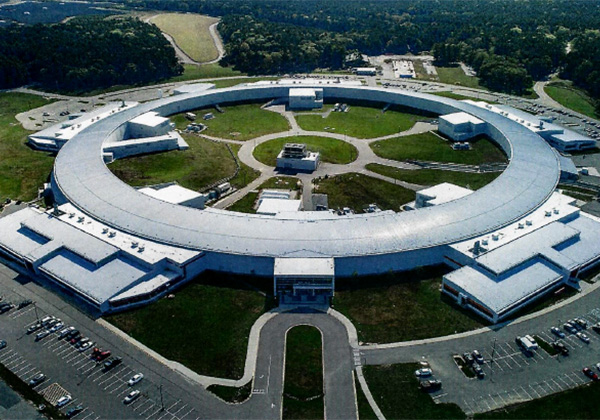
NSLS-II
The National Synchrotron Light Source II (NSLS-II) at Brookhaven National Laboratory is one of the world’s most advanced synchrotron light sources, providing powerful tools for exploring the structure and properties of materials. NSLS-II generates light beams up to 10 billion times brighter than the sun, allowing scientists to investigate materials with exceptional precision. Researchers from around the globe use NSLS-II’s specialized beamlines to study everything from energy storage and quantum materials to life sciences and advanced manufacturing. By uncovering the atomic structure, elemental composition, and electronic behavior of materials, NSLS-II supports discoveries that drive innovation across fields such as chemistry, biology, physics, and engineering.

CFN
The Center for Functional Nanomaterials (CFN) at Brookhaven National Laboratory is a leading national user facility dedicated to advancing nanoscience research. Operated for the U.S. Department of Energy, CFN provides researchers with access to state-of-the-art instrumentation and expert scientific support to explore the design, synthesis, and characterization of functional nanomaterials. Scientists at CFN focus on developing innovative methods for assembling polymers, nanoparticles, biomolecules, and two-dimensional materials into complex, functional architectures. Through strategic partnerships, including close collaboration with the National Synchrotron Light Source II (NSLS-II), CFN integrates advanced characterization tools such as nanoscale X-ray beams and high-resolution electron microscopy. By combining experimentation, theory, and simulation, CFN helps drive discoveries that support energy research, national security, and economic development.
LBMS
The Laboratory for BioMolecular Structure (LBMS) at Brookhaven National Laboratory is a state-of-the-art imaging center dedicated to advancing life science research. LBMS provides scientists with access to advanced cryo-electron microscopes and supporting laboratory resources to study the structure and behavior of biological molecules at the molecular level. By offering these powerful imaging capabilities, LBMS helps accelerate discoveries in biotechnology and medicine, supporting breakthroughs that address critical needs in healthcare and biofuels. Through expert guidance and cutting-edge technology, LBMS serves the greater research community and contributes to innovations that improve human health and the environment.