



Data Governance Council 2017-18 Annual Report
Approved June 15, 2018
Overview
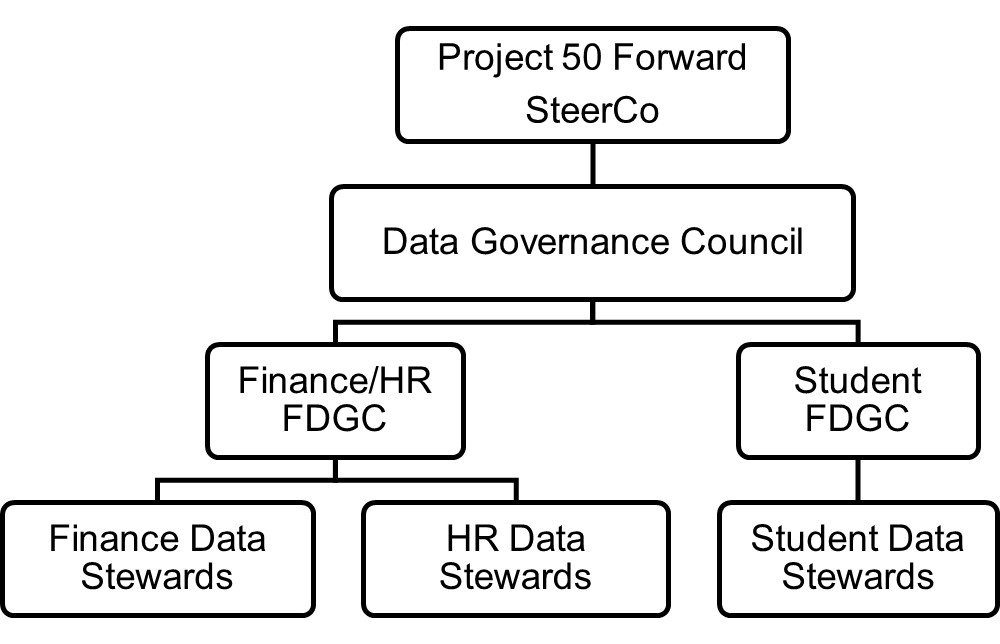
Stony Brook’s data governance system was established in fall 2016 by the Project 50
Forward Steering Committee following the recommendation of an initiative to improve
Stony Brook’s data infrastructure. The Data Governance Council (DGC) oversees the
data governance system, and began meeting in spring 2017. This is the first annual
report of the DGC.
Major accomplishments
- Convened Functional Data Governance Committees for
- Student issues
- Finance/HR issues
- Launched data governance website
- Adopted standards for
- Data dictionaries
- Institutional reporting
- Adopted a data strategy
- Identified and acquired metadata management tool
- Oversaw identification and implementation of 37 projects
- Complete: 6
- In progress: 9
- In queue: 22
Convened Functional Data Governance Committees (FDGCs)
Members were identified and invited to serve on FDGCs, with supervisor approval, and
groups began to meet in fall 2017. Because of overlap in membership between the Finance
FDGC and Human Resources (HR) FDGC, the two were combined into a single group.
In all, FDGCs met 14 times over the course of 2017-18 (8 Student, 6 Finance/HR). Attendance
in general exceeded 85% of membership. Braden Hosch and Kim Berlin chaired and co-chaired
these meetings, and Theresa Diemer provided operational support to ensure their effective
launch. This staffing structure will continue in 2018-19, with the intent of developing
leadership within each FDGC to allow the groups to run themselves.
Members 2017-18
Braden Hosch, Chair
Kim Berlin, Co-Chair
Ahmed Belazi
Diane Bello
David Cyrille
Lyle Gomes
Kate Larsen
Tracey McEachern
Rodney Morrison
Michael Ospitale
Jacqueline Pascariello
Wendy Tang
[Vacant] Univ. Senate designee
[Vacant] VP Research designee
Theresa Diemer, ex officio
Launched Data Governance Website
The Data Governance website was launched as a sub-page of the Institutional Research,
Planning & Effectiveness website.
https://www.stonybrook.edu/commcms/irpe/about/data_governance/data_governance.php
This arrangement allowed for immediate operational control and launch, although the
initial recommendation to make the DGC website operate from an independent location
or portal from the domain www.stonybrook.edu/data remains the long-term plan.
The website includes the Data Governance Framework, membership of the DGC and FDGCs
with meeting schedules and minutes, the report standards and data dictionary standards
adopted by the DGC, and the Stony Brook University Data Strategy.
Adopted Data Dictionary Standards and Report Standards
The Data Governance Framework (I.a.ii.2) charges the DGC with development and adoption
of standards for data dictionaries and reporting conventions.
Data Dictionaries
The DGC adopted data dictionary standards to establish formal expectations for meta
data storage and management; the standards include five principles and 16 required
elements.
See: https://www.stonybrook.edu/datagovernance-new/structure-standards/data-dictionary-standards.html
Reporting standards
Reporting standards have been developed to promote clear communication about data
and to empower data users to meet their responsibilities under the Data Governance
Framework to recognize that institutional data and information derived from it are
potentially complex (2a) and include information about the data source and criteria
when distributing data, reports and ad hoc analytics to guard against misinterpretations
of data (2b).
See: https://www.stonybrook.edu/datagovernance-new/structure-standards/report-standards.html
Adopted a data strategy
In consultation with the CIO, the DGC adopted a data strategy that identifies an approach
to (1) data acquisition, (2) data governance, (3) data quality, (4) data access, (5)
data usage & literacy, (6) data extraction & reporting, and (7) data analytics. A
data asset inventory for West Campus and East Campus, including the hospital was prepared
and shared with IT leadership for review and addition.
Identified and acquired metadata management tool
A subcommittee reviewed technology options to assist with data governance and metadata
management. The DGC followed the subcommittee’s recommendation to adopt the Data Cookbook.
Funds to acquire the tool were re-purposed from the budget for maintenance of a portion
of Blackboard Analytics. The tool has been procured and will be implemented beginning
in July 2018.
Oversaw identification and implementation of 37 projects
The DGC identified 37 projects or issues for initial attention. Six of these have
been completed, nine are in progress, and 22 are in the queue for 2018-19. The process
of identifying and prioritizing issues is ongoing. Completed projects include:
- Definition and storage rules for distance education programs/plans
- Coding standards and cross validation for distance education class sections
- Rationalization of academic group descriptions
- Cleaning and updating of domestic college/university names
- Cross-validation of full-time equivalent (FTE) employee value with full-time / part-time status
- Definition of full-time equivalent (FTE) employee definitions
Completed projects have improved maintenance of distance education offerings for billing,
planning, and program development; standardized naming conventions; improved data
quality on HR issues; improved capacities for multiple constituencies to accurately
identify FTE employee, distance ed. programs and majors and distance ed. classes;
and resulted in additional audit reports to capture these issues.
In progress projects goals include improved understanding around faculty and employee
data and improved maintenance and identification of student admissions, programs and
bio demographic data.
|
|
|
|||
|
|
|
|||
|
|
|