



DATA GOVERNANCE STRUCTURE
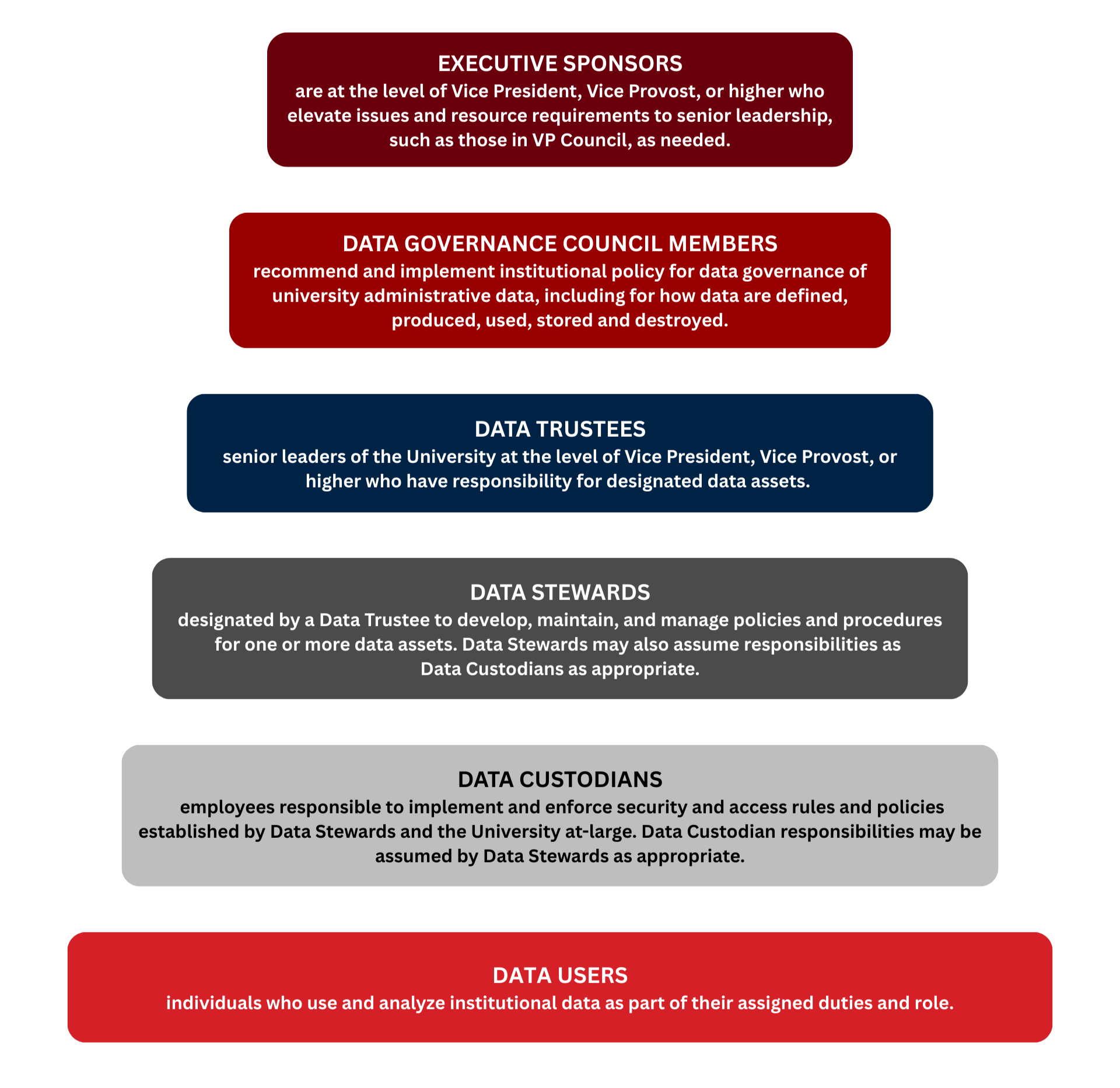
DATA GOVERNANCE STRUCTURE
Executive Sponsors are at the level of Vice President, Vice Provost, or higher who
elevate issues and resource requirements to senior leadership, such as those in VP
Council, as needed.
Data Governance Council Members recommend and implement institutional policy for data
governance of university administrative data, including for how data are defined,
produced, used, stored and destroyed.
Data Trustees are the senior leaders of the University at the level of Vice President,
Vice Provost, or higher who have responsibility for designated data assets.
All data assets of the University fall under the purview of Data Trustees. Data Trustees have the ultimate responsibility for designated data assets, including the security, confidentiality, integrity, usability, retention, and disposition of University Data. Data Trustees delegate care and management of University Data to Data Stewards.
All data assets of the University fall under the purview of Data Trustees. Data Trustees have the ultimate responsibility for designated data assets, including the security, confidentiality, integrity, usability, retention, and disposition of University Data. Data Trustees delegate care and management of University Data to Data Stewards.
Data Stewards are designated by a Data Trustee to develop, maintain, and manage policies
and procedures for one or more data assets. Data Stewards may also assume responsibilities
as Data Custodians as appropriate.
Domain Data Stewards
1. Role
Domain data stewards implement data management policies and procedures in domains of data that cut across multiple business areas.
2. Responsibilities
a. Maintain inventory of data assets
i. List of tables, fields, dictionary information
b. Coordinate Area Data Stewards in implementation of data standards
c. Maintain data dictionary for domain in consultation with data owners, ensuring each element
i. Has a clear unambiguous definition
ii. Has clear value definitions assigned to all values
iii. Is still being used (oversee removal/retirement of unused elements)
iv. Has adequate documentation for origin and sources of authority
d. Communicate data governance policies, procedures and practices to data owners
e. May have role in security policy to confer and restrict access to data
3. Membership
a. Data stewards are identified by the functional leader of an operational unit that manages data
b. Data stewards have data governance responsibilities as formal components of their performance plan
Domains include:
- Enrollment Management
- Financial Aid
- Human Resources
- Research Administration
- Student Records
- Accounting, Budget, Administration areas
- Campus Residences
- Center for Excellence, Teaching & Learning
Area Data Stewards
1. Role
Area Data Stewards are responsible for data and metadata of one or more domains for a specific organizational area or unit and work with domain data stewards to ensure data in their area are aligned with business requirements, to manage the life-cycle of their data, and to ensure data quality.
2. Responsibilities
a. Ensure data in the area are complete and adhere to valid values as specified in the data dictionary.
b. Oversee life-cycle of data in the area - data collection, entry, maintenance, and deletion.
c. Communicate business requirements for data elements to domain data stewards and other areas of the university.
d. Communicate data standards and requirements to members of their area/unit to ensure consistency.
Areas with domain data stewards include:
- Colleges & Schools
- VP Area HR functions (Provost, HSC, Medicine)
- Enrollment management areas (West Campus UG, East Campus UG/GR, SPD, Graduate School)
Domain Data Stewards
1. Role
Domain data stewards implement data management policies and procedures in domains of data that cut across multiple business areas.
2. Responsibilities
a. Maintain inventory of data assets
i. List of tables, fields, dictionary information
b. Coordinate Area Data Stewards in implementation of data standards
c. Maintain data dictionary for domain in consultation with data owners, ensuring each element
i. Has a clear unambiguous definition
ii. Has clear value definitions assigned to all values
iii. Is still being used (oversee removal/retirement of unused elements)
iv. Has adequate documentation for origin and sources of authority
d. Communicate data governance policies, procedures and practices to data owners
e. May have role in security policy to confer and restrict access to data
3. Membership
a. Data stewards are identified by the functional leader of an operational unit that manages data
b. Data stewards have data governance responsibilities as formal components of their performance plan
Domains include:
- Enrollment Management
- Financial Aid
- Human Resources
- Research Administration
- Student Records
- Accounting, Budget, Administration areas
- Campus Residences
- Center for Excellence, Teaching & Learning
Area Data Stewards
1. Role
Area Data Stewards are responsible for data and metadata of one or more domains for a specific organizational area or unit and work with domain data stewards to ensure data in their area are aligned with business requirements, to manage the life-cycle of their data, and to ensure data quality.
2. Responsibilities
a. Ensure data in the area are complete and adhere to valid values as specified in the data dictionary.
b. Oversee life-cycle of data in the area - data collection, entry, maintenance, and deletion.
c. Communicate business requirements for data elements to domain data stewards and other areas of the university.
d. Communicate data standards and requirements to members of their area/unit to ensure consistency.
Areas with domain data stewards include:
- Colleges & Schools
- VP Area HR functions (Provost, HSC, Medicine)
- Enrollment management areas (West Campus UG, East Campus UG/GR, SPD, Graduate School)
Data Custodians are employees responsible to implement and enforce security and access
rules and policies established by Data Stewards and the University at-large. Data
Custodian responsibilities may be assumed by Data Stewards as appropriate.
Data Custodians grant and remove access to specific users and/or data, follow prescribed data handling procedures, and comply with federal and state laws and regulations and University policies for the data in their custody.
Data Custodians grant and remove access to specific users and/or data, follow prescribed data handling procedures, and comply with federal and state laws and regulations and University policies for the data in their custody.
Data Users are individuals who use and analyze institutional data as part of their
assigned duties and role at the university.
Data Assets are information-based resources of significant scope, comprised of University
Data. Data assets include repositories of University Data, systems housing university
data, and services that host University Data.