


Biography:
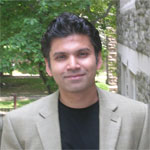
Professor Kunal K. Das is a theoretical physicist whose research is at the exciting interface between condensed matter physics and the physics of ultracold atoms. His current interests include quantum information, and the effects of topology and interactions in quantum dynamics. Much of his recent work has been in the context of ultracold atoms in topologically non-trivial configurations such as in ring-shaped lattices. His research is motivated by basic science as well as by practical applications. He continues to examine ultracold atoms as a macroscopic quantum platform to simulate and probe fundamental physics. He has developed high precision sensor mechanisms associated with such platforms that have led to two U.S. patent awards.
Professor Das has worked on several different topics throughout his career. He has contributed to the theory of Bose Einstein condensate, degenerate Fermi gas and Tonks-Girardeau gas. He has worked on mesoscopic transport in the context of nanotechnology as well as atomtronics. He has published works on applying quantum and classical stochastic calculus to complex systems spanning biology and many-body physics.
Over sixty students have been closely mentored in research by Professor Das. They include both undergraduate and graduate students at multiple universities, and many of them have received awards including at the national level. He is dedicated to creating excellent career placements for the students who work with him.
His research has been continuously supported by grants for nearly two decades, mostly from the National Science Foundation. He has been a Scholar of the Kavli Institute of Theoretical Physics (KITP) in Santa Barbara, CA. He has a deep interest in the foundations of modern physics, which he actively pursues outside of his professional obligations.
Patents
- Patent No. US-12287207-B2 UNITED STATES. Date Issued = 04/29/2025
- Patent No. US-11243079-B2 UNITED STATES. Date Issued = 02/08/2022
Publications
Selected Publications (Titles link to the articles on the journal websites)
- Tomáš Opatrný, Allison Brattley, and Kunal K. Das, Benchmark for Quantum Teleportation with Non-Uniform Prior Distribution, (under review) (2026).
- Allison Brattley, Tomáš Opatrný, and Kunal K. Das, General Machine Learning Algorithm for Quantum Teleportation , Phys. Rev. A 113, 052401 (2026).
- Jian Jun Liu and Kunal K Das, Finite size effects for interacting bosons on small ring lattices, Journal of Physics B, 59 065301 (2026)
- Kunal K. Das and Jacob Christ, Extremal Principle for the Harper-Hofstadter Model, Phys. Rev. B 111, 075405 (2025)
- Allison Brattley, Tomáš Opatrný, and Kunal K. Das, Spin-orbit and hyperfine simulations with two-species ultracold atoms in a ring, Phys. Rev. A 110, 023319 (2024).
- Caelan Brooks and Kunal K. Das, Quantum states and spectra of small cylindrical and toroidal lattices, J. Phys. B At. Mol. Opt. 57, 205301 (2024).
- Caelan Brooks and Kunal K. Das, Invariant points amidst gauge sensitivity in cylindrical and toroidal lattices, Phys. Rev. B 109, 115404 (2024).
- Jonathan Tekverk, Christopher Siebor and Kunal K. Das, Effects of a rotating periodic lattice on coherent quantum states in a ring topology: The case of positive nonlinearity, Phys. Rev. A 109, 023315 (2024).
- Allison Brattley and Kunal K. Das, Quantum scattering states in a nonlinear coherent medium, Phys. Rev. A 108, 023314 (2023).
- Tomas Opatrny and Kunal K. Das, Entangled collective spin states of two-species ultracold atoms in a ring, Phys. Rev. A 108, 043307 (2023).
- Hongyi Huang, and Kunal K. Das, Effects of a rotating periodic lattice on coherent quantum states in a ring topology: The case of positive nonlinearity, Phys. Rev. A 104, 053320 (2021).
- Caelan Brooks, Allison Brattley, and Kunal K. Das, Rotation Sensitive Quench and Revival of Coherent Oscillations in a Ring Lattice, Phys. Rev. A 103, 013322 (2021).
- Kunal K. Das, Significance and Sensor Utility of Phase in Quantum Localization Transition, Phys. Rev. Letters 125, 070401 (2020).
- Kunal K. Das and Miroslav Gajdacz, Synthetic Gauge Fields in Real Space in a Ring lattice, Sci. Reports 9, 14220 (2019).
- Kunal K. Das and Jacob Christ, Realizing the Harper model with ultracold atoms in a ring lattice, Phys. Rev. A 99, 013604 (2019)
- Kunal K. Das, Measurement and significance of Wilson loops in synthetic gauge fields, Phys. Rev. A 97, 053620 (2018)
- Kunal K. Das, Joshua Garner, and Kevin Ruppert, Dynamical resonances and stepped current in an attractive quantum pump, Phys. Rev. A 97, 033614 (2018);
- Miroslav Gajdacz, Kunal K. Das, Jan Arlt, Jacob F. Sherson, and Tomáš Opatrný, Time limited optimal dynamics beyond the Quantum Speed Limit, Phys. Rev. A 92, 062106 (2015).
- M. Kolar, T. Opatrný, and Kunal K. Das, Criticality and spin squeezing in the rotational dynamics of a Bose-Einstein condensate on a ring lattice, Phys. Rev. A 92, 043630 (2015)
- Tomáš Opatrný, Michal Kolář, Kunal K. Das and , Spin squeezing by tensor twisting and Lipkin-Meshkov-Glick dynamics in a toroidal Bose-Einstein condensate with spatially modulated nonlinearity, Phys. Rev. A 91, 053612 (2015).
- Tommy A. Byrd, Kunal K. Das, Kevin A. Mitchell, Seth Aubin, and John B. Delos, Matter,Energy and Heat transfer in Ballistic atom pumps, Phys. Rev. A 90, 023602 (2014).
- Megan K. Ivory, Tommy A. Byrd, Andrew J. Pyle, Kunal K. Das, Kevin A. Mitchell, Seth Aubin, and John B. Delos, Ballistic atom pumps, Phys. Rev. A 90, 023602 (2014)
- Kunal. K. Das, Matthew R. Meehan, Andrew J. Pyle, Quantum Paddlewheel with Ultracold Atoms in Waveguides, Phys. Rev. A 89 063626 (2014).
- Miroslav Gajdacz, Tomáš Opatrný and Kunal K. Das, An atomtronics transistor for quantum gates, Phys. Lett. A 378, 1919-1924 (2014).
- T. Byrd, M. Ivory, A. J. Pyle, S. Aubin, J. Delos, K. Mitchell and Kunal K. Das Scattering by an oscillating barrier: quantum, classical, and semiclassical comparison, Phys. Rev. A 86 013622 (2012)
- Kunal K. Das, Mesoscopic transport and interferometry with wave packets of ultracold atoms: Effects of quantum coherence and interactions, Phys. Rev. A (Rapid Comm.) 84 031601(R) (2011).
- Miroslav Gajdacz, Tomáš Opatrný and Kunal K. Das, Transparent, Non-local, Species-selective Transport in an Optical Superlattice Containing Two Interacting Atom Species, Phys. Rev. A 83, 033623 (2011).
- Kunal K. Das, and Seth Aubin, Quantum Pumping with Ultracold Atoms on Microchips: Fermions versus Bosons, Phys. Rev. Lett. 103, 123007 (2009).
- Tomáš Opatrný and Kunal K. Das, Conditions for vanishing central-well population in triple well adiabatic transport, Phys. Rev. A 79, 012113 (2009).
- Kunal K. Das and Tomáš Opatrný, The role of quantum interference and asymmetries in operation of quantum pumps, Phys. Lett. A 374, 485 (2010)..
- Kunal K. Das, A Quantum Singlet Pump, J. Phys. Condens. Matter 20, 455202 (2008).
- Robert Rovetti, Kunal K. Das, Alan Garfinkel, and Yohannes Shiferaw, Macroscopic consequences of calcium signaling in microdomains: A first passage time approach Phys. Rev. E 76, 051920 (2007).
- Sungjun Kim, Kunal K. Das, and Ari Mizel, Adiabatic quantum pumping in an Aharonov-Bohm loop and in a siliconlike nanowire:The role of interference in real space and in momentum space, Phys. Rev. B 76, 085307 (2007).
- Kunal K. Das, Sungjun Kim, and Ari Mizel, Controlled Flow of Spin-Entangled Electrons via Adiabatic Quantum Pumping, Phys. Rev. Lett. 97, 096602 (2006).
- Sungjun Kim, Kunal K. Das, and Ari Mizel, Adiabatic quantum pumping of a desired ratio of spin current to charge current, Phys. Rev. B 73, 075308 (2006).
- Kunal K. Das and Ari Mizel, Radial Dependence of the Carrier Mobility in Semiconductor Nanowire, J. Phys.: Condens. Matter 17, 6675 (2005).
- Kunal K. Das, Yuri V. Rosotovtsev, and M. O. Scully, Thermodynamic and Noise Considerations for the detection of Microscopic Particles in a Gas by Photoacoustic Raman Spectroscopy, Opt. Commun. 246, 551 (2005).
- Kunal K. Das, G. S. Agarwal, Yu. M. Golubev, and M. O. Scully, A Langevin Analysis of Fundamental Noise Limits in Coherent Anti-Stokes Raman Spectroscopy, Phys. Rev. A 71, 013802 (2005).
- Calvin Stubbins, Kunal Das, and Yohannes Shiferaw, Low-lying energy levels of the Hydrogen Atom in a Strong Magnetic Field, Journal of Physics B, 37, 2201 (2004).
- Kunal K. Das, Bose-Fermi Mixtures in One Dimension, Phys. Rev. Lett. 90, 170403 (2003).
- Kunal Das, Highly anisotropic Bose-Einstein condensates: crossover to lower dimensions, Phys. Rev. A, 66, 053612 (2002).
- Kunal K. Das, M. D. Girardeau and E. M. Wright, Interference of a thermal Tonks gas on a ring, Phys. Rev. Lett. 89, 170404 (2002).
- Kunal K. Das, M. D. Girardeau and E. M. Wright, Crossover from one to three dimensions for a gas of hard-core bosons, Phys. Rev. Lett. 89, 110402 (2002).
- Marvin D. Girardeau, Kunal K. Das and Ewan M. Wright, Theory of a one-dimensional double-X atom interferometer, Phys. Rev. A 66, 023604 (2002).
- Kunal K. Das, G. John Lapeyre, and Ewan M. Wright, Interference of a Tonks-Girardeau Gas on a Ring, Phys. Rev. A 65, 063603 (2002).
- Kunal Das and Thomas Bergeman, Trends in Resonance Energy Shifts and Decay Rates for Bose-Condensates in a Harmonic Trap, Phys. Rev. A 64, 013613 (2001).
- J.H. Marburger III and K.K. Das, Visibility Limit in Multiparticle Eigenstates of Definite Relative Phase, Phys.Rev. A 59, 2213 (1999).
- C. Stubbins and K. Das, Variational Approach to Approximating Energy Levels, Phys.Rev. A 47, 4506 (1993).
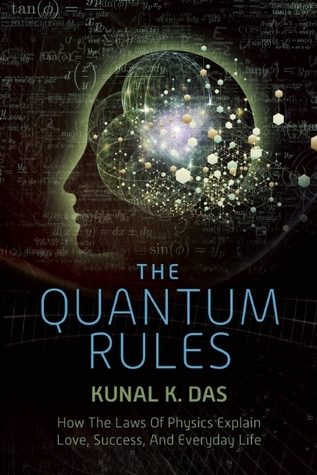
Published Book (NY Times Bestseller)
Research
My reasearch has spanned multiple areas of physics over the years. A brief overview is given below for each, along with a couple of representative papers. While I am not actively working on some of these topics at the present, they all continue to influence and guide my current research interests. Specifically, the diversity of topics has been indispensible for my long term research on the foundations of modern physics, not described here, but on which I expect to publish soon.
- Quantum Information
- Nonlinear Physics
- Quantum Sensors and Simulators
- Topology and Synthetic Gauge Fields
- Coherent Transport Adiabatic Passage
- Mesoscopic Transport
- Stochastic Processes: Quantum and Classical
- Semiclassical Physics
- 1D Physics and Tonks-Girardeau Gas
- Ultracold Atoms, Bose-Einstein condensates (BEC)
This Research continues to be supported by the National Science Foundation (NSF)
Quantum Information
Recent work has focussed on quantum teleportation. A general algorithm was developed based on machine-learning to generate quantum teleportation of arbitrary single and multi-particle states with optimal fidelity. Further improvement of fidelity has been accomplished with multi-state optimization and adaptive measurements. Another important issue that has been addressed is creating well-defined benchmarks to distinguish quantum teleportation from classical counterparts that do not use entanglement. Most established benchmarks only work for teleporting states chosen from an uniform distribution. We have developed rigorous benchmarks that can be applied to teleportation of states that follow non-uniform prior distributions as well. On another front, since much of quantum technology depends on entanglement generation, a recent paper examines how maximal entanglement could be generated between collective spin states of two distinct species of interacting coherent atoms.
- Tomáš Opatrný, Allison Brattley, and Kunal K. Das, Benchmark for Quantum Teleportation with Non-Uniform Prior Distribution, (under review) (2026).
- Allison Brattley, Tomáš Opatrný, and Kunal K. Das, General Machine Learning Algorithm for Quantum Teleportation, Phys. Rev. A 113, 052401 (2026).
Nonlinear Physics
Starting with my doctoral thesis work on Bose-Einstein-condensate (BEC), I have been interested in the nonlinear Schrödinger equation (NLSE) which provides the mean-field description of interactions. In recent years, with the help of several students, I have done a comprehensive study of the NLSE with both open and ring-shaped boundary conditions. We developed a unified description of 1D quantum scattering in the presence of interactions, in terms of a single Jacobi elliptic function with a complex phase. This work hs led to a new way for describing scattering of interacting systems with stationary states. In other work, comprehensive spectrum of stationary states of a NLSE has been determined for a BEC trapped in a ring-shaped lattice, for both positive and negative nonlinearities. I have also been interested in interacting quantum systems that use a full quantum description, such as the Bose-Hubbard model. A recent paper showed novel finite size features in small systems of bosons trapped in just a few lattice sites, which vanish in the thermodynamic limit.
- Jian Jun Liu and Kunal K Das, Finite size effects for interacting bosons on small ring lattices, Journal of Physics B, 59 065301 (2026).
- Allison Brattley and Kunal K. Das, Quantum scattering states in a nonlinear coherent medium, Phys. Rev. A 108, 023314 (2023).
Quantum Sensors and Simulators
Ultracold atoms have become the go-to simulators for quantum phenomena since it scales up quantum behavior from the scale of elementary particles to conglomerations of millions of atoms, as in a BEC. That allows utilizing quantum effects to push the sensitivity of sensors, particularly since matter waves have much shorter wavelengths than typical lasers. Much of my recent work has been in developing ideas for different simulators and sensors using ultracold atoms. I have had two US patent awards for a new principle based on localization rather than interferometry, for high-precision sensors for rotation and magnetic field. Some recent papers have put forward mechanisms to simulate spin-orbit and hyperfine structures, to implement the Lipkin-Meshkov-Glick model, and to study nonlinear phase transitions and spin squeezing, all using interacting ultracold atoms in ring traps.
- Kunal K. Das, Significance and Sensor Utility of Phase in Quantum Localization Transition, Phys. Rev. Letters 125, 070401 (2020).
- M. Kolar, T. Opatrný, and Kunal K. Das, Criticality and spin squeezing in the rotational dynamics of a Bose-Einstein condensate on a ring lattice, Phys. Rev. A 92, 043630 (2015).
Topology and Synthetic Gauge Fields
In the field of ultracold atoms, one of the most significant innovations has been the ability to create features that emulate the behavior of charged particles in the presence of a magnetic field, via a clever use of geometric phase. This continues to be an area of active interest for me due to its ties to gauge theory. I have written a paper on how the quintessential Harper model can be simulated with ultracold atoms in a ring trap. I have extended those ideas to two-dimensional lattice systems with non-trivial topology, including a cylindrical lattice and a toroidal lattice. I have also shown how Wilson loops can be used to characterize truly non-Abelian gauge structures created synthetically, and I proposed a new diamond scheme for creating degenerate dark states that are essential for creating synthetic gauge fields with cold atoms.
- Caelan Brooks and Kunal K. Das, Quantum states and spectra of small cylindrical and toroidal lattices, J. Phys. B At. Mol. Opt. 57, 205301 (2024).
- Kunal K. Das and Jacob Christ, Realizing the Harper model with ultracold atoms in a ring lattice, Phys. Rev. A 99, 013604 (2019).
Coherent Transport Adiabatic Passage (CTAP)
Coherent Transport Adiabatic Passage (CTAP) is an almost magical quantum effect whereby material entities like atoms and electrons can be transferred from one potential well to a non-adjacent potential well without ever having any significant presence in an intervening well. Although it looks on the surface like 'teleportation', it is actually the spatial analog of the well know effect known as Stimulated Raman Adiabatic Passage (STIRAP). I wrote several papers on this phenomenon in the context of ultracold atoms, mostly with my long term collaborator Tomáš Opatrný, where we identified optimal transfer conditions, generalized to dual interacting species transport without the two species ever overlapping, and designed an atomtronics version of a transistor operation with neutral atoms carriers instead of electrons and holes.
- Miroslav Gajdacz, Tomáš Opatrný and Kunal K. Das, Transparent, Non-local, Species-selective Transport in an Optical Superlattice Superlattice Containing Two Interacting Atom Species, Phys. Rev. A 83, 033623 (2011).
- Miroslav Gajdacz, Tomáš Opatrný and Kunal K. Das, An atomtronics transistor for quantum gates, Phys. Lett. A 378, 1919-1924 (2014).
Mesoscopic transport
My interest in mesoscopic transport started during my post-doc at Penn State. I used the Landauer-Büttiker formalism extensively to model transport in nanowires, which are treated as quasi 1D waveguides with different transverse energies acting as distinct channels, and the current driven by the difference in chemical potential. I wrote several papers on adiabatic quantum pumps, in the context of nanoscale transport, and on characterizing mobility in nanowires. This brought me into the general realm of nano-technology, which has been quite useful over the years.
Later, I realized that the same physical setup could be translated to cold atomic systems and wrote a paper on it, specifically suggesting routes to implementing quantum pumps using atom-chips technology. A version of it was subsequently implemented in experiments in the lab of my collaborator, Seth Aubin who was also a coauthor on that initial proposal. I wrote a few other papers on various types of quantum pumping mechanisms, involving different types of time-varying potentials.
- Kunal K. Das, and Seth Aubin, Quantum Pumping with Ultracold Atoms on Microchips: Fermions versus Bosons, Phys. Rev. Lett. 103, 123007 (2009).
- Kunal K. Das, Sungjun Kim, and Ari Mizel, Controlled Flow of Spin-Entangled Electrons via Adiabatic Quantum Pumping, Phys. Rev. Lett. 97, 096602 (2006).
Stochastic Processes: Quantum and Classical
I have applied stochastic calculus to study both quantum and classical systems. The underlying principles are universal in the sense that they can be applied to all arenas of study including physics, biology and economics, which have noise or randomness in them. My work has utilized both Langevin and Fokker-Planck approaches. In the quantum regime, I worked with Girish Agarwal, an authority in the field, on a Langevin analysis of fundamental noise limits in some aspects of Coherent Anti-Stokes Raman spectroscopy. On the classical side, I published on stochastic properties of Photoacoustic Raman spectroscopy, and also on calcium signalling in the context of ion channels in biological cells.
- Kunal K. Das, G. S. Agarwal, Yu. M. Golubev, and M. O. Scully, A Langevin Analysis of Fundamental Noise Limits in Coherent Anti-Stokes Raman Spectroscopy, Phys. Rev. A 71, 013802 (2005).
- Robert Rovetti, Kunal K. Das, Alan Garfinkel, and Yohannes Shiferaw, Macroscopic consequences of calcium signaling in microdomains: A first passage time approach, Phys. Rev. E 76, 051920 (2007).
Semiclassical Physics
n the process of studying quantum pumps, and general quantum scattering by time-varying potentials, a comparison with classical scattering naturally led to bridging of the two limits via semiclassical theory. This lead to several interesting papers with collaborators Seth Aubin and John Delos at The College of William & Mary, and Kevin Mitchell from UC Merced. Specifically, the semiclassical theory gave excellent agreement with the structure of the Floquet side-bands intrinsic to scattering by time-dependent potentials.
- T. Byrd, M. Ivory, A. J. Pyle, S. Aubin, J. Delos, K. Mitchell and Kunal K. Das, Scattering by an oscillating barrier: quantum, classical, and semiclassical comparison, Phys. Rev. A 86 013622 (2012).
- Megan K. Ivory, Tommy A. Byrd, Andrew J. Pyle, Kunal K. Das, Kevin A. Mitchell, Seth Aubin, and John B. Delos, Ballistic atom pumps, Phys. Rev. A 90, 023602 (2014).
1D Physics and Tonks-Girardeau Gas
I wrote several papers on ultracold atoms in 1D, particularly during my postdoctoral years in the Optical Sciences Center working with Marvin Girardeau, who was a pioneer in this field. In those papers, I explore Bose-Fermi mixtures in 1D, and crossover from 1D to 3D, and interference effects. My experience with 1D systems was later useful for studying mesoscopic transport in nanowires, and ultracold atoms in quasi-1D ring traps.
- Kunal K. Das, Bose-Fermi Mixtures in One Dimension, Phys. Rev. Lett. 90, 170403 (2003).
- Kunal K. Das, M. D. Girardeau and E. M. Wright, Crossover from one to three dimensions for a gas of hard-core bosons, Phys. Rev. Lett. 89, 110402 (2002).
Ultracold Atoms, Bose-Einstein condensates (BEC)
My doctoral work was on the static and dynamical properties of BEC. I studied the evolution and damping of BEC, and examined how highly anisotropic BEC's crossover from 3D to 2D and 1D. In recent years, I have been interested in the properties of BEC in configurations with non-trivial topology. Wrapping degenerate ultracold atoms around ring shaped traps can make the non-local quantum effects directly manifest in the macroscopic quantum states. An azimuthal lattice makes the system both more interesting and in some ways simpler by introducing a new length scale. Such coherent systems allow a wide range of quantum mechanical effects to be investigated.
- Kunal Das and Thomas Bergeman, Trends in Resonance Energy Shifts and Decay Rates for Bose-Condensates in a Harmonic Trap, Phys. Rev. A 64, 013613 (2001).
- Kunal Das, Highly anisotropic Bose-Einstein condensates: crossover to lower dimensions, Phys. Rev. A 66, 053612 (2002).
Brief Curriculum Vitae
Education
- Pre-Doctoral Fellow, Harvard-Smithsonian Center for Astrophysics, Cambridge MA
- Ph.D. in Theoretical Physics, SUNY Stony Brook, NY
- M.A. in Theoretical Physics, SUNY Stony Brook, NY
- B. A. in Physics and Mathematics , Franklin and Marshall College, Lancaster PA
Professional Experience
- Professor of Physics, Kutztown University of Pennsylvania (2013 - continuing)
- Adjunct Professor of Physics, Stony Brook University (2021 - continuing)
- Visiting Scholar, Stony Brook University (2017 - 2021)
- Associate Professor of Physics, Kutztown University of Pennsylvania (2008 - 2013)
- Assistant Professor of Physics, Fordham University, Bronk NY (2005- 2008)
- Post-Doctoral Researcher, Penn State University, University Park PA (2003-2005)
- Post-Doctoral Researcher, Optical Sciences Center of the University of Arizona, Tucson AZ (2001-2003)
Awards and Grants (~ $ 1 million)
- Research Grant from National Science Foundation (2023-2026)
- Research Grant from National Science Foundation (2020-2023)
- Research Grant from National Science Foundation (2017-2020)
- Scholar, Kavli Institute of Theoretical Physics (2012-2014)
- Research Grant from National Science Foundation (2013-2017)
- Chambliss Research Award (2012)
- Research Grant from National Science Foundation (2009-2012)
- Cottrell College Science Award from the Research Corporation (2007-2008)
People
- Sicheng Liu [2024 – 2026] [Ph.D. student at Stony Brook Univ ]
- Dan Markov [2024 – 2025] [Ph.D. student at City Univ. of New York ]
- Onyu Kim [2024 – 2025] [Ph.D. student at Rutgers Univ ]
- Leslie Yan [2024 – 2025]
- Jonathan Tekverk Ph.D. [2022 – 2024] [Ph.D. student at Stony Brook Univ ]
- Jian Jun Liu Ph.D. [2022 – 2024] [Ph.D. student at Univ. of Texas, Austin]
- Christopher Siebor [2022 – 2025] [Ph.D. student at Montana State University]
- Aryaman Mishra [2022] [Univ. of Cambridge]
- Sophie Miller [2025-cont]
- Josiah McCarty [2024-cont] [Ph.D. student at McMaster University]
- Caelan Brooks [2018-2022] [Ph.D. student at Harvard University]
- Allison Brattley [2018-2026] [M.D.- Ph.D. Yale University; B.S. M.I.T.]
- Katherine Gabriel [2022-2026] [Ph.D. student at University of Rochester]
- Michael Lafferty [2022-2024] [Ph.D. student at University of Virginia]
- Cameron Crites [2022-cont.]
- Nicholas Davis [2020 -2021.]
- Nicholas Brown [2020 - 2021]
- Ankhitha Manjunatha [2017-2018] [B.S. Princeton University]
- Anna Faretty [2017-2020] ] [Ph.D. student at Kansas State University]
- Gerald Curran [2017-2020] [Ph.D. student at Lehigh University]
- Michael Collins [2020-2021]
- Taylor Worthington [2017-2018] [Gentex Co.]
- Adam Saybolt [2017-2017] [Intelligence Services]
- Ethan Wallace [2017-2017] [Data Specialist at Eurofins Lancaster Labs]
- Jacob McCann [2017-2017] [Ph.D. student at Penn State University]
- Angelo Vardaxis [2016-2017]
- Edward Metz [2016-2018] [Wills Towers Watson]
- Andrew Venzie [2016-2018] [Ph.D. student at Lehigh University]
- Jacob Christ [2015-2019] [Lockheed Martin, MS, Lehigh University]
- Joseph Ritzko [2015-2019] [Defense Industry]
- Jennica LeClerc [2105-2017] [Ph.D. student at Florida State University]
- Daniel Steinberg [2015-2016]
- Joshua Garner [Ph.D. student at Rensselaer Polytechnic University]
- Brian Kilpatrick [2012- 2014] [Ph.D. Brown University]
- Kevin Ruppert [M.Ed Kutztown University]
- Matthew Meehan [2011- 2013] [Ph.D. U. of Wisconsin, Madison]
- Eric Entrup [2012- 014] [Lockheed Martin]
- Ian Tomes [2013-2015] [Defense Industry]
- John Janda [2012- 2014] [Engineer at DEKA]
- Ryan Scheirer [2010-2011] [Ph.D. student in Oregon State]
- Peter Koufalis [2010- 2013] [Ph.D. Cornell University]
- Andrew J. Pyle [2009- 2011] [Ph.D. The College of William & Mary]
- John Jablonski [2009] [Ph.D. student, Penn State University]
- Adam Bullock [2010- 2011]
- Alexander Smith [2008]
- Hongyi Huang, Stony Brook University [2020 – 2023]
- Jonathan Tekverk, Stony Brook University [2022 – 2024]
- Jian Jun Liu, University of Texas, Austin [2022 – 2025]
- Andrew J. Pyle, The College of William and Mary, [2012 – 2018]
- Megan Ivory, The College of William and Mary, [2010 – 2015]
- Tommy Byrd, The College of William and Mary, [2012 – 2014]
- Miroslav Gajdacz, Palacký University, Czech Republic, [2010-2012]
- Sungjun Kim, Pennsylvania State University, [2003-2005]
- J. Mauricio Campuzano, Stevens Institute of Technology, [2007-2008]
- Frank Corvino, Stevens Institute of Technology, [2006-2007]
- Jessica Leszczynski [2006-2008]
- Daniel Blessing ; [2007-2008] [Ph.D. U. of California, San Diego]
- David Carretero [2007-2008] [Ph.D. University of Cambridge, U.K.]
- Matthew Galligan [2007-2008]
- Samantha Kennelly [2007] [Mech. Engineering, Columbia University NY]
- Christopher Chung [2006]
- LeRoy Apker Award: Caelan Brooks
For work on done at Kutztown U. and at Boston U. - Exoplanet Science Prize Fellowship (Inaugural): Brian Kilpatrick
For work done at Brown U. - Delaware Valley Science Fair, 1st place & Franklin Inst. Prize: Ankhitha Manjunatha
For work done at Kutztown U. - NASA Earth and Space Science Fellowship: Brian Kilpatrick
For work on done at Brown U. - NSF Graduate Fellowship: Caelan Brooks
For work done at Harvard U. - Syed R. Ali-Zaidi Award: Caelan Brooks
For work on done at Kutztown U. - American Physical Society (APS - NYS) Research Poster Award:
Matthew Galligan, David Carretero
For work done at Fordham U. - REU at CERN, Geneva: Peter Koufalis
During time at Kutztown U. - Chambliss Award (KU): Caelan Brooks, Jacob Christ, Peter Koufalis
- Physical Sciences Award (KU): Andrew Pyle, Anna Faretty, Caelan Brooks, Jacob Christ, Peter Koufalis
- KU Bears Award (KU): Sofie Miller, Josiah McCarty,Kathryn Gabriel, Brett Yagiello, Nicholas Brown, Michael Collins, Michael Lafferty
- Campion Fellow (Fordham U): Danny Blessing, David Careterro