


Dimitris Assanis, PhD
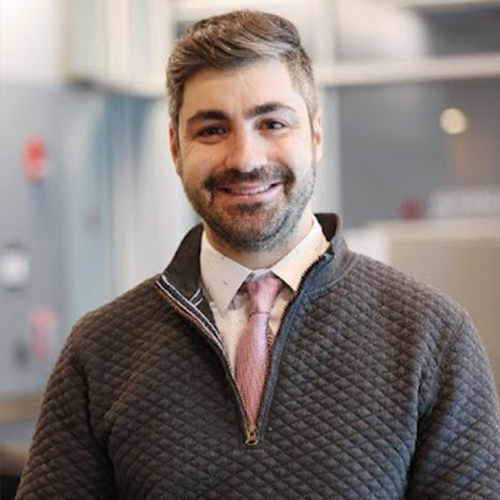 Associate Professor, Mechanical Engineering
Phone: 631-632-8022
Email: dimitris.assanis@stonybrook.edu
Office: Light Engineering 131
Education:
- University of Michigan, Mechanical Engineering, Ph.D. 2016
- University of Michigan, Mechanical Engineering, M.S. 2012
- University of Michigan, Mechanical Engineering, B.S. 2011
Professional Experience:
- Associate Professor, Mechanical Engineering, Stony Brook University, 2025 - present
- Assistant Professor, Mechanical Engineering, Stony Brook University, 2020 – 2025
Research Interests and History:
Dimitris Assanis is an Associate Professor of Mechanical Engineering at Stony Brook University, Founding Director of the Advanced Combustion & Energy Systems (ACES) Laboratory, and an affiliate of the Institute for Advanced Computational Science. His research advances efficient, low-emission power generation and propulsion through fundamental and applied work in advanced combustion, alternative and carbon-free fuels, hydrogen energy systems, and hybrid energy conversion. His group combines experiments, optical diagnostics, high-fidelity simulation, and data-driven methods to understand and control fuel injection, mixing, ignition, heat release, emissions, and system performance. Current efforts span hydrogen and ammonia combustion; renewable and bio-derived fuels; fuel-flexible engines and distributed generators; electrochemical–combustion hybrid systems; and resilient, dispatchable clean power.
Overview:
Professor Assanis leads the ACES Laboratory in developing clean, high-efficiency energy-conversion technologies for transportation, distributed power, and the evolving electric grid. The group investigates hydrogen, ammonia, renewable liquid fuels, natural gas, and hybrid energy systems, linking fundamental combustion science with practical component and system development. Research integrates advanced engine experiments, high-speed optical diagnostics, emissions measurement, CFD and large-eddy simulation, chemical-kinetics modeling, and AI-enabled prediction and optimization. A central goal is to reduce NOx, particulate matter, methane slip, and lifecycle carbon emissions while preserving efficiency, reliability, flexibility, and real-world deployability. Current work includes hydrogen-powered distributed generation and microgrids, hydrogen-plus-renewables systems, fuel-flexible combustion, laser-enabled ignition, and independent field validation of next-generation power technologies.
Accomplishments:
- Developed and patented, with an automotive OEM, a passively fueled dual pre-chamber cylinder-head concept for high-efficiency lean combustion.
- Established one of the few U.S. university research capabilities for controlled hydrogen- and ammonia-fueled engine combustion, emissions characterization, and fuel-flexible power-system testing.
- Demonstrated low-carbon and carbon-free combustion pathways in spark-ignition and compression-ignition engines using hydrogen, ammonia, methane–hydrogen blends, renewable biofuels, reformate, and fuel-cell anode off-gas.
- Co-developed advanced optical and computational tools—including high-speed spray imaging, extinction-based tomography, CFD/LES, and machine-learning models—to measure and predict fuel injection, mixing, ignition, combustion, and emissions.
- Designed and demonstrated scalable engine-exhaust sampling and aftertreatment testbeds that accelerate emissions-control and catalyst development under representative exhaust conditions.
- Leading DOE-supported HyPower work to demonstrate integrated hydrogen production, storage, and use with renewable generation, while independently evaluating hydrogen-capable dispatchable power technologies for New York’s grid.
Research Areas:
Research Interests:
Advanced Energy
The Advanced Combustion & Energy Systems (ACES) Laboratory develops high-efficiency, low-emission energy-conversion systems for transportation, distributed power, and the evolving electric grid. Professor Assanis’ research spans advanced engines, solid-oxide fuel-cell/engine hybrids, and fuel-flexible systems using hydrogen, ammonia, renewable fuels, natural gas, and carbon-recycling pathways. Current work advances hydrogen production, storage, and utilization; field validation of hydrogen-capable linear generators; and resilient, dispatchable power for New York. Looking ahead, the group is developing modular hydrogen-plus-renewables energy systems that integrate power generation, thermal management, emissions control, storage, controls, and grid-facing operation.
Design & Manufacturing
Professor Assanis’ research translates combustion and energy-conversion science into practical, configurable hardware platforms. The ACES Laboratory designs, integrates, and validates flexible engine and power-generation test systems, fuel-delivery architectures, emissions and aftertreatment testbeds, high-speed data-acquisition systems, and mobile field-measurement laboratories. This work combines computer-aided engineering, instrumentation, controls, safety, and design-for-testability to accelerate development of fuel-flexible and low-emission technologies. Future efforts will couple AI-enabled design tools and digital twins with prototype development, enabling rapid optimization and deployment of advanced combustion, hydrogen-power, and laser-enabled ignition systems.
Fluid Mechanics
The laboratory investigates the fluid-mechanical processes that govern fuel injection, spray breakup and evaporation, turbulent mixing, ignition, flame propagation, and pollutant formation in advanced energy systems. Professor Assanis combines optical measurements with high-fidelity CFD and large-eddy simulation to resolve complex reacting flows in engines, combustors, and novel propulsion devices. Past work has addressed gasoline spray behavior, low-temperature combustion, fuel stratification, pre-chamber combustion, and aerodynamic flow structures; current work extends these foundations to hydrogen, ammonia, methane, and multi-fuel combustion. Future research will develop predictive, data-informed models and control strategies for turbulent reacting flows across a wide range of power-generation and propulsion applications.
Optics
Professor Assanis uses optical science and imaging as essential tools for observing and controlling otherwise inaccessible combustion phenomena. The ACES Laboratory employs high-speed imaging, optical-access combustion systems, extinction-based spray diagnostics, tomographic reconstruction, and laser-based approaches to quantify fuel sprays, mixture formation, flame development, and combustion instabilities. These methods provide the experimental foundation for validating computational models and advancing clean-fuel technologies. Building on this work, the group is developing laser-enabled ignition and photochemical reactivity-control concepts for hydrogen, ammonia, and other difficult-to-ignite fuels, together with next-generation nonintrusive diagnostics for high-speed energy-conversion devices.
Thermodynamics
Professor Assanis’ thermodynamics research focuses on extracting more useful work from fuels and energy carriers while minimizing emissions and thermal losses. His group studies heat release, ignition chemistry, fuel reactivity, gas exchange, heat transfer, and efficiency limits in spark-ignition, compression-ignition, hybrid, and electrochemical-thermal energy systems. Previous work has addressed HCCI and RCCI combustion, reformate and anode-off-gas utilization, advanced biofuels, and combined heat-and-power concepts. Current and future research emphasizes hydrogen- and ammonia-fueled power systems, thermal integration of hybrid energy technologies, waste-heat recovery, and thermochemical pathways for carbon recycling and resilient decarbonized energy systems.
News:
-
Assanis Receives ASME Internal Combustion Engine Early Career Award
-
Mechanical Engineering Faculty Receive Young Academic Inventor Awards
-
Rodrigo Ristow Hadlich Successfully Defends PhD Dissertation on AI-Driven Engine Optimization
Featured In:
- Ideas into Impact: Researchers Share Breakthroughs at Young Academic Inventors Symposium (SBU News)
- Stony Brook Celebrates Inventors Turning Research into Real-World Impact (SBU News)
-
Is Lightning-Fast Plasma the Key to a Cleaner Car Engine? (Wired)
-
Engineering a New Ventilator, from Conceptual Design to Animal Testing in 10 Days (SBU News)
-
National Grid Ventures to test pioneering hydrogen-fueled linear generator (Power Engineering)
-
UMass Lowell, Stony Brook Awarded $6.3M Grant to Enhance U.S. Navy’s Energy Resilience (UMass Lowell)