


Lattice-Based Structures Advance Safer UAV Design
 As unmanned aerial vehicles (UAVs) become increasingly common in applications ranging
from logistics and search and rescue to surveillance and live-event videography, the
risk of unintended collisions with people has also grown. While collision-avoidance
systems can reduce these risks, they depend on sensors and electronic controls that
may not always detect or respond to an unexpected collision in time.
As unmanned aerial vehicles (UAVs) become increasingly common in applications ranging
from logistics and search and rescue to surveillance and live-event videography, the
risk of unintended collisions with people has also grown. While collision-avoidance
systems can reduce these risks, they depend on sensors and electronic controls that
may not always detect or respond to an unexpected collision in time.
In a new study sponsored by the Department of the Navy, Office of Naval Research (ONR),
and published in the Journal of Aerospace Engineering, Assistant Professor William Stewart, Professor Shikui Chen, Anh Tung Ho, and Brendan 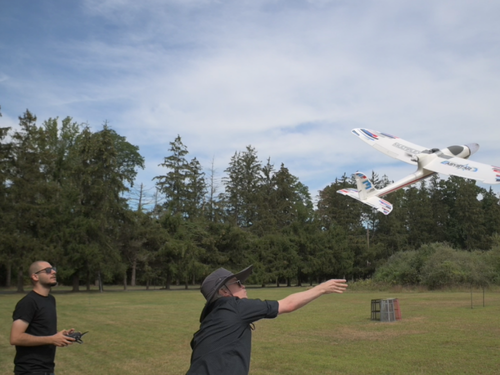 Donovan address this challenge through passive safety by designing the UAV itself to reduce injury if a collision occurs. In their paper, “Using Lattice-Based Structures to Enhance Collision Safety between Humans and Fixed-Wing
UAVs,” the researchers describe a deformable lattice-based structure made from pliable plastic
to replace conventional rigid nose-cone materials. Through computer simulations and
physical impact experiments using human head models, the team found that the new design
can reduce potential head injury by up to 50 percent compared with a standard rigid nose cone.
Donovan address this challenge through passive safety by designing the UAV itself to reduce injury if a collision occurs. In their paper, “Using Lattice-Based Structures to Enhance Collision Safety between Humans and Fixed-Wing
UAVs,” the researchers describe a deformable lattice-based structure made from pliable plastic
to replace conventional rigid nose-cone materials. Through computer simulations and
physical impact experiments using human head models, the team found that the new design
can reduce potential head injury by up to 50 percent compared with a standard rigid nose cone.
Stewart emphasized the broader potential of the research, noting:
“UAVs of all types can be made safer. This can reduce the existing regulatory burden of UAV operations, and open the door to many more commercial applications.”
The research demonstrates how structural design can complement electronic safety systems, providing protection even when a collision cannot be prevented. The lattice-based concept could also be adapted to other UAV components, including wings and fuselage sections, and potentially to other types of aerial robots.