


National Experts Gather at Stony Brook to Explore the Future of Robotics and Embodied AI
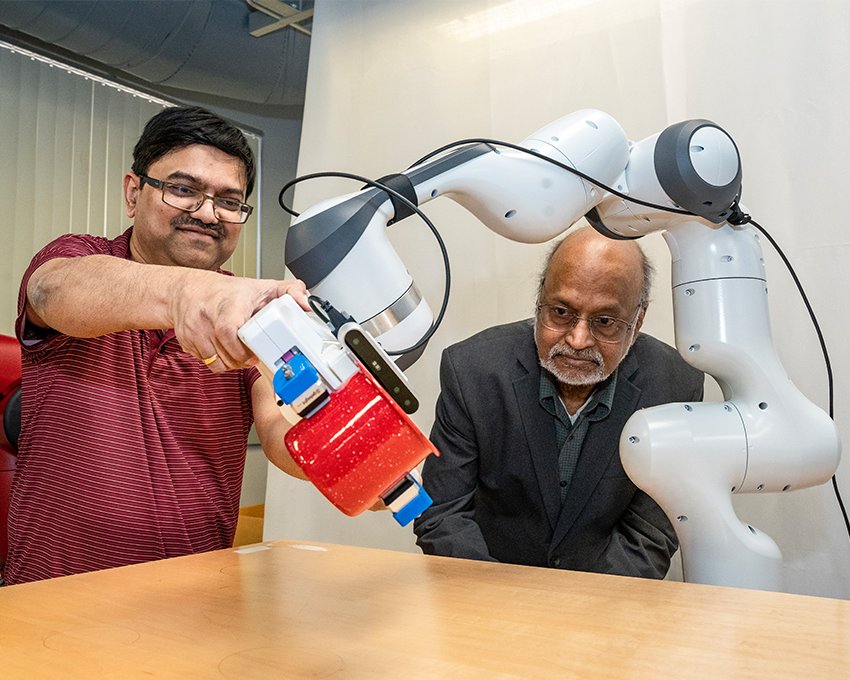 Stony Brook University recently hosted an invite-only Embodied AI Workshop that brought
together leading researchers from universities and national laboratories across the
country. Organized by Associate Professor Nilanjan Chakraborty (Mechanical Engineering), Professor Lav Varshney (AI Innovation Institute and Electrical and Computer Engineering), Professor C.R. Ramakrishnan (Computer Science), and Professor I.V. Ramakrishnan (Computer Science and Associate Dean for Research), the workshop welcomed experts
from institutions including MIT, Columbia University, Duke University, and Brookhaven
National Laboratory to explore how advances in artificial intelligence are shaping
the future of robotics and autonomous systems.
Stony Brook University recently hosted an invite-only Embodied AI Workshop that brought
together leading researchers from universities and national laboratories across the
country. Organized by Associate Professor Nilanjan Chakraborty (Mechanical Engineering), Professor Lav Varshney (AI Innovation Institute and Electrical and Computer Engineering), Professor C.R. Ramakrishnan (Computer Science), and Professor I.V. Ramakrishnan (Computer Science and Associate Dean for Research), the workshop welcomed experts
from institutions including MIT, Columbia University, Duke University, and Brookhaven
National Laboratory to explore how advances in artificial intelligence are shaping
the future of robotics and autonomous systems.
The workshop focused on enabling intelligent machines to perceive, reason, and operate in complex, real-world environments. Presentations highlighted the growing role of embodied AI in robotics research, covering topics such as robotic manipulation, autonomous decision-making, sustainable materials design, and human-AI interaction. Researchers also examined the technical challenges of developing intelligent systems that can safely and effectively collaborate with people.
For Chakraborty, whose research focuses on robotics, motion planning, and autonomous systems, the workshop provided an opportunity to foster collaboration across disciplines and institutions. By bringing together experts in engineering, computer science, and artificial intelligence, the event encouraged the exchange of ideas that will help advance the next generation of autonomous technologies.
“Intelligence in the physical world brings challenges that are very different from those encountered in purely digital environments. A robot has to perceive an uncertain world, reason about what to do, and then act safely and reliably through physical interaction. The goal of this workshop was to bring together researchers with different perspectives on these embodied AI problems, identify the fundamental questions that still need to be addressed, and create new collaborations that can help move embodied AI from impressive demonstrations toward systems that can operate robustly in the real world.”
The workshop reflects Stony Brook University's commitment to interdisciplinary research and its growing leadership in robotics and embodied AI. As these technologies continue to evolve, collaborations like this are helping shape the future of intelligent machines and their applications across engineering, manufacturing, healthcare, and beyond.
For more information:
- From Robotics to Human Interaction: Embodied AI Takes Center Stage at Stony Brook Workshop (SBU News)