


The Analects of Dasan: A Korean Syncretic Reading (Vol. I-VI)
A Landmark Contribution to Korean Intellectual History and East Asian Thoughts
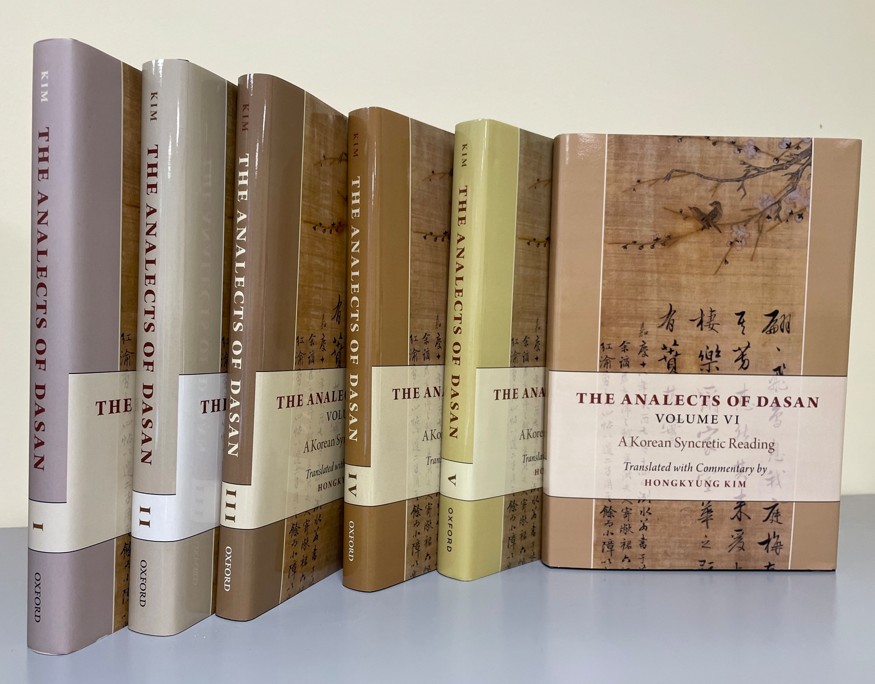
The Center for Korean Studies at Stony Brook University is proud to highlight Professor Hongkyung Kim’s six-volume English translation and study of Dasan Jeong Yak-yong’s Old and New Commentaries on the Analects (論語古今註), published by Oxford University Press from 2016 to 2026.
One of Korea’s most important intellectuals, Dasan (1762–1836) developed a distinctive and critical interpretation of the Confucian tradition. Professor Kim’s monumental translation makes Dasan’s forty-volume work accessible to an international readership for the first time in its entirety, opening new possibilities for research in Korean Studies, East Asian Studies, Confucian philosophy, and comparative intellectual history.
Selected Scholarly Reviews
Professor Hongkyung Kim’s The Analects of Dasan has received recognition from leading scholars of Confucianism, Korean intellectual
history, and religious studies. Reviewers have particularly praised the project’s
originality, scholarly rigor, and importance in bringing Dasan’s thought to a global
readership.
"This series basically delivers Dasan’s commentaries on the Analects, but his meticulous
and critical investigations about all the resources accessible to him, from the ancient
Chinese commentaries of He Yan (何晏 195–249) to the views of Japanese scholars such
as Dazai Zun (太宰純 1680–1747), allow us to engage comprehensive references to each
chapter in detail. Since the release of its first volume in the Fall of 2016, this
series has proved itself an invaluable contribution to the scholarship of East Asian
philosophical thought by providing one of the most scrupulous and global commentaries
on the Analects available in English. … Readers will enjoy the steadfast quality of
Kim’s translations and illuminating exposition, which well reflect Dasan’s practical
approaches to the texts and draw attention to the key issues of each chapter." – Dobin
Choi, Leiden University, Philosophy East and West
“[G]iven the originality and complexity of Dasan’s commentary and the scale of his
work, Professor Kim’s book is an historic accomplishment. … After translating each
of the original Analects passages and Dasan’s commentary, Professor Kim provides his own explanations of Dasan’s
explanations. These are always substantial and sometimes longer than the text they
elucidate. They provide a wealth of additional sources and historical context and
occasionally endeavour to explain why Dasan criticized or defended particular views
because of his engagement with and commitment to important political and social issues
of his time.” – Ivanhoe Philip John, Georgetown University, Journal of Confucian Philosophy and Culture
"Hongkyung Kim's translation and commentary is an important step toward introducing
the writings of one of the most outstanding thinkers in Korean history...revealing
not only Dasan's breadth of knowledge ranging over two millennia worth of commentaries
on the Analects, but also Kim's own deep knowledge of the history of Confucianism and Korean intellectual
history. Kim begins with an excellent scholarly introduction that helps readers unfamiliar
with Dasan understand his importance in Korean intellectual history...Even seasoned
readers of the Analects will find novel insights in this book...Given the outstanding quality of both the
translation and commentary, all scholars with an interest in deepening their understanding
of the Analects, Confucianism, and East Asian philosophy more generally should eagerly anticipate
the completion of this project. I highly recommend this book to anybody interested
in these topics." – Richard Kim, Loyola University Chicago, Notre Dame Philosophical Reviews
"Tasan's commentaries are extremely insightful also for a better grasp of the wider commentarial tradition. Kim's annotated translation remains of the highest quality. His explanations are perceptive and erudite."
"Every chapter is followed by the selected commentaries, supplemented and refuted by Tasan, upon which Kim in turn provides perceptive expositions."
"Kim succinctly discusses the evolution of Tasan scholarship, the NKC 's genesis and contents, as well as Tasan's overall neo-Confucian thought, which he calls "Learning of Practical Principle." -- Lukas Pokorny, University of Vienna, Religious Studies Review
“[W]hat Hongkyung Kim does in this book is to expound the deeper and authentic meaning of "practical learning" by going back to Confucius' Analects. … I wholeheartedly applaud Hongkyung Kim's indispensable contribution to this volume. In the main text, Hongkyung Kim, after his translation of each chapter, has placed his own explanations of the meaning of Dasan's discussions. These explanations are crucial in understanding the nature of Dasan's commentary and his philosophy in general, the creativity of his interpretations, and the exegetical implication of his reading. This book is indispensable for understanding not only Dasan's commentary on the Analects but also Dasan's philosophical ideas and spiritual orientation." – Young-Chan Ro, George Mason University, Acta Koreana
"This translation is significant, providing scholars interested in the Analects, Korean Confucianism, and Confucianism in general an important resource. Dasan has his own unique interpretation of the Analects, either by siding with one of the traditional interpretations or by providing an unprecedented interpretation. So it is an important text to understand Dasan's own understanding of the Analects, Dasan's own philosophy, and the Analects itself. Kim gives more than mere translation. He also provides a commentary, which...not only summarizes Dasan's view, but often situates it in the historical context in which Dasan is writing, including his exchanges on the relevant passages with his contemporaries. While there is an abundance of English translations...there has not been a comprehensive English translation of the text including its long and rich commentary tradition until now." -- Huang Yong, The Chinese University of Hong Kong