



IEEE Student Laboratory
Contact: President, IEEE Student Branch
Location: Room 175, Light Engineering
Usage: Student Club 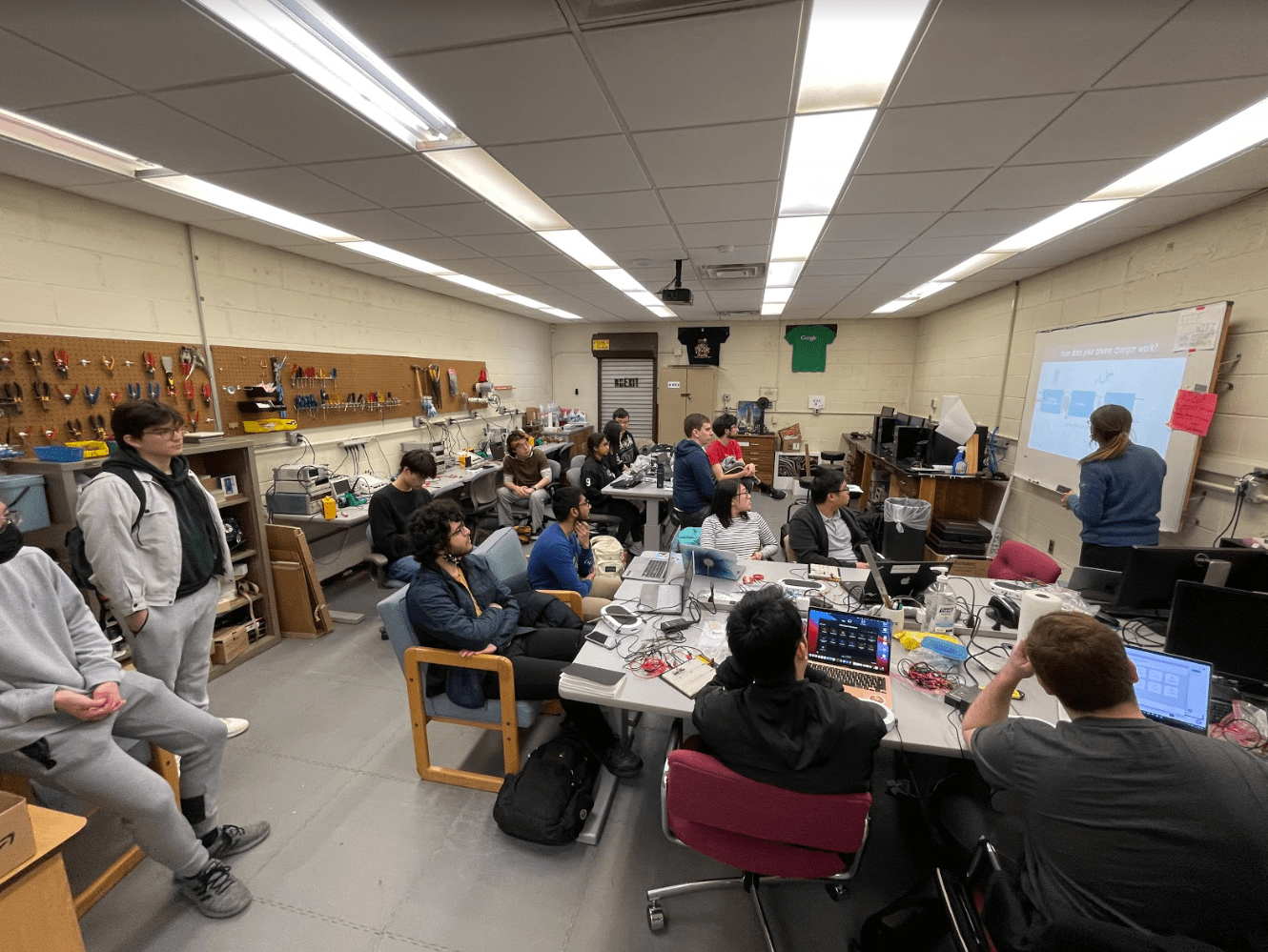
This laboratory is run, independently, by the student chapter of the Institute of Electrical and Electronic Engineers. This lab contains 16 networked computers and various test equipment. It also has 4 dedicated computers with access to Engineering CAD programs utilized in the curriculum. Seniors find the laboratory particularly useful in testing their senior design projects.

A Message from Professor Thomas Robertazzi
Some of us are members of IEEE (the Institute of Electrical and Electronic Engineers)
as students. But is it a worthwhile investment after graduation – particularly for
those with a bachelor’s or master’s degree?
Personally, I think IEEE membership is worth the cost as it connects its members with a wider world of electrical engineering in many different potential ways. With over 423,000 members in more than 160 countries, it is the world’s largest technical professional society.
One of the most worthwhile aspect of IEEE membership is its publications. Of course the IEEE Transactions are written at a high level for those of us who are specialists. But IEEE also publishes many accessible magazines that give a broad look at their areas of coverage. I personally get IEEE Computer, Communications Magazine, IEEE Security and Privacy and IEEE Aerospace Magazine (I am something of a space buff). There are many other magazines. Actually it would be surprising if you didn’t find a publication of interest among IEEE’s approximately 200 Transactions, Journals and Magazines. Most are available or moving to online publication.
As a working professional there are also opportunities to attend conferences (more than 1800 annually in 95 countries), participate in standards work (more than 1300 active standards and over 500 under development), get involved in a technical society (39 societies and 7 technical councils), a local section (there are 334 sections) or a chapter (there are 2,116) that bring together local members with similar interests. These activities can give you as an engineer external visibility outside of your own organization as well as the chance to meet and interact with other colleagues.
Finally, if one stays in the technical side of the business, there are opportunities for elevated grades of membership such as Senior Member and IEEE Fellow.
The only downside of IEEE membership is that the individual member usually has to pay for it, which even on a professor’s salary is a concern. Still, it is less expensive than being a member of the American Medical Association and American Bar Association. There are some financial benefits such as reduced conference registration rates, insurance plans, discounts on financial services and on home and office services and on travel services. Ultimately though IEEE membership allows the engineer to take charge of their careers on their own terms. So even with a bachelor’s or master’s degree, I would personally say the cost/benefit ratio of IEEE membership is pretty good.
All the Best,
Professor Thomas Robertazzi