



Wastewater-Based Epidemiology
Wastewater-based epidemiology (WBE) is a relatively new approach that uses targeted biomarkers in wastewater samples to obtain qualitative and quantitative information on the health of communities within a given wastewater catchment. This approach has been successfully applied worldwide in the pre-COVID-19 era to monitor the estimated consumption of pharmaceuticals, illicit drugs, alcohol, and tobacco, demonstrating its ability to provide near-real-time insights into population health metrics. With the onset of the COVID-19 pandemic in 2020, the focus shifted from chemical biomarkers to viral targets. WBE was widely used during and in the later stages of the pandemic to measure SARS-CoV-2 viral loads in wastewater, tracking the spread, prevalence, and trends of COVID-19 infections in communities.
Starting in June 2020, the Center initiated a WBE project to detect SARS-CoV-2 virus in wastewater influent collected from STPs across Long Island, NY. The goal of this project was to provide a cost-effective approach to track trends in case counts and serve as an early warning system to detect and prepare for future outbreaks of COVID-19, enabling timely interventions such as public notice, management, and governmental and medical community planning. Building on the success of SARS-CoV-2 monitoring, the Center’s WBE program has expanded to monitor a broad range of pathogens to support community-level public health surveillance across Long Island. This evolution reflects the program's flexibility as a platform for tracking diverse public health indicators. Current monitoring efforts focus on SARS-CoV-2, measles virus, Legionella pneumophila, and Cyclospora cayetanensis. While ongoing COVID-19 monitoring continues to provide insight into community activity, measles virus surveillance supports preparedness for potential re-emergence events. Furthermore, the inclusion of Legionella and Cyclospora broadens the program’s scope to include bacterial and parasitic pathogens of high public health interest beyond viral respiratory diseases. In addition to these current targets, the Center has previously performed wastewater testing for tuberculosis-related targets and Vibrio cholerae. These efforts were instrumental in evaluating the broader applicability of wastewater surveillance for emerging and re-emerging pathogens. This work is being done in collaboration with the Suffolk County Department of Health Services, the NYS Department of Health, and the Centers for Disease Control. For more information, please visit the NYS Wastewater Surveillance Network dashboard.
In December 2024, our Center, with the help of the Nassau County Department of Health,
expanded the scope of its WBE chemical monitoring program to monitor the prevalence
of drugs, including opioids and stimulants, in Nassau County communities. Our Center
began receiving up to 15 wastewater samples per week from nine sewage treatment plants
in Nassau County. Samples are analyzed for a panel of 27 drugs and metabolites using
liquid chromatography tandem mass spectrometry (LC-MS/MS). We further expanded our
scope of work to Suffolk County in August 2025 to analyze the same panel of drugs
in wastewater from nine sewersheds across the county. We regularly share our data
with the NYS Department of Health and the Nassau County Department of Health to help
them better understand the spatial and temporal patterns in drug consumption. In addition,
our Center has begun investigating 17 cannabinoids and their metabolites, including
isomeric forms of tetrahydrocannabinol and synthetic cannabinoids, in wastewater.
We aim to include PFAS, microplastics, and other emerging chemicals of concern in
our work plan to support public health authorities in implementing near-real-time
public health interventions.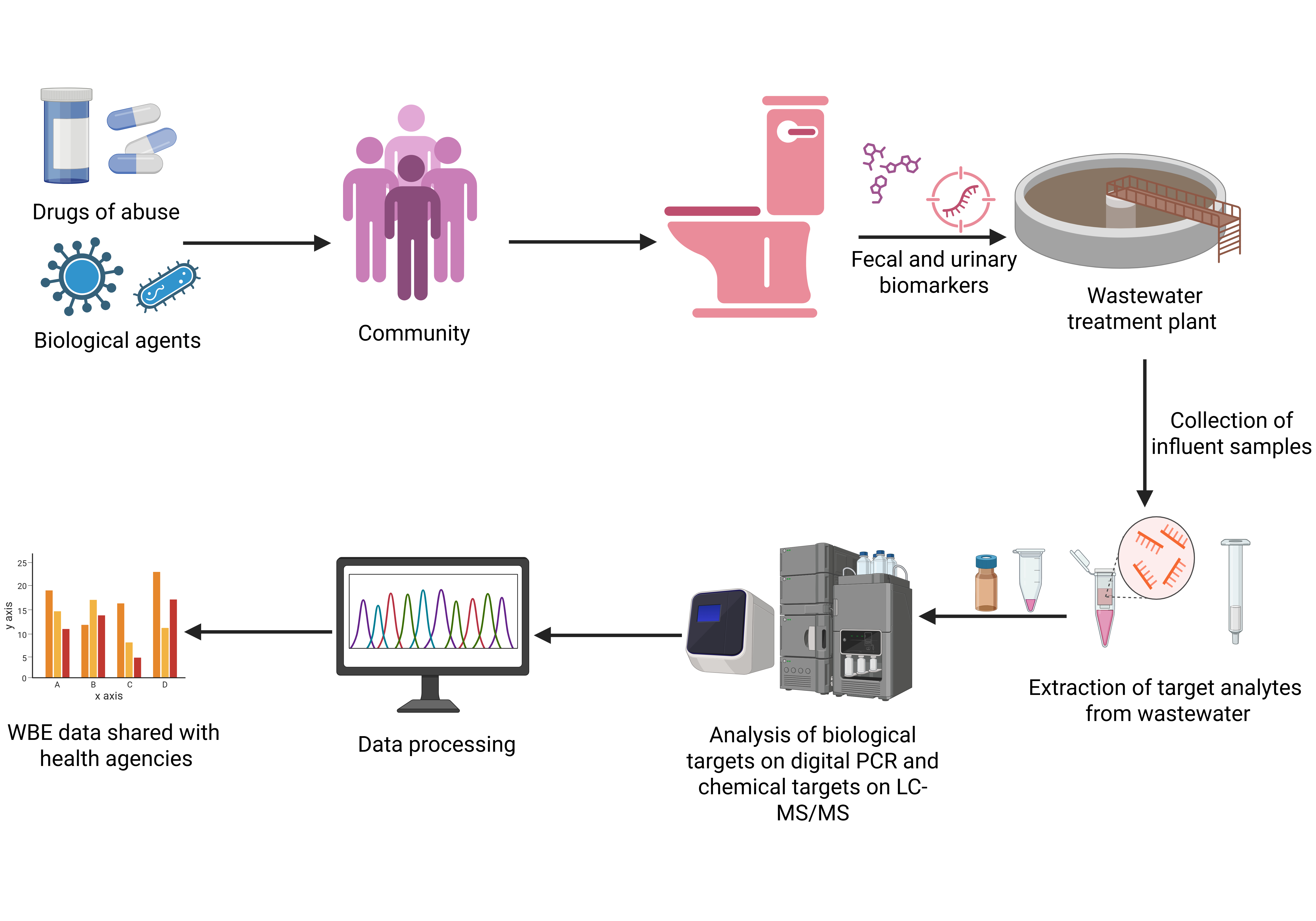
Created in BioRender. Kumar, R. (2026) https://BioRender.com/7kq3isw