



Data Governance Council 2024-25 Annual Report
September 2025
Overview
Stony Brook’s data governance system was established in fall 2016 in order to strengthen
Stony Brook’s data infrastructure. The Data Governance Council (DGC) oversees the
data governance system and began meeting in spring 2017. This is the eighth annual
report.
The DGC focused this year on data policy reviews, communication efforts, and data
quality and data privacy improvements. We continued topics that were prioritized by
our executive sponsors, Dr. Braden Hosch, VP for Educational & Institutional Effectiveness,
and Dr. Simeon Ananou, VP for Information Technology and Chief Information Officer.
Three themes that would pose significant importance for data governance (1) mitigating
risks on sensitive data, (2) process improvement for university data as we implement
a new ERP system for financials, budget and HR, and (3) Communication from the DGC
to educate the responsible use of data.
Major Accomplishments
- Amendments to key data policies
- Guidelines for appropriate use of data
- Conducted biennial maturity model assessment
- Significantly expanded digital data definitions
- Collected data disposition practices
Data Policy and Governance Framework Enhancements
Amendments were made to three key university data policies and the Data Governance
Framework. These changes were made to improve clarity, consistency, and understanding
of data protection and usage across the institution.
| Analytics and Enterprise Data Officer | Kim Berlin |
| Chief Enrollment Management Officer | Richard Beatty |
| Chief Financial Aid Officer | Nicholas Prewett |
| Chief Institutional Research Officer | Rob Miller |
| University Controller | Cassandra Amadio |
| University Registrar | Diane Bello |
| Advancement designee | Susan Agro |
| Campus Planning & Facilities designee | Christopher M Martin |
| Chief Diversity Officer designee | Judith Brown Clarke |
| Enterprise Risk Management designee | Marrisa Trachtenberg |
| Finance & Administration designee | Jeff Mackey |
| Health Sciences designee | David Cyrille |
| Human Resources designee | Tracey McEachern |
| Information Technology designee | Maryam Mirza |
| Provost’s Office designee | Kara DeSanna |
| Research designee | Robert Davidson |
| Student Affairs designee | Ahmed Belazi |
| University Senate designee | Andrew Kirsch |
Theresa Diemer, Assistant Director for Data Governance and Management, ex officio
Arielle Markiewicz, Business Analyst for Data Governance, ex officio
The updates include a strengthened definition of University Data and expanded guidance
on acceptable use, legal compliance, and the integration of emerging technologies
such as artificial intelligence. Specific details of the approved changes are documented
in the Data Governance Council (DGC) Meeting Minutes dated November 21, 2024.
Guidelines for Appropriate Use of University Data
Guidelines to establish clear standards and best practices for the use, handling and
sharing of institutional data has been drafted to promote responsible data stewardship
across the university. These guidelines apply to all university personnel with access
to sensitive information through a system data store, system application, or reporting
and analytics platforms. This draft provides references to the relevant University
Data Policies, informs on FERPA compliance, best practices for data users and custodians,
and information on ongoing compliance training. The guidelines are currently in draft
form and will undergo a formal review process to finalize content and determine the
most effective distribution and implementation strategies.
Process Improvement for WolfieONE
Several topics from the DGC have been actively discussed across WolfieONE committees.
Topics addressed – job title realignment, maintenance and management of administrative
roles, definition of faculty. A workgroup identified the WolfieONE business structures
required to identify and classify faculty and tenure status within the system. However,
work remains to be done in expanding faculty categorization beyond current definitions
used in PeopleSoft and the data warehouse.
PeopleSoft Improvements
Access to sensitive student and employee data through the PeopleSoft SOLAR ‘Advisor
Menu’ panel has been significantly restricted to improve data privacy. Academic advisors
are now limited to viewing records only for students who are actively enrolled and
only when searching by a specific ID number. Previously the system allowed unrestricted
access to sensitive student and employee records without filters, raising concerns
about excessive data exposure.
“Clean Address” software has been implemented and integrated with the PeopleSoft system
to provide automatic correction for addresses entered in real-time.
Data Asset Inventory and Data Disposition
The DGC continues to maintain an inventory of data assets on Stony Brook University’s
West Campus, which has grown to 134 assets. This year, a survey regarding data disposition
practices was conducted. The tally below shows the distribution of assets and those
with data disposition practices across 13 Data Trustees, excluding Medical Health
Systems.
|
Data Trustees |
2024-25 | Data Disposition |
| Provost | 35 | 14 |
| Chief Information Officer | 22 | 9 |
| Vice President Finance & Administration | 18 | 8 |
| Vice President Student Affairs | 17 | 6 |
| Executive Vice President Health Sciences | 9 | 2 |
| Vice President for Enterprise Risk Management and Chief Security Officer | 8 | 1 |
| Vice President for Educational and Institutional Effectiveness | 7 | 0 |
| Vice President for Research | 7 | 1 |
| Vice President for Advancement | 4 | 1 |
| Director of Athletics | 2 | 1 |
| Vice President for Facilities and Services | 2 | 1 |
| Vice President for Marketing and Communications | 2 | 2 |
| Vice President of Human Resource Services | 1 | 0 |
| Total Data Assets | 134 | 46 |
Approximately 34% of the West campus assets reported having data purging or masking
procedures. The primary reasons cited for implementing data disposition practices
are to free up storage, improve system performance and to reduce and mitigate risks
for sensitive data. Other less common reasons include regulatory compliance or honoring
individual requests for data removal.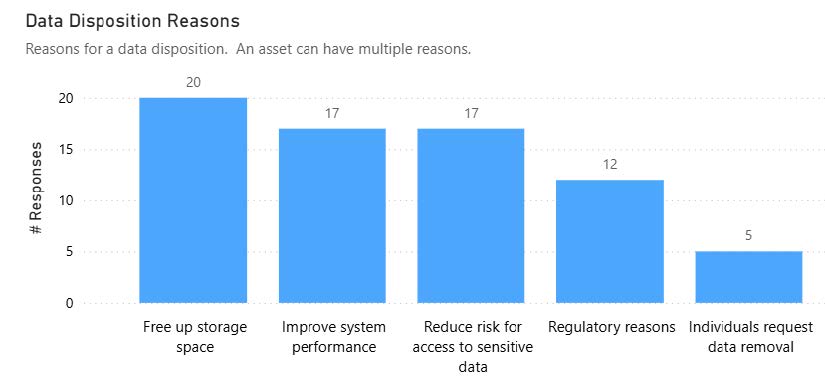
Most data assets on West Campus are classified as highly sensitive, yet fewer than
10% of these have established data disposition practices. Assets with low and moderate
sensitivity show a more balanced split between those that follow data disposal measures
and those that do not. Additional details to the data disposition responses are available
in Appendix 1. 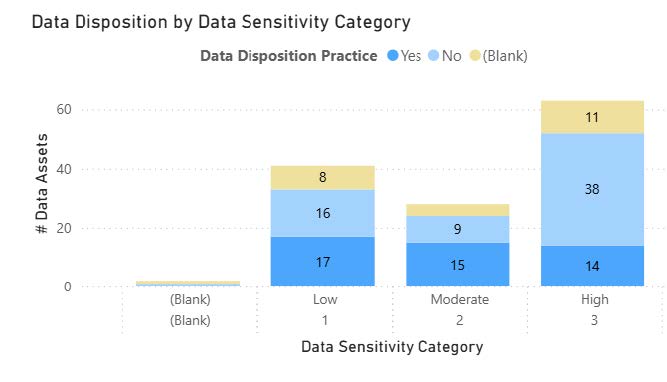
Data Cookbook Progress and Expansion
The Data Cookbook serves as Stony Brook’s centralized digital repository for managing
the institutional data dictionary, report and dashboard profiles and both functional
and technical definitions. Currently, it includes data definitions for academic, human
resources, budget and financial data elements. Over the past year, significant progress
has been made by our Data Governance Business Analyst in expanding the repository,
adding approximately 600 new data definitions bringing the total to over 650.
To enhance accessibility and usability, these definitions have begun to be integrated
into Tableau and Power BI, allowing users to interact and reference within reporting
and analytics environments.
Data Governance Maturity Assessment
In June 2025, the DGC deployed the biennial maturity assessment of the university’s
data governance practices. Mean maturity levels were calculated from 39 respondents
shown in the graphs below, ordered by the domains and topics that scored the highest
averages in descending order. The overall direction for 2025 continues to improve
from our benchmark in 2017. In the past three assessments, most data domains have
improved and grown within the “adopted & implemented” stage (3.0-3.9) with student
and financial areas in the upper range of this level. Facilities is the only area
that has not progressed and remains in the “developing” stage.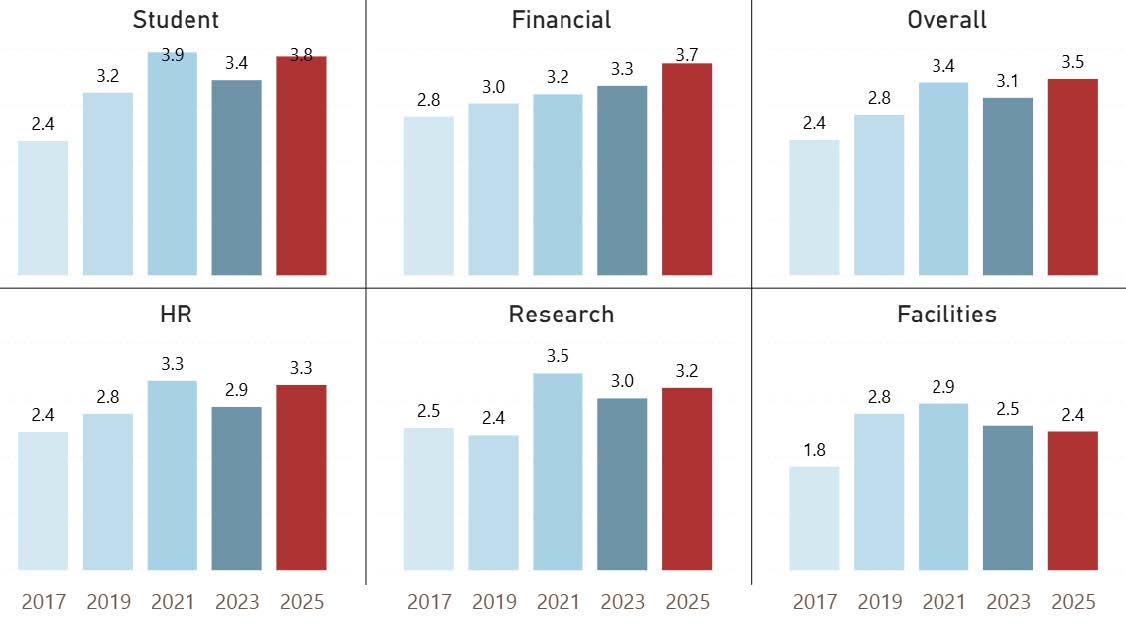
Overall, the five data governance topics -- Culture, Communication, Data Quality,
Roles & Responsibilities, and Organizational Structures, are more or less at the same
level as they were in 2021. However, individual data domains with the exception of
facilities have improved on all five data governance topics.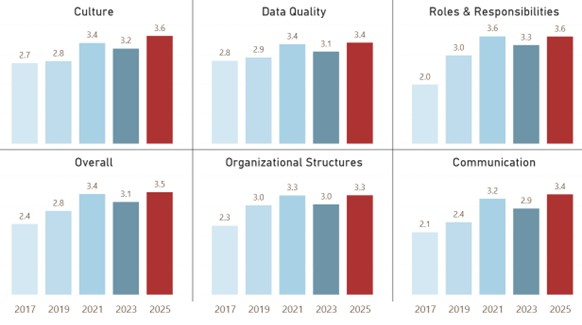
|
|
|
|||
|
|
|
|||
|
|
|