



Data Governance Council 2022-23 Annual Report
September 14, 2023
Overview
Stony Brook’s data governance system was established in fall 2016 in order to improve
Stony Brook’s data infrastructure. The Data Governance Council (DGC) oversees the
data governance system and began meeting in spring 2017. This is the sixth annual
report of the DGC.
Major Accomplishments
-
Expanded DGC membership and identified new executive sponsors
-
Adopted a new University data access policy
-
Completed a pilot project to permanently delete obsolete data
-
Filled a new position for a Data Governance Business Analyst
-
Continued implementation of the Data Cookbook digital definitions
-
Conducted the biennial maturity model assessment
Executive Sponsors and Expansion of the Data Governance Council membership
The two Executive Sponsors for the DGC had been filled by the Senior Vice President
& Chief Information Officer and the Vice President of Strategic Initiatives. Both
of these positions were vacated during 2022-23 and prompted the DGC to identify new
sponsorship. One of the executive sponsors starting 2023-24 will be the incoming Vice
President for Information Technology and Chief Information Officer. Pending a formal
vote at the next meeting, we have identified the Vice President for Educational &
Institutional Effectiveness as the second executive sponsor.
Members 2022-23
Kim Berlin, Chair
Diane Bello, Co-Chair
Andrei Antonenko
Ahmed Belazi
Braden Hosch
Cassandra Amadio
David Cyrille
Dawn Medley
Jim Gonzales
Lyle Gomes
Nicholas Prewett
Paula Di Pasquale-Alvarez
Robert Davidson
Sara Lehmann
Susan Agro
Tracey McEachern
Theresa Diemer, ex officio
Arielle Markiewicz, ex officio
As priorities of the DGC have been moving more toward topics of data risk management
and data policy, we considered the membership of the DGC and recognized the need to
include VP areas that were not currently represented and who would provide valuable
input into these conversations. Three areas that will be added in the 2023-24 year
are Vice President for Enterprise Risk Management and Chief Security Officer, Equity
and Inclusion, and Campus Planning & Facilities.
Data Governance Framework has been drafted to adjust the executive sponsors and to
expand membership of the DGC and to set the DGC membership to VP areas rather than
titles. The Stony Brook University Data Governance website will continue to retain
the names and titles of council members. https://www.stonybrook.edu/commcms/irpe/about/data_governance/data_governance_council
Adoption of a new Policy on Data and Data Access
The DGC empaneled a committee to review Stony Brook’s data access policy and to propose
revisions to replace outdated DoIT policies that had been in place since 2007. The
committee was composed of Braden Hosch, VP Educational & Institutional Effectiveness;
Matthew Nappi, Chief Information Security Officer; Marissa Trachtenberg, Director
of Risk Management & Policy Compliance; Dara Goldstein, Chief Privacy Officer, Stony
Brook Medicine; and Doug Panico, Assistant Vice President, Audit & Management Advisory
Services.
The committee delivered a new University policy that promotes accountability over data assets, responsibilities of data stewards and data custodians, and distinguishes procedures for different types of access. Data Trustees are executive leaders that oversee broad data domains and ultimate responsibility for the data assets in their purview. Data Stewards and Data Custodians are responsible for developing written procedures for how data access is granted for routine access and non-routine access, how permissions are given for special privileges, how data access requests are evaluated, (such as having a legitimate university business, or advancing mission), the re-release of data, and for how users are routinely removed and reviewed. Data stewards have 6 months from the policy adoption date to fulfill this request and data custodians have 9 months. The collection of this information started in Spring 2023 through a new questionnaire called the “Data Access Management Procedures”. This data collection is expected to be ongoing through December 23, 2023.
The policy was approved and adopted by the VP Council on March 23, 2023. It will be reviewed every three years.
The “Policy on Data and Data Access” can be found on the university “Policies” webpage: https://it.stonybrook.edu/policies.
Data asset inventory
The number of data assets in the Data Asset Inventory is the same as last year. The
University, excluding Health Systems, maintains 95 data assets. In 2022-23, one new
data asset was added, and one was retired. Additional information about data assets
is now being collected to comply with the requirements of the new Policy on Data and
Data Access.
There are 13 Data Trustees identified and listed below by the number of data assets
in their purview.
|
Data Trustees |
# Data Assets |
|
Provost |
23 |
|
Vice President Finance & Administration |
23 |
|
Chief Information Officer |
13 |
|
Vice President Student Affairs |
9 |
|
Vice President for Educational and Institutional Effectiveness |
7 |
|
Vice President for Research |
4 |
|
Vice President of Human Resource Services |
3 |
|
Executive Vice President Health Sciences |
3 |
|
Vice President for Advancement |
3 |
|
Director of Athletics |
2 |
|
Vice President for Enterprise Risk Management and Chief Security Officer |
2 |
|
Vice President for Facilities and Services |
2 |
|
Vice President for Marketing and Communications |
1 |
|
Grand Total |
95 |
Data trustees and data steward organizations are identified for all University data
assets (Appendix B). The Data Asset Inventory contains information about basic contents,
storage location, sensitivity level, data acquisition, data integration, linkage data
access, reporting and the availability and type of analytics (see Appendix C).
Data Disposition
A pilot project was successfully conducted this year to permanently delete obsolete
data and to begin a repeatable, annual process. This ongoing process will reduce risk
to the university by removing sensitive data that has no practical value to the university.
The Financial Aid Office, led by Nicholas Prewitt, worked with the Information Technology
Enterprise Applications & Integration team led by Jim Gonzalez to identify financial
aid Institutional Student Information Record (ISIR) records for past applicants who never attended the university. The teams identified
~84,000 records between 2003-2016 that contain applicants of the university who never
attended and have no financial records. The process to delete these data was more
manual than automated but was written and stored in a way to be repeatable once a
year. The Financial Aid office plans to repeat the purge each January for the following
year of data (next will be 2017). It is expected that approximately 5,000-7,000 ISIR
records will be deleted each year.
A DGC priority for 2023-24 is planned to scope another area for data disposition.
Two areas being considered are application data for prospective students who did not
enroll, and application data for prospective employees who were not hired.
Business Analyst for Data Governance
The first full time position dedicated to Data Governance activities was filled this
year. The new position of Business Analyst for Data Governance was filled by Arielle
Markiewicz in January 2023. She reports to the Assistant Director for Data Governance
and Management, Theresa Diemer, in the Office of Institutional Research, Planning
& Effectiveness. This new position is an important role for the long-term support
and effective continuation of data governance activities and is making an impact to
advance the priorities and initiatives of the DGC.
Continued implementation of the Data Cookbook
The Data Cookbook was acquired at the end of 2017-18. This metadata management tool
provides a digital repository for data definitions and other metadata that will be
integrated with existing reporting and analytics to improve the understanding about
the data. The new Data Governance Business Analyst, Arielle Markiewicz, has greatly
advanced this work and added 59 definitions for a total of 198 and added a number
of new report profiles for a total of 68. Reference data was added by the Enterprise
Data & Analytics office to more than 75 definitions. Reference data provides data
profiles on allowable values, data types and ranges. It is planned in 2023-24 to make
this information available to end users when viewing reports and analytics in our
effort to improve communication and understanding about data.
Maturity Assessment 2023
Every two years we conduct an assessment of the maturity level of our data governance
topics across the most commonly used data domains. The data governance maturity assessment
considered data domains along five key topics:
- Organizational Structures
- Roles and Responsibilities
- Data Quality
- Communication
- Culture
The most common data domains, financial, student/academic, human resources, research,
and facilities are provided in the assessment and respondents also had the opportunity
to rate “other” data domains.
Maturity was rated on a 5-point scale (1-informal, 2-developing, 3-adopted & implemented,
4-managed & repeatable, 5-integrated and optimized). Members of the DGC, data stewards
of assets in the university data asset inventory, and selected university leaders
with titles such as Assistant/Associate Vice President/Provost were asked to respond.
We received 28 responses out of 95, or about 30% participation in this years survey.
Maturity Assessment 2017-2023
The maturity level between 2017-2023 has progressed from the range of “developing”
stage (2.0-2.9) to “adopted & implemented” stage (3.0-3.4) for most of the data domains
and most of the data governance topics. Since we initiated Data Governance, “Organizational
Structures” are much more established with the advent of the DGC, executive sponsors,
a newly dedicated data governance position, and the naming of data trustees, data
stewards and data custodians for University data assets. The new policy for data
and data access supports the understanding of what the “Roles & Responsibilities”
are for those who oversee a data domain. ”Communication” tends to be the lowest rated
and getting information about data systems, policies, definitions circulated is a
challenge. The Financial data shows a steady rise each year but other data domains
show a slight decline from 2021. This could be a number of reasons – changes in personnel,
less participation due to lack of focus and bandwidth and possibly anomalous results in 2021 that set the stage too high. Despite the slight declines,
much progress has been made in several areas and we feel the overall direction continues
to improve.
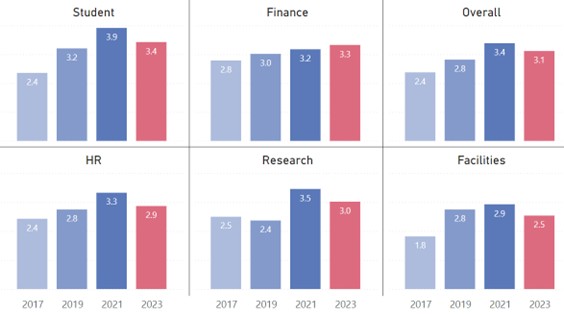
Data Governance Topics across all data domains 2017-2023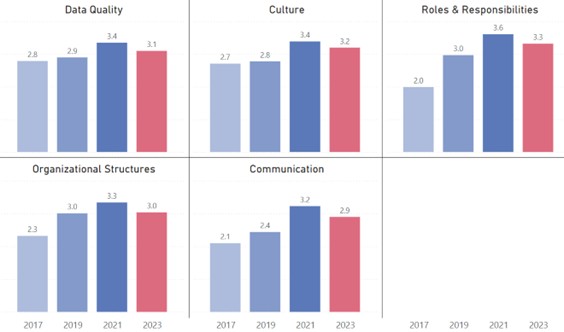
|
|
|
|||
|
|
|
|||
|
|
|