


RESEARCH THRUSTS
CONSTITUTIVE MODELING OF MATERIAL FAILURE
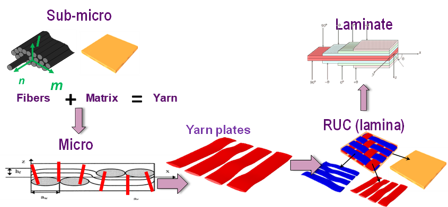
Heterogeneous materials such as polymers and their composites exhibit a wide range of failure mechanisms depending on the loading condition. As a result failure prediction under multi-axial loads is highly complex since it occurs via the combination and interaction of a variety of mechanisms such as fiber breaking, matrix micro-cracking, fiber kink bands etc. We are tackling this challenge by developing mechanism-based, constitutive models, often within the framework of the microplane modeling theory.
Relevant Publications
1. Wardhekar S., Kirane K. (2025) Microplane Constitutive Model for Tension–Compression Asymmetry and Pressure-Sensitive Damage in Polymers, J. Appl. Mech. March 2025, 92(3): 031002.
2. S. H. Asif, T. Abdullah, and K. Kirane (2026) “Rate-dependent microplane triad model for high strain rate behavior of woven composites” International Journal of Solids and Structures, 339, 114132
2. J. Xue and K. Kirane (2022) “Cylindrical microplane model for compressive kink band failures and combined friction/inelasticity in fiber composites I: Formulation” Composite Structures 289, 115382, https://doi.org/10.1016/j.compstruct.2022.115382
REGULARIZATION OF FAILURE MODELING
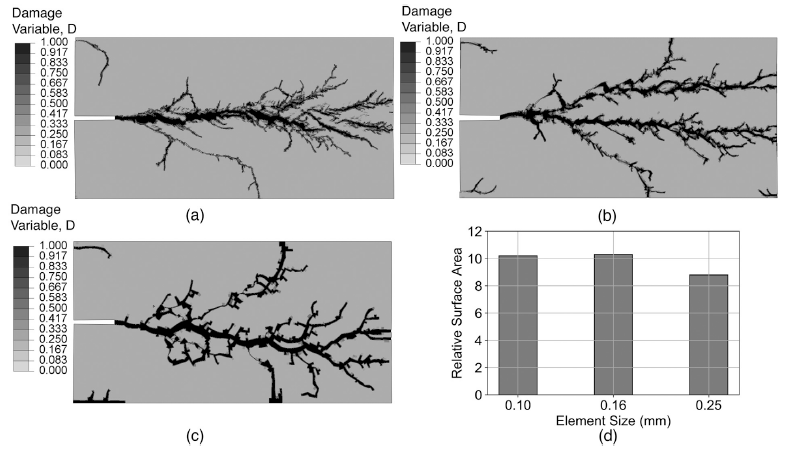
Failure and fracture in heterogeneous materials are inherently localized phenomena, yet their numerical representation can become dependent on the computational discretization. We are developing regularized failure models that provide objective predictions of damage evolution and fracture energy, independent of mesh size and resolution. By incorporating characteristic length scales through approaches such as crack-band regularization and nonlocal or microplane formulations, our models can enable reliable simulation of strain localization, progressive damage, and complete fracture across different specimen sizes and material architectures. Particular emphasis is on dynamic failure problems
Relevant publications
1. Y. Lam, T. Abdullah, and K. Kirane (2023) “Dynamic crack penetration vs. deflection at material interfaces and the role of rate dependent strength and toughness” J. Mech. Phy. Solids, 173, 105208
2. T. Abdullah and K. Kirane (2022) “Strain rate dependence of the mesh objectivity in dynamic fracture analyses with the crack band model” Engineering Fracture Mechanics, 269, 108501
CHARACTERIZATION OF FAILURE IN MATERIALS
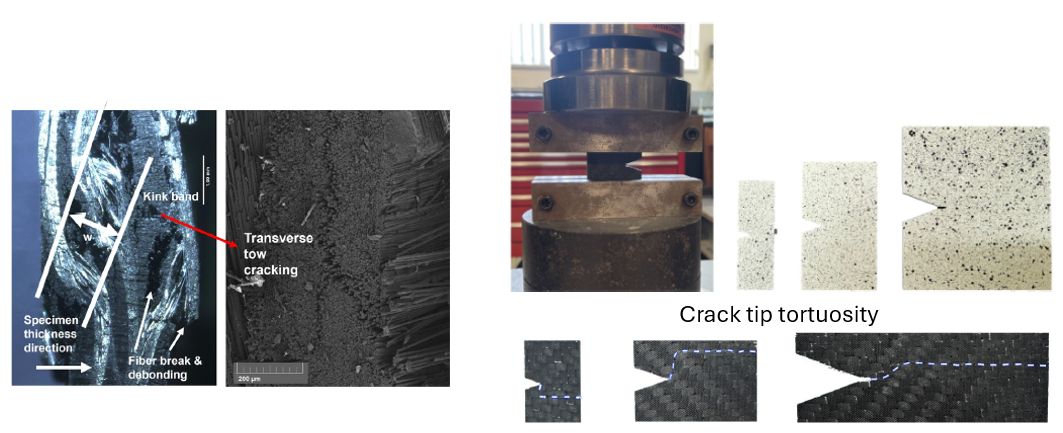
We are interested in characterizing material failure across multiple length scales, with particular emphasis on revealing damage mechanisms that govern fracture. In particular we are investigating how material architecture, loading conditions, multiaxial stress states, and specimen size can influence failure behavior in advanced materials. We also strive to develop new experimental techniques for this purpose, and employ techniques such as mechanical testing, digital image correlation, and optical microscopy.
Relevant publications:
1. L. Grotz and K. Kirane (2024) “Characterizing compressive failure mechanisms and their transitions in woven composites under on and off-axis loading” Composite Structures 330, 117848
2. M. John, J. Park, & Kirane, K. (2024). “Modified lap shear test for intralaminar shear failure of fiber reinforced composites” Composites Part A: Applied Science and Manufacturing, 185, 108368.
3. W. Miao and K. Kirane (2026) “Kink band fracture energy of 2D woven composites with 3D mixed-mode corrections and size effect analysis” Theoretical and Applied Fracture Mechanics, 142, 105361
ADVANCED MATERIALS
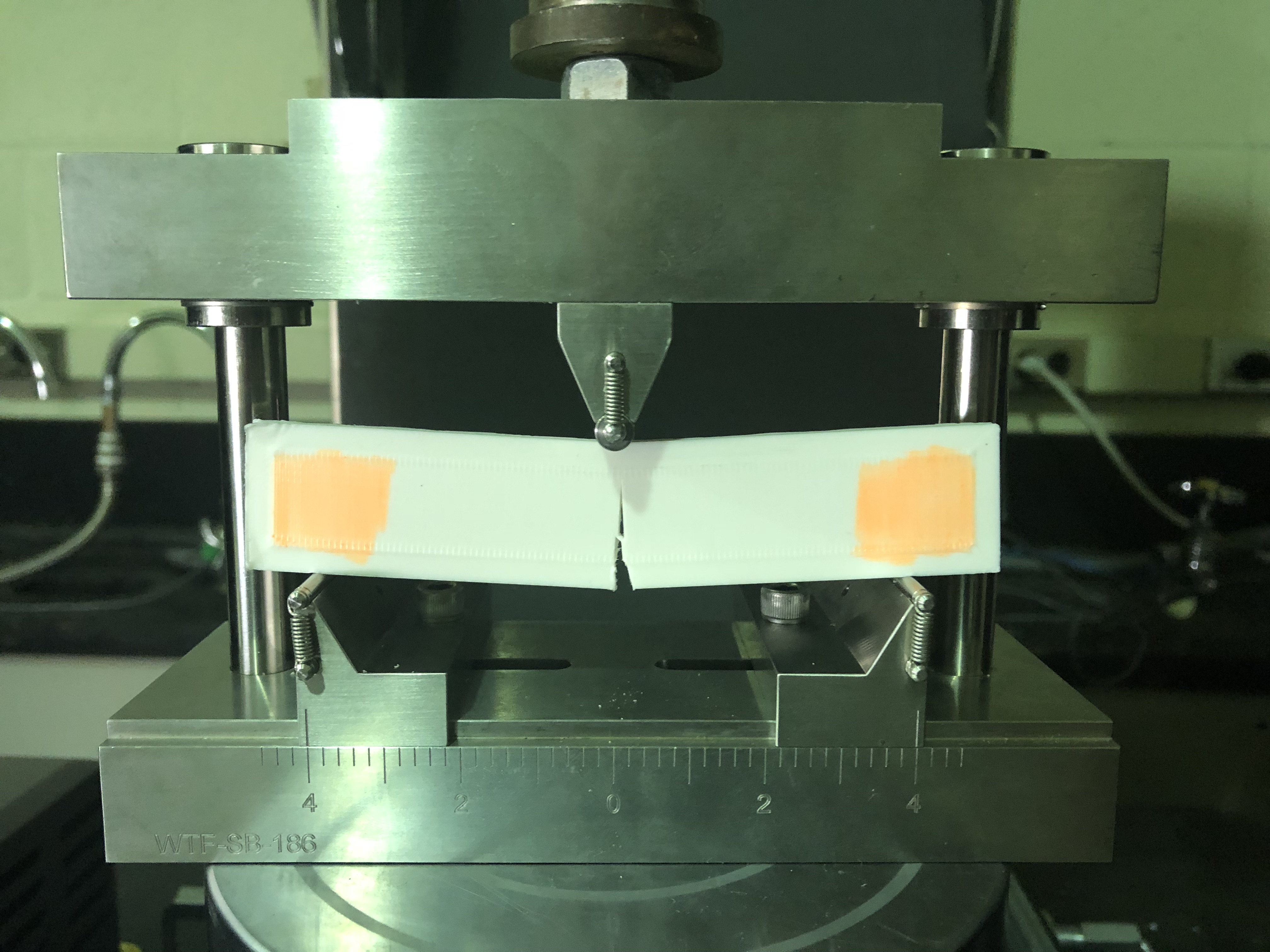
We are investigating how material structure, anisotropy, and characteristic length scales govern fracture mechanisms and size effects in advanced materials, including polymers, nanocomposites, 3D-printed and micro-architected materials. Through a combination of experiments and modeling we are aiming to understand how microstructure, interfaces, defects, and specimen size influence strength, fracture energy, and failure mechanisms.
1. S. Wardhekar and K. Kirane (2026) “Size Effect Based Fracture Toughness Characterization of Epoxy Resin to Resolve Small-Scale Yielding Ambiguity,” Polymer Engineering & Science (2026): 1–14.
2. A. Nurizada and K. Kirane (2020) “Induced anisotropy in the fracturing behavior of 3D printed parts analyzed by the size effect method” Engineering Fracture Mechanics 239, 107304
BIOMECHANICS AND SOFT MATERIALS
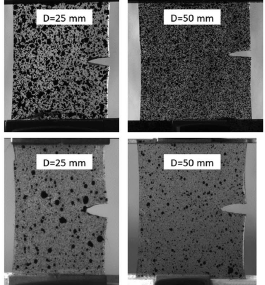
We are exploring the mechanics of biological tissues and other soft materials. Our emphasis is on highlighting the role of mechanics in biomedicine. Using experiments and computational modeling, we are investigating the complex, nonlinear, and anisotropic behavior of soft tissues, with a recent application being the modeling of abdominal hernias.
Relevant publications
1. M. Redzematovic and K. Kirane (2021) “Homogenization of the Mooney-Rivlin coefficients of graphene based soft sandwich nanocomposites” Mechanics of Soft Materials 3, 6.
2. K. Gonzalez, J. Xue, A. Chu and K. Kirane (2020) “Fracture and energetic strength scaling of soft, brittle and weakly nonlinear elastomers” Journal of Applied Mechanics, 87(4): 041009
NANOMECHANICS
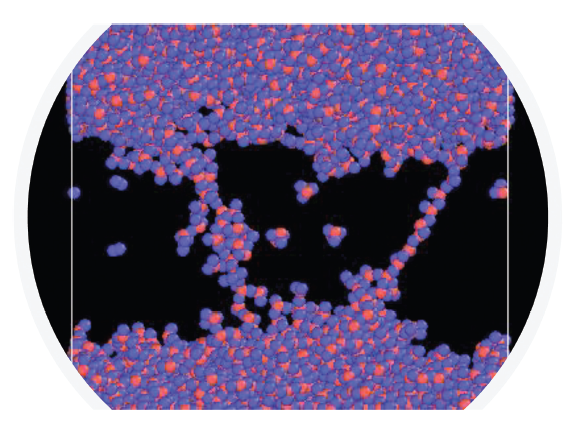
We are investigating the mechanical behavior and failure of materials at the nanoscale, using molecular dynamics modeling. We are studying fracture and deformation in silica and other nanostructured materials and help understand how nanoscale structure governs strength, damage, and fracture.
Relevant publications
1. Bryski E. and Kirane K. (2025) “Statistical variability in mechanical properties of amorphous silica predicted by molecular dynamics” Journal of Non-Crystalline Solids, 65, 123444
2. J. Park and K. Kirane (2021) “Transitional flaw size sensitivity of amorphous silica nanostructures analyzed by ReaxFF/SiO based molecular dynamics” Journal of Applied Physics, 129 (17), 175103