



The Department of Ecology & Evolution Presents: The Living World Series
A close-up photograph of vibrant pink cherry blossoms on a dark wooden branch against a clear blue sky.

Darwin DayThursday, Feb 12, 2026, Wang Center, Union Auditorium6:00pm start time
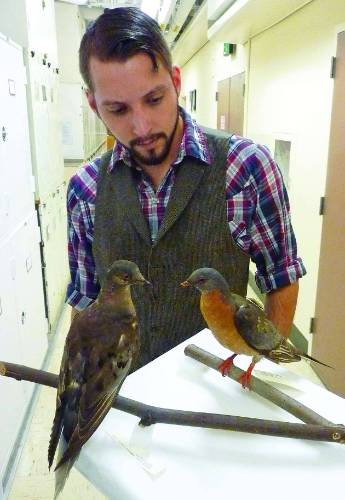
Dr.Ben Novak, Bird Conservation & Informed Biobanking, Link to Darwin Day Page
Title: Passenger Pigeon De-extinction:The Re-evolution of America's Forest Engineering BirdEarthstockMonday, April 21st, 2025, Javits Center, Room TBA5:00 pm start time(Map to Parking Lot), (Walking Directions)
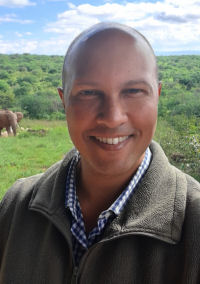
Dr. Dino Martin, Chief Executive Officer of the Turkana Basin Institute (TBI)
|
Monday, September 15th, 2025
Javits Center, Room 11 || 6:00 PM start time
(Map to Parking), (Walking Directions)
Dr. Rebecca Pearce || Undergraduate Biology, Center for Molecular
Medicine/Biology Learning Labs

Title: Clever But Curious, Smart But Scared:
Why Might American Crows Not Always Seem Always Seem As Intelligent As They Are?
Abstract: In this talk, she will explore why highly intelligent animals like American crows may not always appear as clever as they are, examining how risk perception, age, and exploratory tendencies may shape their ability to solve cognitive tasks. The study highlights the challenges of interpreting animal minds and the subtle factors that can mask true cognitive abilities. Her research focuses on the complexities of animal cognition, particularly how external and internal factors influence behavior.
Wednesday, October 1st, 2025
Javits Center, Room 111 || 6:00 PM start time
(Map to Parking), (Walking Directions)
Dr. Giovanna McClenachan || Assistant Professor,
School of Marine & Atmospheric Sciences
Title: From pocket parks to oyster reefs:
Community solutions to coastal climate change
Abstract: Coastal communities face growing risks from flooding, heat, and land loss,
but solutions don't always require massive seawalls or million-dollar restoration
projects. In this talk, I explore how community-centered nature-based approaches—from
urban pocket parks to restored oyster reefs—can reduce climate risks while building
resilience. These strategies not only provide ecological benefits like flood mitigation
and cooling but also create social infrastructure that
strengthens community ties and collective response during crises. By working with
nature and investing in spaces that bring people together, we can design local, adaptive
solutions to global climate challenges.
Monday, November 17th, 2025
Javits Center, Room 111 || 6:00 PM start time
(Map to Parking), (Walking Directions)
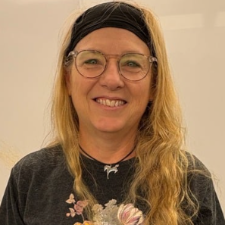
Dr. Sharon Pochron || Assistant Professor, School of Marine and Atmospheric Sciences
Title: The Afterlife of Roundup:
Soil, Earthworms, and Plant Health
When most people think of Roundup, they think of cancer. But the bigger story may be in the soil. Roundup stresses plants, earthworms, and microbes—but soils show surprising resilience. I’ll share what we know about how these communities bend, recover, and adapt, and why that recovery matters for both understanding ecology—and the food systems we all depend on.
Monday, December 15th, 2025
Life Sciences, 038 || 6:00 PM start time
(Map to Parking), (Walking Directions)
Dr. Oliver Shipley || Assistant Professor, School of Marine and Atmospheric Sciences
Title: Far From Home:
Over a Decade of Unlocking Long-Distance Migrations and Feeding Ecology of Sharks
Abstract: Oliver Shipley is an Assistant Professor in The School of Atmospheric Sciences at Stony Brook University. Shipley's research uses a diverse scientific tool kit to study the ecology of highly migratory marine predators. This talk will summarize over ten years of research studying the migrations and foraging interactions of one of the world's most infamous groups of predators, sharks. Shipley will summarize research spanning the Caribbean to coastal Long Island, New York where he will discuss some of the most pressing and emerging challenges facing shark management and conservation today.