


Isaiah Odhiambo Nengo. 1961-2022.
(emended from a tribute by Patricia Princehouse)
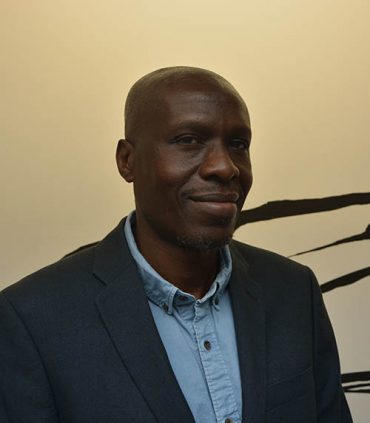
Isaiah Nengo was Associate Director of TBI and a Research Professor in the Department of Anthropology and IDPAS when he died suddenly on January 23, 2022 in Nairobi after a short illness.
Isaiah’s most visible single contribution to science was the discovery and innovative analysis of the last common ancestor of living apes and humans: the complete fossil skull of Nyanzapithecus alesi -which was published in the world’s top scientific journal, Nature, and numbered among Discover magazine’s top 50 scientific discoveries of 2017. In the 1990s, while most of the field had their eyes fixed on fairly recent forms like Australopithecus, Isaiah was excavating the earliest fossil skeleton of an ape, Ekembo nyanzae, demonstrating that this early Miocene form already had the signature ape characteristic: it had lost the tail, clearing the way for upright walking 10 million years later. His many finds from 10-20 Ma oriented the field of Miocene ape studies through cutting edge analysis of new fossils from East African sites such as Songhor, Buluk, and Napudet. In collaboration with the Grenoble Synchrotron, he used cutting edge imaging that blew prior approaches out of the water. He pursued sophisticated quantitative analyses that allow scientists to see these animals in their adaptational, ecological, and even social world.
After joining the Stony Brook faculty and reaching out to colleagues in Ecology and Evolution and Geosciences, Isaiah took a bold step to make paleoanthropology a locus for big science. Isaiah amassed a dream team of workers across diverse fields to create the multi-million dollar Turkana Miocene Project (TMP, funded by the National Science Foundation’s Frontier Research in Earth Sciences program) to produce an unprecedented understanding of tectonic, environmental, biological, and climate change across the crucial time interval from 30-5 Ma. The TMP hinged on a whale fossil. Isaiah acknowledged the contradictions the fossil posed and wouldn’t let it go. That whale overrode the geophysicists and rewrote the coastline of the Miocene Indian Ocean. His collaborators are continuing his work and no doubt equally stunning results are yet to emerge from the TMP group.
Born into poverty in a Nairobi slum, Isaiah’s mind was opened to science by a high school trip to the natural history museum. Not only was he enthralled by the exhibits, but he was also riveted by the words of Richard Leakey, who revealed the vast world of our ancestors that can be accessed only by science. Young Isaiah had never spoken to a white man before, but Leakey was so compelling as to overcome any concerns. Nengo set his life’s course right then and there, but he did not speak with Leakey again for five years. He knew he needed a college degree in science, so he majored in zoology at the University of Nairobi. On graduating he returned to the museum to knock on Richard’s door to ask for a job. Leakey promptly turned him down. But Nengo persisted and eventually became Leakey’s protégé. A PhD at Harvard followed, working with David Pilbeam and Stephen Jay Gould. Following a post-doc at Berkeley, then a decade of teaching in the US, Isaiah was called back to Kenya by Leakey to become Director of Science and Research, and Associate Director of the Turkana Basin Institute at Stony Brook.
Isaiah was an outstanding teacher and mentor to students and fellow scientists, including his work starting Africa’s first masters program in human evolutionary biology, at Turkana University College in Lodwar, Kenya, where he was hard at work giving the world a new generation of African scientists with stellar training. He was dedicated to issues of equity and inclusion and participated actively with colleagues at Stony Brook to provide a more diverse group of students with access to excellent programs and to support their success.
Isaiah’s career had taken off when he joined the Stony Brook faculty and the future looked bright when his life was tragically cut short by disease. He will be sorely missed as a colleague, friend, mentor, and teacher.