


Brown – Blanche? Black. Weaving intersections of language, culture and race through autoethnography
Date: Thursday, February 9th, 2023, 4:00 PM
Location: Wang Center, Room 201
Watch: Brown – Blanche? Black. Weaving Intersections of Language, Culture, and Race
Lecture Abstract
While researchers have adopted a range of approaches for collecting language ethnographies, rarely have they
turned their analytic tools on
themselves. In this presentation, I attempt to weave an evocative autoethnographic (Crawley, 2012) narrative of the racial,
cultural, religious and linguistic threads that have become integral to my work as
a multilingual classroom-based researcher across international contexts. This endeavor
is an attempt to realize Ellis and Bochner’s (2000) notions of evocative autoethnography, i.e., “to extend
ethnography to include the heart, the autobiographical and the artistic text” (p.
669). Beyond reflecting on my intersectional lived experience with languages, cultures and
race, autoethnography invites us to explore who we are be(com)ing in and through research
particularly with/as minoritized language users. In this presentation, I weave experiences of my own identity dissonance with my research
with minoritized language users as a way of reflecting on
linguistic bec(com)ing and belonging from an intersectional perspective.
About the Speaker: Gail Prasad
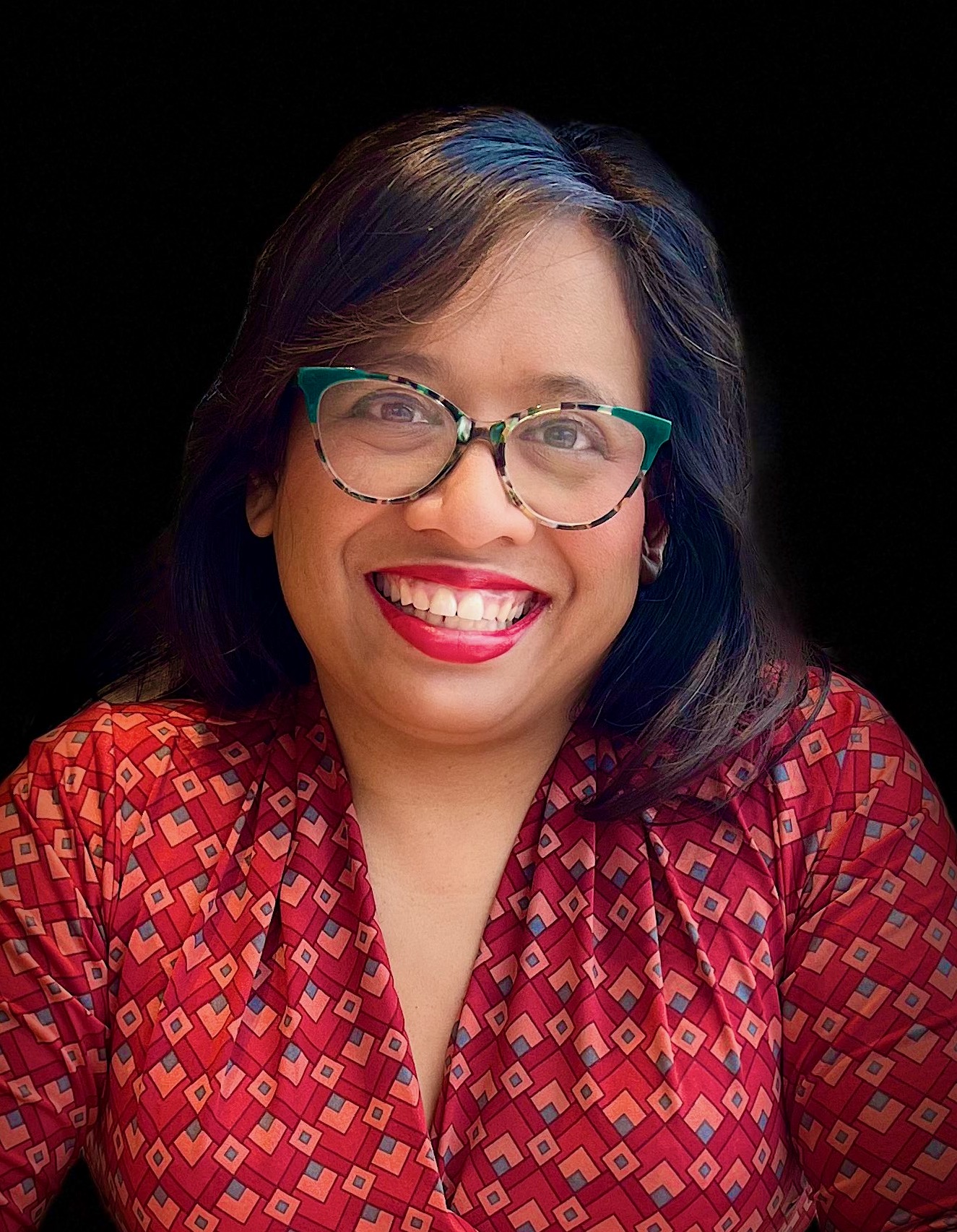
Gail Prasad is an assistant professor in the Faculty of Education at York University, Toronto, Canada. Her research focuses on critical multilingual language awareness and approaches to multilingual education and teacher development. She has partnered in research with teachers, students and families in Canada, the US, France, Kenya and Burkina Faso. Her scholarship has been published in English and French in journals including TESOL Quarterly, the International Journal of Bilingual Education and Bilingualism, the Canadian Modern Language Review and Glottopol. She is also a co-editor of Multilingualism & Education: Researchers’ Pathways and Perspectives, published in 2022 by Cambridge University Press.