

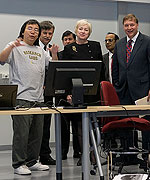
“Stony Brook faculty and students are doing amazing things, … and we will work tirelessly to raise the funds to help support their efforts to achieve excellence and impact. ”
Print Speech  5 of 6
NYSUNY2020 provides us with a tremendous opportunity to stabilize our finances and resume our positive trajectory. But as I have emphasized it will not be enough to help us achieve the truly top tier status (“the Berkeley of the East”) that John Toll envisioned in the 70s, and I see on our horizon today. What do we need?
First, we must do a better job of obtaining philanthropic support for the University. Fundraising, support from our alumni and friends, is absolutely vital to our future. We have a wonderful group of supporters, individuals who truly have transformed this University, and I know all of us are grateful to them for believing in this University and what we do. But we need to do even more in this realm. We have a tremendous advantage as a State school, the money donors give does not need to help us keep the lights on (the State does that). Instead, it can go directly to helping us achieve excellence—investing in recruiting or retaining the best faculty by creating an endowed professorship; providing a scholarship so an outstanding undergraduate or graduate student can attend Stony Brook and devote themselves full time to their studies; providing an endowment to ensure that a critical academic program or institute will remain relevant and vital for years to come, or creating a new landmark on our campus, whether a recreation building for our students, or a laboratory where new discoveries will be made.
Coming from a private institution, I have seen how essential fundraising is for today’s University. We need to improve our efforts, and with Dexter Bailey in place, I am committing to significant new investments in Advancement. We are developing a strategy to better engage our alumni, to do a better job in telling our story, and to better identify and create programs of excellence and distinction that merit support. Stony Brook faculty and students are doing amazing things on this campus, and around the world, in academics, research, health care, community service, and athletics, and we will work tirelessly to raise the funds to help support their efforts to achieve excellence and impact.
Second, we must improve our sponsored research support. In 2009-10, for the first time Stony Brook surpassed $200 million dollars in sponsored project expenditures, and we ranked first among SUNY’s 64 campuses in research expenditures. This figure was increased by one time funds from the American Reinvestment and Recovery Act (ARRA)—and as those funds phase out in 2011, our dollars have decreased. As everyone knows, this is shaping up to be an extraordinarily difficult time for our funding agencies, NSF, NIH, DOE, DOD, etc., with budget reduction efforts dominating the current climate in Washington. Monday, I was at an advisory meeting for one of the major institutes of NIH, and they are preparing for the possibility of very significant reductions in their funding dollars. So, growing or even maintaining sponsored research support in this environment is going to be very challenging.
Nevertheless, I believe we have opportunities. We still have not fully leveraged our partnerships with Brookhaven National Laboratory and Cold Spring Harbor laboratory, and this must be a high priority for us moving forward. One area of particular interest is imaging. Human beings are visual creatures, and seeing is critical to understanding. Microbiology depended upon the discovery of the microscope, astronomy the telescope, and today’s structure based drug design comes from X-ray crystallography. The building of the NSLS-2 at Brookhaven National Laboratory, and the continuing advances in PET/MRI and other imaging modalities provide us with unique opportunities in this realm. I have committed significant resources to exploring a new imaging initiative that is designed to bring together scientists on this campus (and by that I mean both sides of Nicolls Road) and at BNL to push the frontiers in several areas. Under Ken Kaushansky’s leadership, our first phase is focusing on neuroimaging, looking at the brain, not just its anatomy, but visiting its function at the cellular and molecular level. More initiatives will follow, and we will work to create a new imaging institute that can serve as a focal point (pun intended) for collaborations between BNL and Stony Brook in this vital area. We also are working with Brookhaven National Laboratory to re-vitalize our Joint Photon Sciences Institute, an effort designed to position Stony Brook to better utilize the extraordinary capabilities of the NSL-2.
We also have tremendous opportunities in energy research—our new Advanced Energy Center should be the catalyst for new collaborative efforts with BNL, and other partners on the Smart Grid, on improved storage devices, and on renewable energy sources. We have strengths in a number of these areas, but will need to build critical mass if we are to be competitive for major awards. We also have the opportunity to grow our efforts in marine and atmospheric sciences. The expansion of our marine research station at our Southampton Campus represents just one part of a strategy to increase our research portfolio in this vital area.
)
)
)
)
)
)
)