


Richard S. Lee Research Excellence Award
The Richard S. Lee Research Excellence Award is given to a select Masters or PhD graduate for an exceptionally strong dissertation, as well as a graduating senior who has demonstrated a commitment to research and who will be pursuing an advanced degree. This honor comes with a certificate and a $500 scholarship. Congratulations goes to Xiaoqiang Xu, PhD, and Jason Hamechand, BE. They received this award during the 2025 Mechanical Engineering Convocation ceremony.
Here's a bit about these excellent researchers:
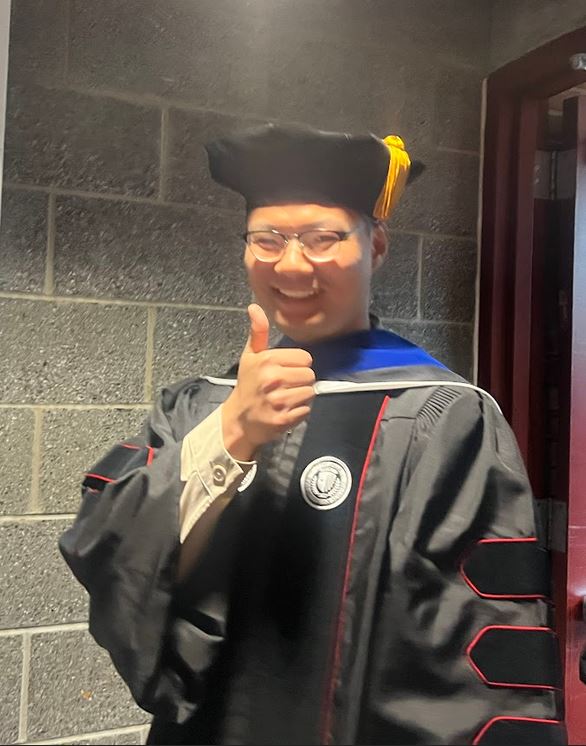 Under the guidance of Professor Shikui Chen, Xiaoqiang Xu has been selected as an exceptional PhD candidate whose research accomplishments,
leadership, and professional development make him highly deserving of this award.
His work has led to five peer-reviewed journal publications, including articles in
Computer Methods in Applied Mechanics and Engineering and International Journal of
Heat and Mass Transfer, and several conference papers in prestigious venues such as
ASME IDETC/CIE and InterPACK. His innovative contributions to topology optimization
for thermal management, additive manufacturing, and multiphysics modeling have been
recognized with multiple awards, including the 2023 Graduate Research Symposium Poster
Award at Stony Brook University. Beyond his research, Xiaoqiang has completed highly
competitive internships at Toyota and Apple and demonstrated strong service to the
academic community by serving as a reviewer for top journals. We commend Xiaoqiang
for his impressive academic record, professional growth, and broad impact in research
and education.
Under the guidance of Professor Shikui Chen, Xiaoqiang Xu has been selected as an exceptional PhD candidate whose research accomplishments,
leadership, and professional development make him highly deserving of this award.
His work has led to five peer-reviewed journal publications, including articles in
Computer Methods in Applied Mechanics and Engineering and International Journal of
Heat and Mass Transfer, and several conference papers in prestigious venues such as
ASME IDETC/CIE and InterPACK. His innovative contributions to topology optimization
for thermal management, additive manufacturing, and multiphysics modeling have been
recognized with multiple awards, including the 2023 Graduate Research Symposium Poster
Award at Stony Brook University. Beyond his research, Xiaoqiang has completed highly
competitive internships at Toyota and Apple and demonstrated strong service to the
academic community by serving as a reviewer for top journals. We commend Xiaoqiang
for his impressive academic record, professional growth, and broad impact in research
and education.
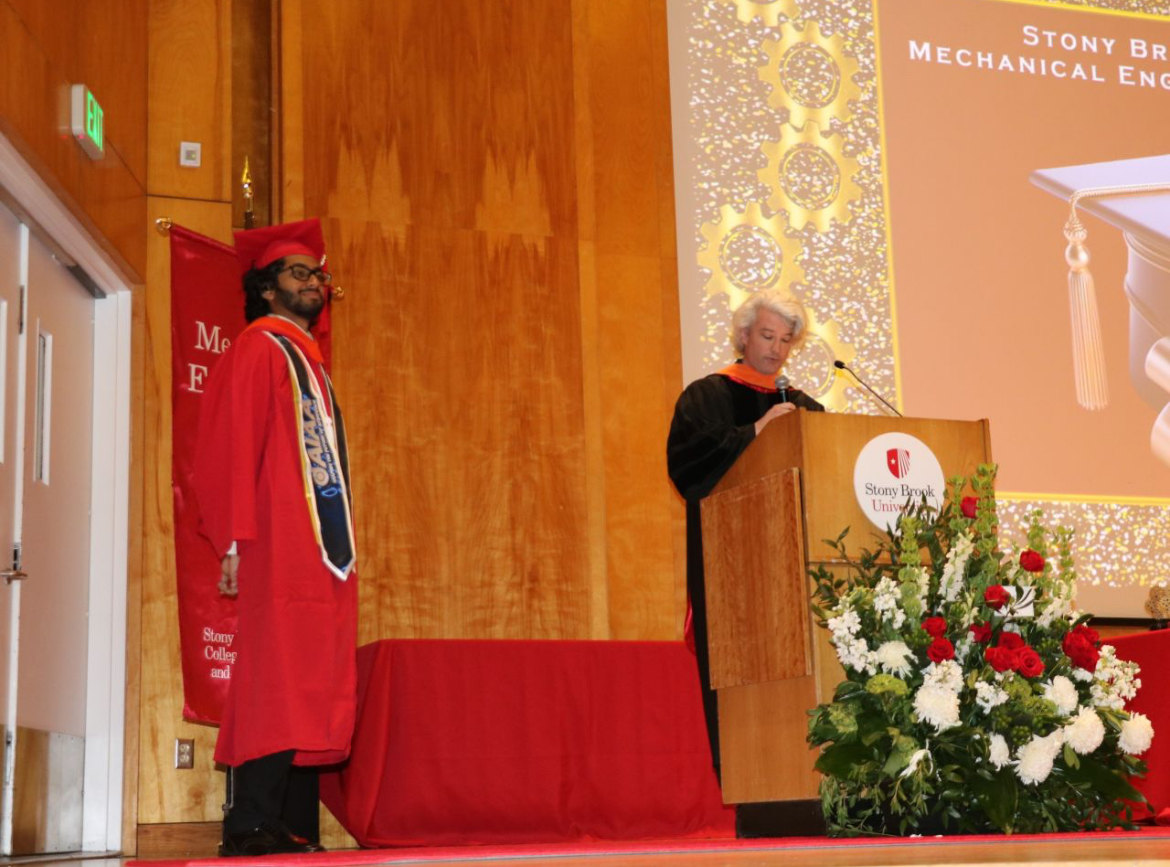 Under the guidance of Professor Spencer Zimmerman, Jason became interested in parallel image processing for turbulence measurements
and taught himself parallel reduction and basic CUDA programming for Nvidia GPUs.
He continued this work for two semesters, successfully converting a holographic image
back-propagation code from MATLAB to CUDA, resulting in a substantial reduction in
run time. Jason will be pursuing a research-track Master’s Degree at Johns Hopkins
University in the fall.
Under the guidance of Professor Spencer Zimmerman, Jason became interested in parallel image processing for turbulence measurements
and taught himself parallel reduction and basic CUDA programming for Nvidia GPUs.
He continued this work for two semesters, successfully converting a holographic image
back-propagation code from MATLAB to CUDA, resulting in a substantial reduction in
run time. Jason will be pursuing a research-track Master’s Degree at Johns Hopkins
University in the fall.