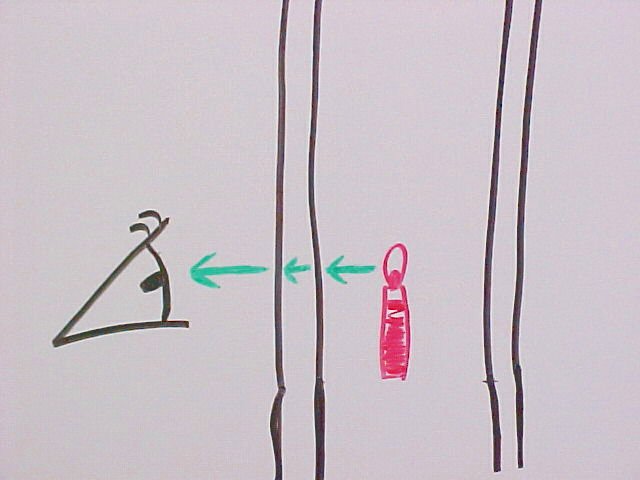
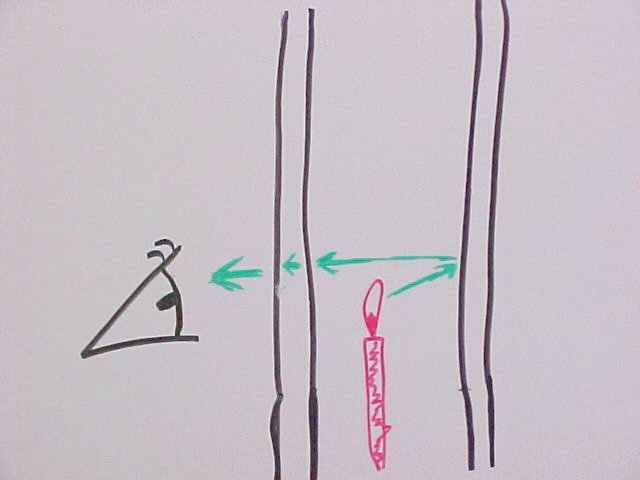
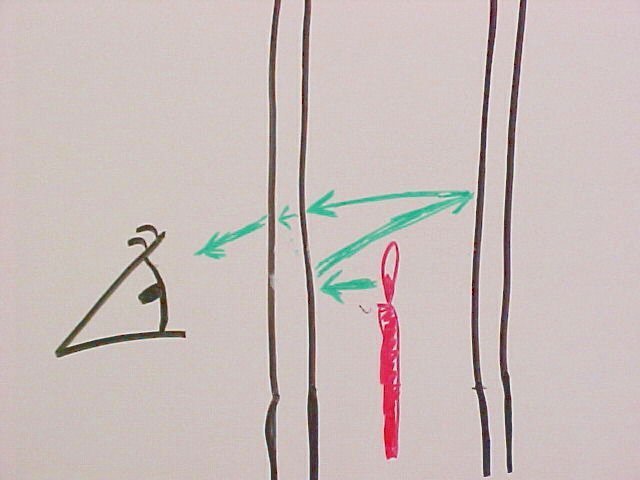
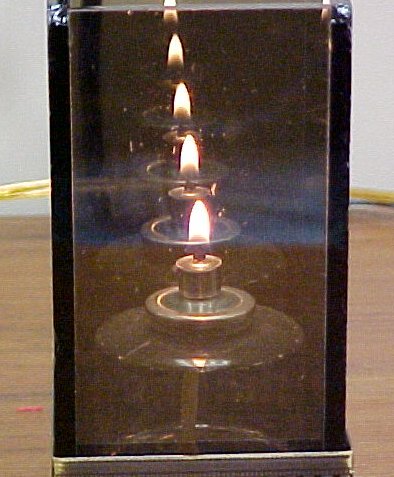
Why I chose this:Well... other than my somewhat disturbing fascination with fire...I find the concept of the one-way mirror fascinating. Different materials in glass give it different properties. The one-way mirror is an example. The glass is treated with a material that allows it to transmit light (like a window), reflect light (like a mirror) and absorb light. In his lab, Dr. Noé had a clever lantern from the The Curry Club that had a small oil lamp in a chamber made of one way mirrors. As the fire light bounced off the inner surface of the mirror, it got weaker, which is why the successive flames that you see get fainter and fainter. I was curious to see how much fainter the successive flames got, in relation to the first flame, as they reflected repeatedly off of the inner surface of the mirror. This lead to my project in this lab. |
|
What I did:
In order to find out how much fainter the flames were getting, I had to measure the amount of light that was reflected and transmitted by the different surfaces of the mirror. I did this in several steps.
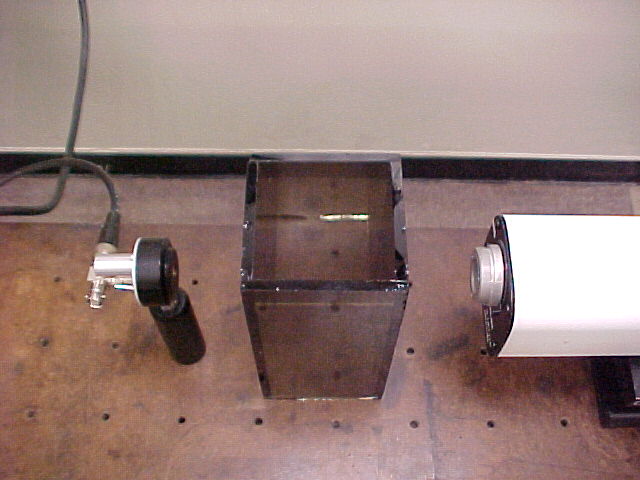
Part One: Setting up
I set up a laser and a photo detector. The photo detector was used to measure the strength of the light. The laser light measured 1235 mV. I used this as my control, in order to compare the light when transmitted through and reflected off of the mirror.
Part Two: The real fun begins...
Next I started taking the measurements.
I began by finding out how much light is transmitted through each surface of the mirror.
- When the laser light was allowed to pass through the outer surface, its strength was reduced to 268.9 mV.
- When the light passed through the inner surface of the mirror, the strength was similar, at 266.8 mV.
Next, I determined the amount of light that was reflected by the inner surface of the mirror. (The reflective properties of the outer surface were of no concern to me because the flame never reflects off of the outer surface.)
- The laser beam bounced off the inner surface and into the photo detector, where its strength was measured to be 450 mV.
Part Three: Looking at the mirrors
After finding out how much light is transmitted or reflected off of the mirrors, I looked at the path of the light itself.
- For the first, and therefore brightest, flame you see, the light is not reflected off the inner surface of the mirror and therefore the reduction in its strength is caused only by being transmitted through the inner mirror.
- For the second flame, the light is reflected off of the inner surface of the mirror once, and then transmitted through the inner surface of the mirror.
- The third flame is reflected off of the inner surface twice before being transmitted through the inner surface of the mirror.
Each flame continues in this manner.
Part Four: Conclusion and Analysis
From the data above, I was able to come up with a way to formulate the relative strength of each flame:
f=rnwhere f is the relative brightness of the flame, r, which we found is equal to approximately 0.36, is the effect of the light being reflected off of the inner surface of the glass, and n is the number of reflections of the flame. The graph of this formula is shown below. The graph shows that the ninth reflection (n=9), which we can just barely see, is 10,000 times weaker than the first image of the candle (n=0).
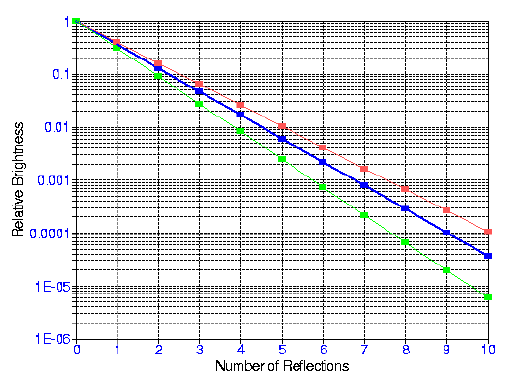
green: r = 0.30 blue: r = 0.36 red: r = 0.40
And Finally...
I'd like to thank the good people at WISE, the Laser Center, and especially Dr. Noé for this opportunity. I had a lot of fun with this. I think I learned more, both from Dr. Noé and my fellow students, by working in this lab than I have from any science course that I have taken.Some Links
Click here: Physlink.com If you want to learn more about one-way mirrors, or just about anything else...
The best search engine ever...