I'm sure you have taken pictures of family members or friends and seen a red "glow" in the center of their eyes -- or seen a night jogger wearing shiny reflective material for visibility purposes and wondered how each worked? It was not until I truly explored each of these simple facts and found that they were not only related, but much more complex and vital to other areas of science and of our daily lives then I would have ever thought! Naturally, this heightened my interest and decided to test them even further. What made this project even better was that it was not so mething which had a specific recipe or instruction guide, it was a unique project which had limitless boundaries to test!Reflectors and the Cat's Eye
So, what is this project truly testing?
So, you are probably wondering right now, what is this project all
about? Basically, this project focuses on optical devices that have
the property of returning light to a known source. In order to
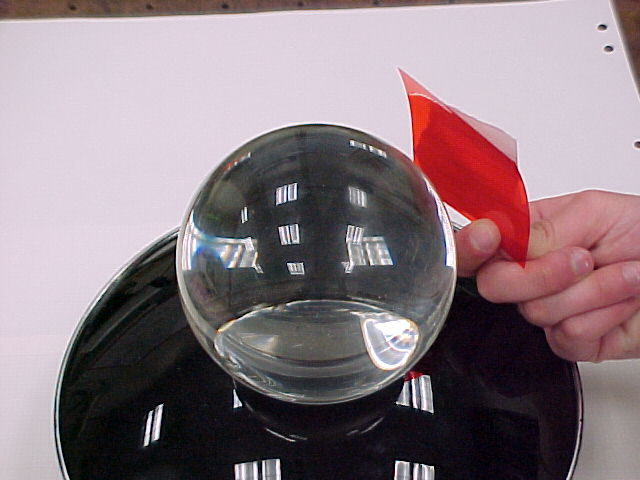
demonstrate the path of light, I simulated a cat's cornea lens and
Scotchlite 3M, a shiny silvery reflective surface often used for night
vision, to test reflection of light in hopes to determine the cause of
red-eye and to explain the unusual irridescent glow of reflective
paper.
What is a Cat's Eye and what does it have to do with reflection?
All eyes reflect light because our eyes reflect light in two
directions, through the rods and through the cones. The cat's eye is
of particular fascination because their eyes have a special reflective
surface called the tapetum which improves their night vision by
doubling the amount of light that is able to hit the retinal cells.
This permits their eyes to remove diffused light inside the cell by
propelling it back the opposite direction through the pupil in order
to improve night vision -- so that's why cat's can see so well!! This
special layer makes a cat's eyes glow brightly in the dark, especially
when you shine a light ne ar their eyes at night.
Our eyes also have a similar property as cats, except this is where
the infamous "red-eye" comes in. "Red-eye" is commonly seen after a
flash photograph is taken. Our eyes tend to reflect the light from
the flash back towards the camera which causes a reflection hence,
red-eye. In order to minimize "red-eye", we need to move the camera
lens much further away from our eyes [from the flash actually] in
order to prevent the camera from "seeing" the light that eyes are
beaming back at it.
The Cat's Eye Experiment!
In order to test the reflection concept of "cat's eye" I had to investigate
much further into the physics (scary!) of reflection.
Setup
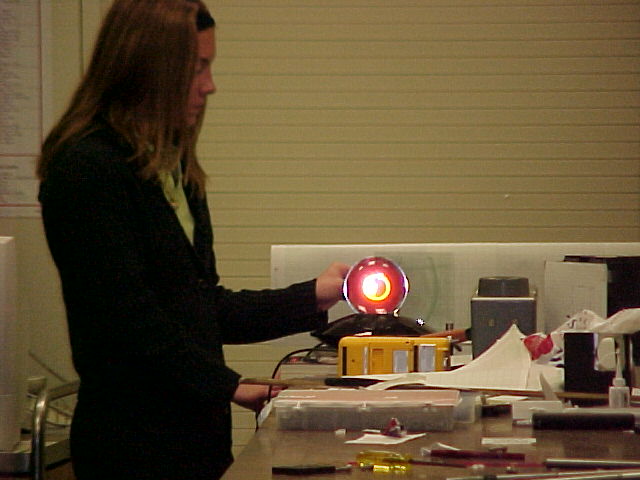
Here is the image with the incorrect focal length. It is blurry and almost completely red!

Look below for pictures of my experiment...
I took pictures of Scotchlite 3M from different distances.
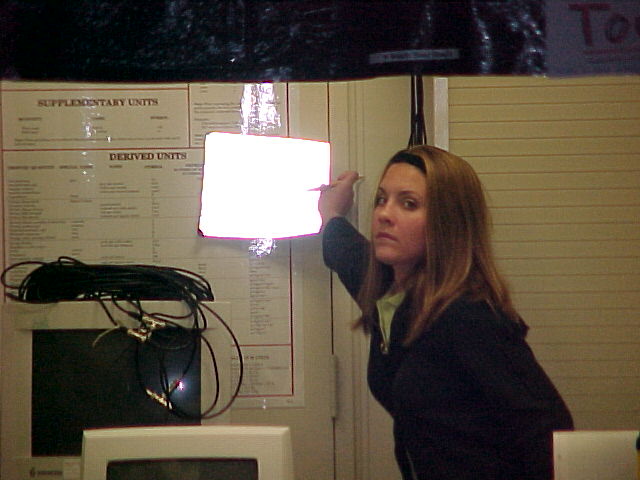

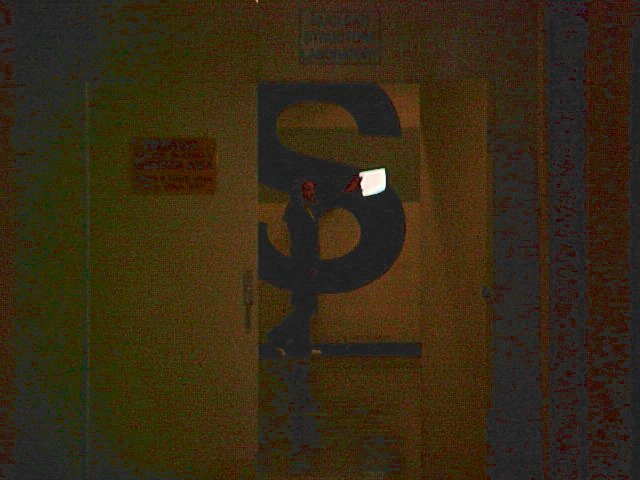
I took pictures of Scotchlite 3M from 40 feet, 68 feet and 180 feet, respectively.
Look how bright the material is!
As I moved further away, the illuminescence intensified greatly. At one point it looked as the 3M was the only light source in feet!
I wondered what exactly caused such an effective source of reflection and such
an effective illuminescence...I investigated further.
What is Scotchlite 3M Made from?
The remarkable thing about scotchlite 3M is that it is made up of tiny
glass beads. These tiny glass beads are around 500 microns small and
are sprayed on top of a painted surface such as, road signs and
reflective tape! These beads have a carefully chosen refractive index
(how much light will bend when entering) so that as the light shines
through them, it will refract and then reflect inside of the glass
beads. When this happens, most of the light will become reflected
directly at the source from whence it came from causing a [bright]
GLOW!
The challenge of making this perfect reflective material came back in 1937 when the company 3M thought it would be a profitable idea for a company to create a more reflective material then white or yellow paint. They decided to move onward with the experimentation and from this, they decides to sprinkle tiny glass beads onto a painted stripe in hopes to achieve a greater reflectivity. Although it was successful, they moved on to better experiments.
The idea of using 3M's roofing granules was suggested and a researcher named Harry Heltzer was determined to find the most reflective material of all time. So, he took reflective beads, 0.015 inch, about 100 microns, in diameter and proceeded to make his own reflective striping. By late summer, after all of his testing, he had an effective prototype: "a prefabricated, double-coated cloth tape with beads on one side." However, this could not stand up to inclement weather so the experimentation continued.
After the immense amount of experimentation, the glass beads were
shifted from a horizontal striping to a vertical sign coverage. The
result was astounding! The first Scotchlite 3M reflective sheeting was
made and went on to become the leader in highway signage! See what
persistence and determination can do!!!
Some Interesting Links...
Here are some cool links that Dr. Noe found...its remarkable how many uses
Scotchlite 3M has!
LAEGOS Experiment! Very Interesting!
Reflectors on the Moon!
Bicycle Reflectors!
Pretty Cool Site on Reflectors!
See the Glowing in Action!
Let's tie it all together!
From my experimentation, I have found that the cat's eye acts like
reflective material in many ways. When light moves through the eye,
just as in glass beads, if the focal length is not precise, you will
achieve a blurry image or "red-eye." Similarly, if the light from a
source hits the reflective tape at an improper length, you will not be
able to see the reflective glow instead, it will appear grey.
So, light has many functions in our everyday lives! It was fascinating to discover that light and physics could be fun and how important it is to everyday life! I want to thank Dr. Noe for making this experience possible and for all of his time and patience.
References:
Research by: Kristin Regan
Advising Professor: Dr. Noe
Special Thanks to : The Laser Center and the W.I.S.E. Program
Any further questions? I'll be happy to answer :)
Email Kristin })i({