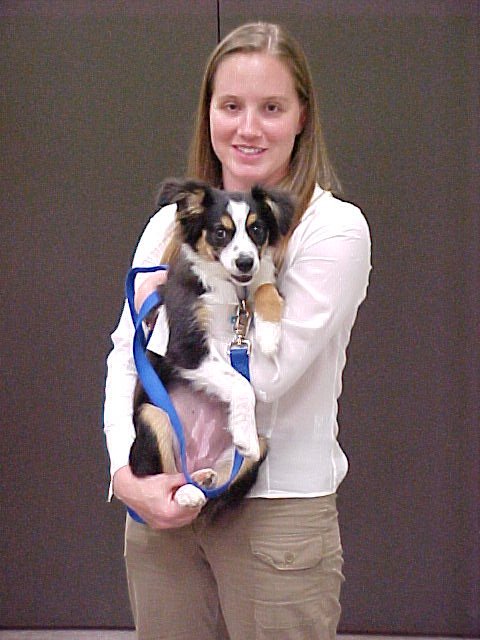
Jose A. Mawyin, the Stony Brook Years.
Summer 2001 was the first time I worked full time on the Laser
Teaching Center. During this summer my project dealt with the "Which
Way Experiment" which shows a very interesting Quantum Effect. I started
working on this project the previous semester with one of the Graduate Students
, Mirna Lerotic. After many technical problems (who knew that reflections of
mirrors would flip polarization), we gathered enough data for her to present
the results in her Optics Rotation talk and for me to present in the Undergraduate Achievements Day. This
effect can be explained in different ways. With light it shows that
orthogonally polarized light cannot interfere. With particles it can
show the collapse of the wave function for a particle traveling
through two different branches of an interferometer at the same time. It was a fun
project and the beginning of my work on the LTC. We had some neat
experiments going on in the LTC there was Ziggy working on his
sono-luminescence (even thou at the beginning there was more of the
sono part than luminescence), we had Doug working on his holograms, there was Lisa helping everybody with their projects while trying to tidy up the lab
and many Simmons people working feverish to complete a project before
the end of the program, plus we had Guy. I had the opportunity to meet so many
different people from far ranging places such as Australia or Puerto
Rico. I spent my free time fraternizing with both people from the REU and the AGEP program even when technically I
belonged to AGEP. However, the REU crew had people doing physics so I
used to hang out in my building with AGEP one day (the girl from
Puerto Rico made some tasty hispanic dishes) and the next day I would
crash over the adjoining building to hang out with REU (they had a
chef there too but she was vegetarian so no meat, but she was knew her
way around salads, wine and cheese). I wish them the best on whichever
route they take in the future. I thank Nina from AGEP for her
sponsorship during this summer and her continuous help until the
present. Memorable things from the summer: watching "You, me and them"
on the film festival, the trip to the Metropolitan
Museum and the medieval armor and weapons collection, listening to
the free concerts at Central Park while sipping a Merlot and eating
Brie with a buttered French loaf and who could forget those Square
Dancing marathons.
The OSA 2001 Conference that took place in Long Beach, California was
a blast. I traveled with Doug Broege and we presented our work to the
attending Physicist. I presented my work on the "Which Way Experiment"
that I worked on the previous summer. We could not get a hotel room
nearer the Conference hotel so we spend the week on a Days Inn motel
on the outskirts of Long Beach (quite an adventure). We attended a
heap of presentations and this was the time when I got interested in
Atom Optics and all the neat things that you can to Atoms using
light. I enjoyed the talk given by one of the retiring members of the
OSA board at the conclusion of the conference, he talked about how
Optics (interferometry) can be related to Astrophysics while discussing
the grandiose designs for the land-based and space-born Gravity Wave
Detectors (LIGO and LISA), those things are huge and for me represent
the spirit of big physics. There was a beautiful waterfront beside the
Conference hotel with an ocean liner moored on the other side of the
shore. Sadly Long Beach seems to go to bed by 8PM so there was nothing
to do once it got dark. Also the neighborhood around our motel was
kind of rough and tumble and not advisable to wander around in the wee
hours of the morning, especially when the bus that brings you back
dumps you in the middle of nowhere at 1AM. It was a nice 2 hour walk
back to our room (next time I need to remember to bring a compass and
map) only to discover that they had invalidated our access cards
because some snafu with the credit cards. On the plus side I fell in love
with the sourdough burgers
from the Jack in the Box beside our motel (so finger licking good) I spent
the whole time just eating those. As a personal anecdote I remember
when one night back in our room I was telling Doug that one day I
could swear I saw those pesky quantum wave equations and that they
looked like waving rainbows that trembled when you tried to touch
them. His response went like "..sure Jose I believe you". I probably
had a head-rush or had a dream after studying for a Quantum Mechanics
midterm.
Another summer at Stony Brook and a new project to work on. This time I worked on
non-linear optics and its application. I was tasked to research the
possibility of generating 389nm light using frequency conversion of
1447nm and 532nm light in a non-linear crystal. This combination process can be
done. However, I found some setbacks on finding an efficient source for
the 1447nm light. It was either enough power but with a too broad
linewidth or a fine linewidth but with a extremely small power
output. In any case the project remains on hold until we can get a
better source. But I came up learning a lot about the broad field of
non-linear optics and their applications in both experimental physics
and telecom. I also learned that sometimes there are more than one
ways to get your project started. In this case, frequency conversion
was not the only way to get 389nm light but frequency doubling was
also an option. Through this project I really became acquainted with
the library resources of Stony Brook (once I had 12 books about the
same topic under my account) and I had my first exposure on dealing
with vendors that don't really know how their advertised product
works. We had a big group of REU students this time, there was Doug working
on the optimum way to introduce holography as a do it yourself project for the
students taking the Optics course next semester, we had Brendan working on
chaotic behavior of laser cavities around threshold current (region when gain just compensates over losses), we had Owen working on laser modes inside a home-made HeNe that became the center-piece of many following projects, there was Jill
working on the power law and there was Jennifer working on Optics Demostrations. Also, we had a full complement of
Simon's students such as Alex and Waldo. During that summer, the night of the 4th of July to be
specific, we had an encounter with the security/law enforcement units
of the campus. We got into trouble because they said we were loitering
around and walking inside the fountain in front of the Administrations
building. What happened is that we got into a discussion about strange
attractors from Chaos theory and one of my fellow summer researchers
was trying to explain the concept to me by using the water fountain as
an example (the chaotic behavior of the water droplets as they exit
the nozzle are bounded on their trajectory by gravity and their
initial velocity). Luckily, after mentioning that we were doing
research during the summer, the incident got resolved quickly even
thou they told us to vacate the premises. Such is the price needed to
pay for the advancement of knowledge. The final presentations were interesting
thanks to some insightful questions from the attending faculty and REU students. Highlights: When poor Dr. Noe jumped when he saw Brendan's hat, the Star Wars kid and Clint with the glasses incident.
This was my second OSA conference and my chance to finally visit Florida. During
this conference I presented the work I did on non-linear optics and what
could be achieved if only we could get our hands on an infrared source
that met our requirements. During my previous semester in SB I had
developed a taste in Quantum Computing so I attended a handful of talks
dealing with this topic. Some of them were somehow above my head but I was
able to understand the concepts that they were presenting. The field seems
to hold great promises in the not so distant future. However, all of the
talks on Q.C. only showed theories of what a Quantum Computer could do and
how to build one. There were two memorable memories from this trip. The
first was the dinner
with the the undergraduates presenting posters hosted by
Prof. Metcalf, Dr. Noe and some other Professor whose name slips my
mind. While enjoying a refreshment before our meal I had the chance to
discuss with Dr. Noe and Prof. ? about what Grad School would be like and
the experiences of a physicist both inside and outside a lab. The
following meal was unforgettable (im still saving up for that bottle of
Faustino I) and showed me not all Physics takes place in a research lab
but that also ideas dealing with on-going and future projects are
exchanged when you are socializing with your peers. Finally I had a great
time when after the conference for the day was closed I got together with
other undergraduates
to discuss physics in general. What do we like about
it right now and where do we think is heading to. It was a very lively
discussion and for some reason I don't remember I won the argument in a
discussion by mentioning Hawking's Radiation emanating from a black
hole (in the sense that the energy trapped inside the black hole
can leak out until it evaporates). Probably we were talking about the heat
death of the universe or another such wild eye topic. And never forget
those wacky Brazilian guys that we met at the party at the closing day of
the conference.
My third summer at Stony Brook and as usual I started working on a new project. This time I'm
working on the Simulation
of the Optical Bloch Equations for two and three
level systems. They all deal with population transfer schemes that use
light sources that are slowly changing in frequency to move atoms from one
state to another with high efficiency. My interest on this subject
arose after attending an Optics Rotation event where graduate student
Dan Li made a presentation that dealt with the two level problem. I
liked the principle behind this process and I asked Prof. Metcalf if
I could continue working on this project. He accepted my request and
I started writing my own version of the simulation. Since this is a
computer simulation, I had to polish my rusty programming skills. First
started with Maple which I found a bit too simple, then I switched to
Mathematica which I found too dry and finally settled on MatLab which both
offered many more built-in routines for an easier way to write and present
the simulation and also has a broad user help database with a community
that is eager to help questions posted by users (there is always somebody
that knows more than you about a subject). I started working on
this project the previous semester and I was able to show an alpha
version of my program in the Undergraduate
Achievement Day where
I was fortunate enough to have the chance to show it to my Optics
and Electronics teacher, Prof. Jacobsen
and couple of visiting
students
working on Prof. Weinacht's lab, my former Lasers
teacher. However, programming is not all
I do in the LTC. We have as every previous summer some students part of
the Simmons program. I try to answer their questions while hoping not to
confuse them too much. And its great (not confusing them but answering
questions) because you don't truly understand something until you can
successfully explain it to somebody else. This summer we
had an interesting group: Allison working on
self-imaging and
studying the underlying
mechanism
behind the Talbot
Effect, James
working on locking a diode laser to the Rubidium cell
resonance for his MOT and
Tom working on the
effects of extreme light intensity on
different materials and its application on laser
ablation and engraving. Highlights: Jame's home-made
Tesla Coil, Sage's stories (she would beat Sheherazade in
a tale tell contest, "It was the funniest thing ever! :)") and finally
that
one day while
talking in the Talbot/MOT/Tweezers lab and from behind the curtains we
hear Maanit say "I've solved it!" and then *insert your favorite sitcom
tune* suddenly Patrick
opens the curtains and pops in while
complaining about his misfortune with the lab computers, priceless
moment. "Real World: Nerdvana", when you combine
4 REU and
6 Simon's students in a lab full of lasers and assorted
optics, hilarity ensues. Summer
fun.