
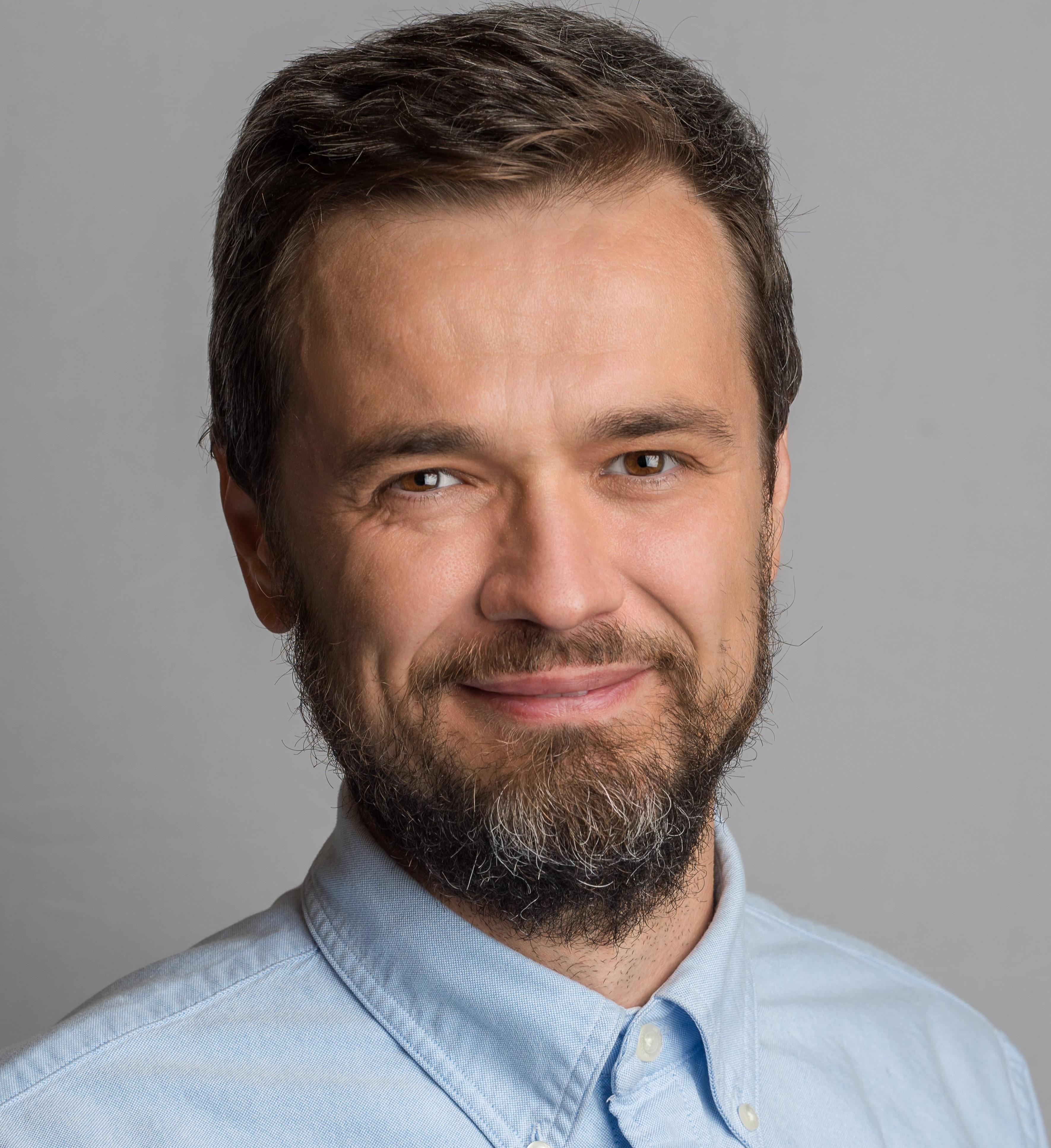
Vasili Perebeinos
University at Buffalo
"Solid-State Materials as Quantum Light Sources for Quantum Internet"
Dr. Perebeinos is a Professor of Electrical Engineering Department at University of Buffalo. He joined University at Buffalo in 2018 from the faculty Skoltech, Moscow, Russia where he was since June 2014, after spending 11 years at IBM T. J. Watson Research Center, Yorktown Heights, NY, prior to Brookhaven National Lab as a Research Associate. He received Diploma in 1997 in Physics from the Moscow State University and PhD degree in 2001 in Physics with Council Commendation from the State University of New York at Stony Brook. During his research career, he became a Fellow of the Fellow of the American Physical Society in 2013, he has received three times the highly competitive “IBM Research Technical Accomplishment”. His research interests are in the area theoretical and computational physics of novel low dimensional materials, which offer new opportunities in electronic, opto-electronic, quantum and information technology applications. His work (over 90 articles, one book chapter, one US patent) was cited over 15,000 times (h-index 50 – google scholar).
“Solid-State Materials as Quantum Light Sources for Quantum Internet”
The advancement of Quantum Networks for Secure Long-Range Communication, Quantum Computing, and Quantum Sensing technologies critically depends on materials development. Solid-state materials allow building scalable devices on a chip. There are stringent requirements for the quantum material properties, such as high coherence time, on demand quantum state generation, detection, and transduction. In this talk, I will review solid-state materials platforms for generating quantum light, including excitons, trions, and polaritons in two-dimensional materials and van der Waals heterostructures; rear earth ions in 3D bulk materials; nonlinear optical materials for spontaneous parametric down conversion. I will emphases the role of many-body interactions in low dimensional materials and theoretical challenges for describing linear and nonlinear optical properties of quantum materials.