
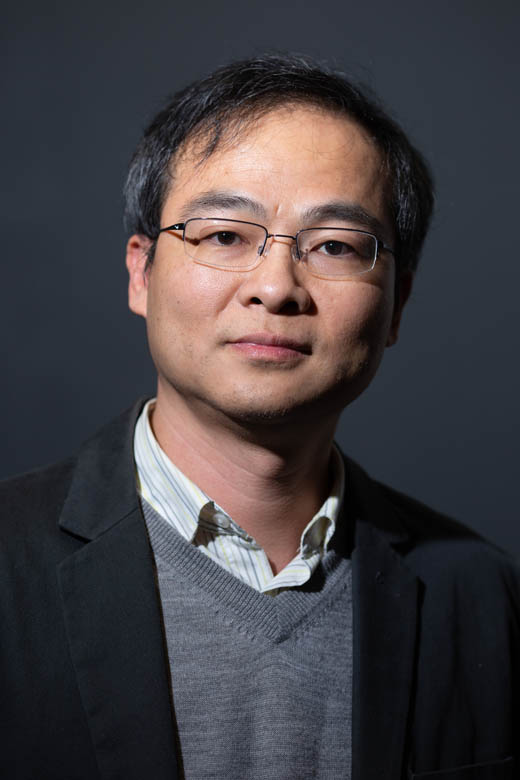
Tzu-Chieh Wei
Stony Brook University
Tzu-Chieh Wei received his PhD from the University of Illinois in 2004, working on quantum entanglement theory and schemes of entangled photons for quantum information processing. He held postdoctoral positions at the University of Waterloo (Institute for Quantum Computing) and University of British Columbia before his arrival at Stony Brook University in 2011. Working on quantum information science, he has contributed to the development of the geometric measure of entanglement, quantum computational universality of two-dimensional Affleck-Kennedy-Lieb-Tasaki (AKLT) states and the existence of the spectral gap in AKLT models, the use of symmetry-protected topological states for measurement-based quantum computation, possible QMA-hardness complexity for bosonic problems, and applications of tensor-network methods in quantum many-body systems, as well as several milestone experiments in quantum information. His recent interest includes error mitigation for quantum devices, quantum algorithms, and quantum machine learning, and he has been spearheading the effort in creating a quantum master’s program at Stony Brook.
“Quantum Ready Workforce”
Quantum Science and Technology has evolved rapidly over the past few decades, leading to quantum processors with as many as one hundred quantum bits or more. Related research originated from a small scientific community but has grown to a multidisciplinary field of its own---Quantum Information Science. The demand from research institutions, national labs and industry is fast growing. How can we train the next quantum ready workforce? The National Science and Technology Council published a report on “National Strategic Overview for Quantum Information Science” that also emphasizes “Creating a quantum-smart workforce for tomorrow”. The current educational system with discrete disciplinary tracks may not be suitable for training a workforce with a broad-range of necessary expertise: physics, information, computer science and engineering. This panel will discuss various ideas, questions and issues concerning a quantum ready workforce.